








Editor's note: It's time to look back on the top energy transition news for the second half of February. The five most-read EnergyCapital stories feature a prestigious prize for a Rice professor, an Austin startup powering up in Houston, solar news, and more. Get the details below.
1. Houston clean energy pioneer earns prestigious Welch Foundation award

Rice professor and Solidec co-founder Haotian Wang's research enables CO2 to be converted into valuable chemicals and fuels. Photo courtesy Welch Foundation.
A Rice University professor has earned a prestigious award from the Houston-based Welch Foundation, which supports chemistry research.
The foundation gave its 2025 Norman Hackerman Award in Chemical Research to Haotian Wang for his “exceptionally creative” research involving carbon dioxide electrochemistry. His research enables CO2 to be converted into valuable chemicals and fuels.
The award included $100,000 and a bronze sculpture. Continue reading.
2. Austin energy startup expands to Houston, offering electricity with backup batteries

Justin Lopas and Zach Dell founded Base Power in 2023 and are now expanding the company's electricity and backup battery offerings to Houston. Photo courtesy Base Power.
An Austin startup that sells electricity and couples it with backup power has entered the Houston market.
Base Power, which claims to be the first and only electricity provider to offer a backup battery, now serves the Houston-area territory served by Houston-based CenterPoint Energy. No solar equipment is required for Base Power’s backup batteries.
The company is initially serving customers in the Cy-Fair, Spring, Cinco Ranch and Mission Bend communities, and will expand to other Houston-area places in the future. Continue reading.
3. Solar farms are booming and putting thousands of hungry sheep to work
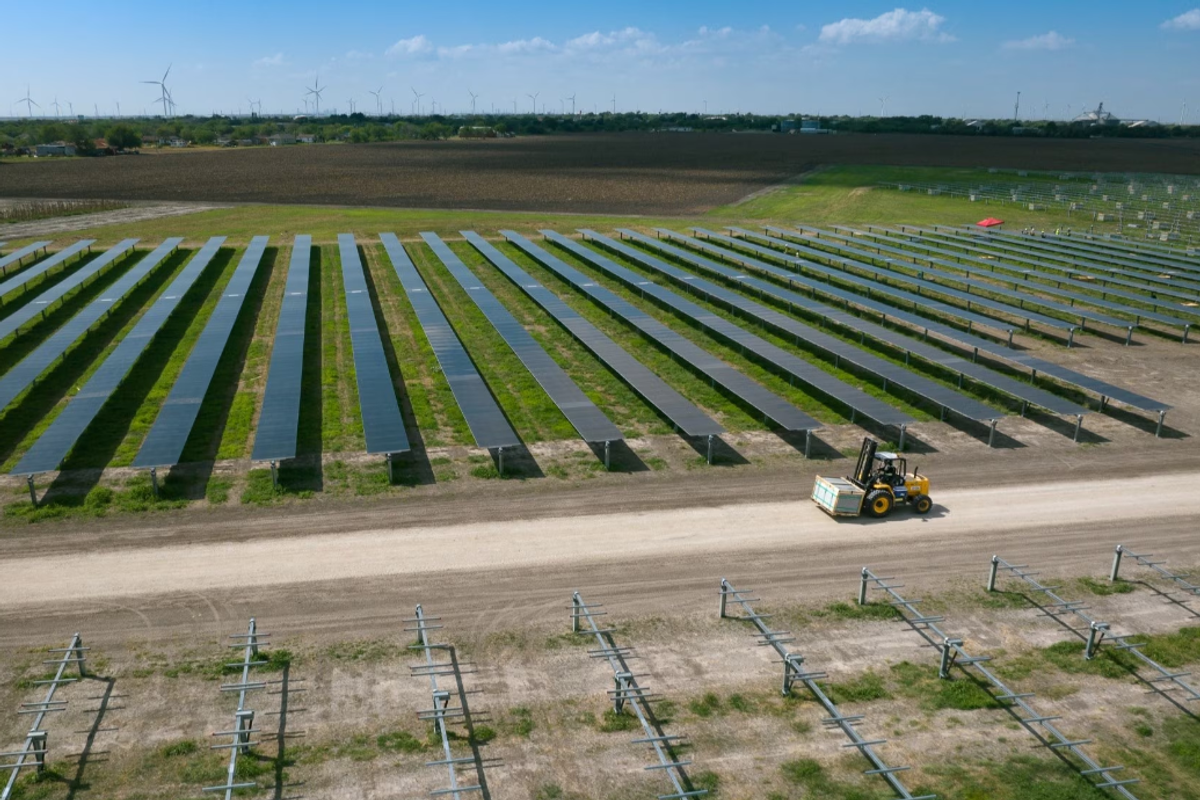
A photo of BP's new solar farm in Texas. Photo via bp.com
On rural Texas farmland, beneath hundreds of rows of solar panels, a troop of stocky sheep rummage through pasture, casually bumping into one another as they remain committed to a single task: chewing grass.
The booming solar industry has found an unlikely mascot in sheep as large-scale solar farms crop up across the U.S. and in the plain fields of Texas. In Milam County, outside Austin, SB Energy operates the fifth-largest solar project in the country, capable of generating 900 megawatts of power across 4,000 acres.
How do they manage all that grass? With the help of about 3,000 sheep, which are better suited than lawnmowers to fit between small crevices and chew away rain or shine.
The proliferation of sheep on solar farms is part of a broader trend — solar grazing — that has exploded alongside the solar industry. Continue reading.
4. Houston venture firm invests in Virginia fusion power plant company in collaboration with TAMU
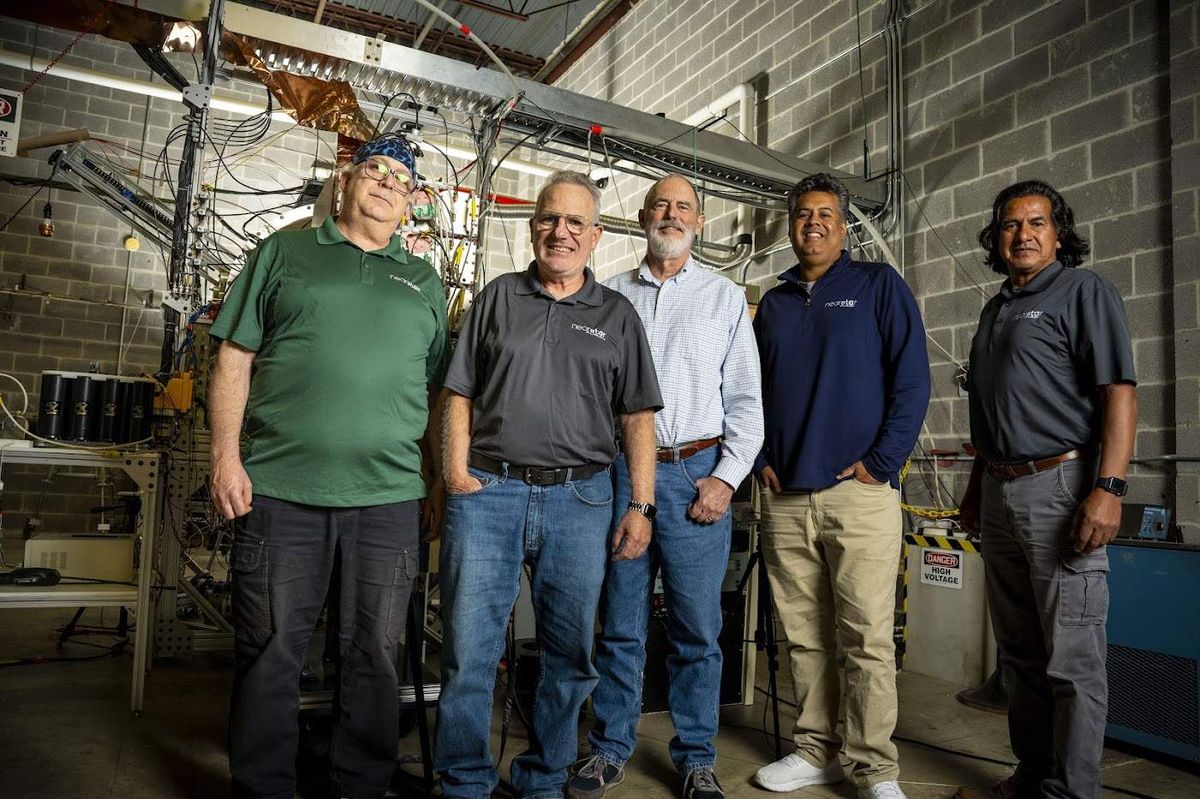
NearStar Fusion team Andrew Case, Chris Faranetta, Douglas Witherspoon, Amit Singh and Marco Luna. Photo courtesy NearStar Fusion.
Houston-based climate tech venture firm Ecosphere Ventures has partnered with Virginia Venture Partners and Virginia Innovation Partnership Corporation’s venture capital program to invest in Virginia-based NearStar Fusion Inc., which develops fusion energy power plants.
NearStar aims to use its proprietary plasma railgun technology to safely and affordably power baseload electricity on and off the power grid through a Magnetized Target Impact Fusion (MTIF) approach, according to a news release from the company.
NearStar’s power plants are designed to retrofit traditional fossil fuel power plants and are expected to serve heavy industry, data centers and military installations. Continue reading.
5. Report: Texas solar power, battery storage helped stabilize grid in summer 2024, but challenges remain
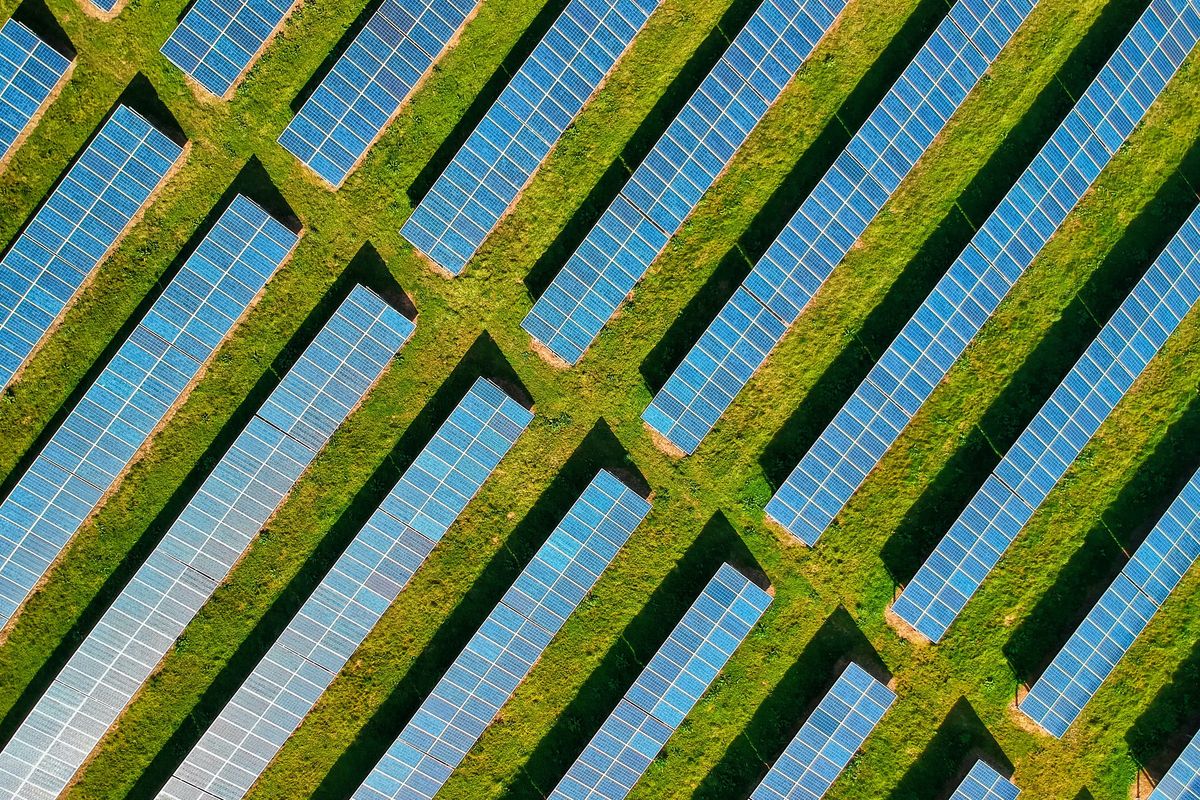
Solar power met nearly 25 percent of midday electricity demand within the ERCOT grid during some of 2024's hottest summer days. Photo by Red Zeppelin/Pexels
Research from the Federal Reserve Bank of Dallas shows that solar power and battery storage capacity helped stabilize Texas’ electric grid last summer.
Between June 1 and Aug. 31, solar power met nearly 25 percent of midday electricity demand within the Electric Reliability Council of Texas (ERCOT) power grid. Rising solar and battery output in ERCOT assisted Texans during a summer of triple-digit heat and record load demands, but the report fears that the state’s power load will be “pushed to its limits” soon.
The report examined how the grid performed during more demanding hours. At peak times, between 11 a.m. and 2 p.m. in the summer of 2024, solar output averaged nearly 17,000 megawatts compared with 12,000 megawatts during those hours in the previous year. Between 6 p.m. and 9 p.m., discharge from battery facilities averaged 714 megawatts in 2024 after averaging 238 megawatts for those hours in 2023. Solar and battery output have continued to grow since then, according to the report. Continue reading.