Going solar is now easier thanks to city and federal help. Photo courtesy of Houston Solar Tour
Alternative-energy-seeking locals now have a sunny way to buy into a solar. The City of Houston has launched Texas Solar SwitchHouston, a new program aimed at helping Houstonians purchase and install rooftop solar panels and battery storage.
In partnership with Solar United Neighbors, the Solar Switch program offers hassle-free way to purchase solar panels by creating a massive, group discount for residents, be it home or small business needs.
This comes with the new Inflation Reduction Act’s clean energy incentives and is part of the City of Houston's Climate Action Plan goal to generate 5 million MWh per year of local solar, per a press release. Customers who install solar also receive a 30-percent tax credit, thanks to the The Inflation Reduction Act.
Registration for the program is free and available online. The City of Houston assures that there is "no obligation for homeowners to purchase solar panels." Discounts and installers are determined through a competitive auction process, per the City.
"With energy prices increasing, homeowners and small businesses are looking for opportunities to save on their energy bills and increase their resilience to climate-related events," said Mayor Sylvester Turner. "Texas Solar Switch Houston provides our community with a simple and straightforward way to become better informed about solar energy and access a competitive offer from a vetted, experienced solar installation company."
Signed and passed into law by the Biden Administration in August, the Inflation Reduction Act will invest some $369 billion in domestic energy production and manufacturing with a goal of reducing carbon emissions by 40 percent by 2030. That federal mandate means locals can now take steps towards power backup, while potentially easing up on the beleaguered Texas grid.
“More and more Houstonians are looking to solar and battery storage for self-sufficiency, which has the added benefit of making our grid more resilient,” said Hanna Mitchell, Texas program director for Solar United Neighbors, in a statement. “With the recent passage of the IRA, now is a particularly good time to go solar.”
Nearly 20 companies from Houston, ranging from global multinationals to innovative startups, joined the team at Argonne National Laboratory in Lemont, Illinois, for a full day of meetings, discussions, and networking focused on advancing innovation, commercialization, and industry collaboration.
The fly-in organized by the Houston Energy Transition Initiative, provided a unique opportunity for companies to engage directly with Argonne researchers, technical experts, and leadership while gaining a deeper understanding of the laboratory’s world-class capabilities. Participants explored how national laboratories can help bridge the gap between breakthrough research and commercial deployment, particularly in areas critical to U.S. competitiveness and economic growth.
The significance of this engagement extends beyond a single visit. While the U.S. Department of Energy operates 17 national laboratories, none is located along the Gulf Coast, a region uniquely home to industry, infrastructure, and energy systems at commercial scale. HETI’s continued work with the national laboratories helps bridge that geographic and operational gap by connecting world-class scientific research with companies that understand how to scale and deploy technologies. The Argonne fly-in also created space to address practical barriers to collaboration, including complex agreements and lengthy contracting timelines, and to explore ways to establish partnership frameworks more efficiently.
Explore HETI’s key takeaways from the fly-in:
1. Scaling Technologies for Commercial Use
A central theme was the importance of scale-up infrastructure and the role Argonne plays in helping companies reduce technical and manufacturing risks. Participants learned how facilities such as the Materials Engineering Research Facility (MERF) support the transition from laboratory discoveries to pilot-scale production and ultimately commercial manufacturing. These capabilities are especially valuable for companies working to move promising technologies from concept to market.
The discussions also highlighted Argonne’s extensive work in critical materials, battery recycling, advanced manufacturing, and supply chain resilience. Attendees learned about initiatives including the ReCell Center, AI-enabled materials discovery, and advanced modeling tools that can help businesses understand supply chain vulnerabilities and evaluate mitigation strategies. These capabilities have applications across energy, chemicals, manufacturing, semiconductors, defense, and emerging technologies.
2. Creating Pathways for Collaboration
Another key takeaway was the importance of engaging early. Companies do not need to arrive with a fully developed project or solution. Argonne offers multiple pathways for collaboration, including sponsored research, user facility access, technology licensing, pilot-scale testing, and Cooperative Research and Development Agreements (CRADAs). These partnerships help companies access specialized expertise, facilities, and analytical tools that can accelerate innovation and commercialization
3. Building Connections Across Industry and Research
The fly-in reinforced the value of relationship building. Bringing together nearly 20 organizations in one place created meaningful opportunities for collaboration, knowledge sharing, and identifying future projects.
The conversations throughout the day demonstrated a shared commitment to strengthening domestic innovation, developing resilient supply chains, and creating pathways to bring new technologies to market.
Fervo Energy’s flagship project in Utah just generated its first geothermal power.
The electricity is now flowing to the power grid from one of Cape Station’s three generation units, Houston-based Fervo said in a news release. This represents an early but important milestone for the project, as the unit isn’t scheduled to deliver contracted power until Oct. 1.
The achievement, coming four months after Fervo’s roughly $2.2 billion IPO, demonstrates the viability of enhanced geothermal systems (EGS).
“This is a gamechanger for the geothermal industry. It establishes EGS as the defining new power generation technology of our time, and we believe it shows that the commercial and technical maturity of EGS is ready to meet the urgent need for reliable, clean power,” Tim Latimer, co-founder and CEO of Fervo, said in the release.
The plant’s two other units are scheduled to launch commercial operations on Jan. 1.
The three units make up the project’s 99-megawatt first phase. The next phase, which will add 400 megawatts of capacity, is under construction. The second phase is set to go online in 2028.
Altogether, Cape Station will provide more than 4 gigawatts of capacity, with 900 megawatts already spoken for. The 900 megawatts of contracted electricity would be enough to power nearly 1 million U.S. homes per year.
“Cape Station works because we treated the subsurface like an engineering challenge,” Jack Norbeck, co-founder and chief technology officer of Fervo, added in the release. “Years of drilling, completion design, subsurface modeling, and flow testing led to this moment, and this is the validation that matters most.”
Enhanced geothermal continuously draws on heat that’s deep underground, producing electricity around the clock regardless of weather or time of day. That makes it one of the only carbon-free resources capable of constant power delivery, which is critical for data centers and AI infrastructure.
While hundreds of thousands descend on New York for Climate Week, Houston offered a different proposition: come where the work is being built. And last week Houston proved that it’s solving for more energy and fewer emissions; reliability and affordability; speed and durability. We are solving for the “&.”
That equation sharpened last week. On Sept. 14, the Environmental Protection Agency announced it had repealed most 2024 federal carbon-pollution standards for power plants and proposed rescinding remaining greenhouse-gas requirements. Policy matters, but it can pivot. The need to build does not.
HECW is a proving ground, not another conference stop. As I wrote in the Houston Chronicle, Mayor Sylvester Turner planted the seed by insisting we bring people together across the city and industry to drive Houston’s energy future. He knew false choices have no place here: oil and gas and clean technology; prosperity and stewardship; industry and lower emissions.
ECW joined the Climate Week Network this year, connecting Houston to a growing community of more than 500,000 people across 22-plus cities. We now have a seat at the global table—and a responsibility to use it well, building with other cities and the wider clean-energy-solutions world rather than merely talking at them.
The capital is already moving. Since 2017, Houston Energy Transition Initiative member companies have invested more than $95 billion in low-carbon infrastructure, technologies, and research and development. This is where the transition is financed, engineered, tested and operated. But the work requires more than capital. It requires capital allocators who understand the difference between a promising idea and a project that can scale, hire and endure.
Last week was Houston’s show and tell. At ARTECHOUSE, The &Bassador Reception & Awards brought art, technology, culture, philanthropy and energy together. Then the week went beyond downtown.
Sugar Land Town Square became the launchpad for the Metro Innovation Tour & Market: a place for an ecosystem conversation about smart cities, clean energy, equitable access and next-generation mobility before participants boarded three tour routes across greater Houston. It was also the starting point for the Bay City South Innovation Tour to Erthos Project Bravo in Matagorda County, where small groups saw Earth Mount solar modules being installed in real time. The conversation did not end at a panel. It went to the project site.
The HTX Tech Tours included a visit to the Erthos Project Bravo in Matagorda County. Photo courtesy
Approximately 100 startups from around the world pitched at Rice Alliance, Greentown Labs and Halliburton Labs events. At Astros Night at Daikin Park, builders, backers, and believers traded conference rooms for the diamond, creating an experience, not just another event. That is how this work becomes civic fabric.
Activation also means making the energy story felt, not merely explained. AY Young brought the Battery Tour for live performances. It was a reminder that the “Power of &” is not confined to a boardroom or a laboratory. Art and technology, culture and commerce, a new generation and established industry can share the same stage—and help more people see themselves in the work ahead.
Perhaps no activation made the “Power of &” more immediate and real than the Houston, We Have Solutions open mic night. At Creatopia’s Innovation Studio, people took the mic—or simply listened—to share what they were building, the problem they could not stop thinking about, and the connection they hoped to make. It put founders, artists, community builders, researchers and future-makers in one room. That is collaboration in real time: different kinds of expertise meeting before anyone knows exactly what the solution will be.
FOX26 helped carry that story beyond the rooms we convened, hosting Erthos COO Jessica Knight, Mars Materials co-founder Aaron Fitzgerald, and investors Taylor Chapman and Juliana Garaizar to discuss building and backing the future in Houston. Our region should be proud—not as self-congratulation, but because the world is beginning to experience energy and climate solutions firsthand.
This was also a week to give back. Allies in Energy awarded $27,500 to nine organizations advancing energy and climate literacy, civil dialogue, workforce pathways and community action. NRG Energy’s Brighter Communities provided a founding gift to expand the week and fund local grants. It took partners, hosts, sponsors, volunteers, funders and community organizations. That is the “Power of &”: collaboration that leaves a stronger community behind.
The “Power of &” cannot stop at Houston’s city limits. Louisiana’s participation—through its support of the Digital Delta Symposium & Expo—made clear that Houston’s builder ecosystem is regional by necessity. Gulf Coast infrastructure, supply chains, talent, and industrial decisions do not recognize state lines. Neither should our collaboration. If we are serious about building more energy with fewer emissions, we must align capital, resources and opportunity across the entire Gulf Coast.
That same commitment to practical collaboration means listening, learning and adjusting. A builder’s mindset does not protect a plan simply because it came first; it improves the conditions for the work to succeed. That is why Houston Energy and Climate Week will move to April 4–10, 2027—better weather, more time and space for connection, and a stronger city-wide experience for the people building what comes next.
But the real test begins now. Can we keep widening the circle? Can we continue to turn research into projects, pilots into infrastructure, capital into good jobs and climate ambition into results that families and communities can see? Can we make every new solution stronger by bringing in the people who must finance it, build it, operate it, live beside it and benefit from it?
That is the work ahead. Turner understood that Houston does not move forward by asking who wins the argument. It moves forward by asking who is ready to solve the problem. His legacy—and the promise of the “&”—is an invitation to choose collaboration over division, action over performance and possibility over false choices.
The future does not need another city to talk about it. It needs Houston to keep building it. And it will only be built if we keep choosing the "&."









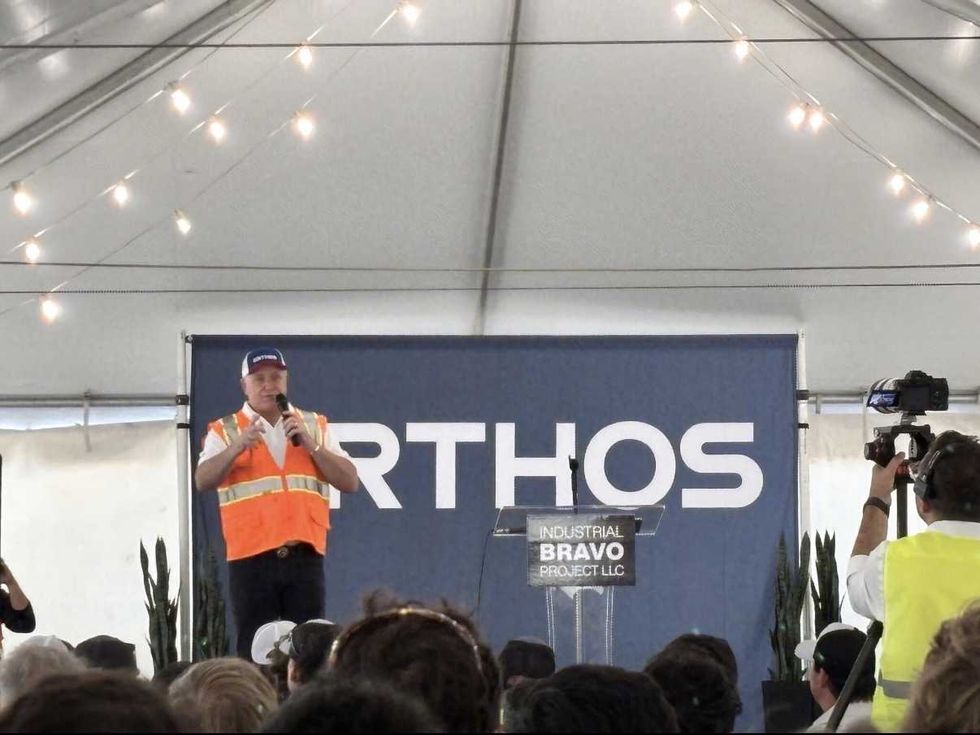 The HTX Tech Tours included a visit to the Erthos Project Bravo in Matagorda County. Photo courtesy