







quick catch up

3 things to know this week in Houston's energy transition ecosystem

Here's what you need yo know this week. Photo via Getty Images

Editor's note: It's a new week — start it strong with three quick things to know in Houston's energy transition ecosystem: Baker Hughes makes headlines for new hydrogen tech and grants, three people to know in energy, and more.

Who to know

Last week, EnergyCapital had three stories introducing you to key players within the energy transition:

  • Patrick Sullivan, president and of Hawaii-based Oceanit, explained the impact the company is having on the energy transition in Houston and beyond. Read more.
  • Ken Gilmartin, CEO of Wood, shared his company’s strategic mission for the future and their recent wins in the energy space that are driving the energy transition forward. Read more.
  • Tania Ortiz Mena was named president of Sempra Infrastructure, which is based in Houston. Read more.

What to attend

Here are two events not to miss this month. Photo via Getty Images

Put these upcoming events on your radar.

  • October 10-11 — SPRINT Robotics World Conference and Exhibition will show that many robots are in use and that the industry is accelerating and starting to scale. Learn more.
  • October 30-31 — Fuze is a must-attend event for executives, investors, and founders serious about solving the energy crisis and boosting company efficiency. Learn more.

Baker Hughes makes moves
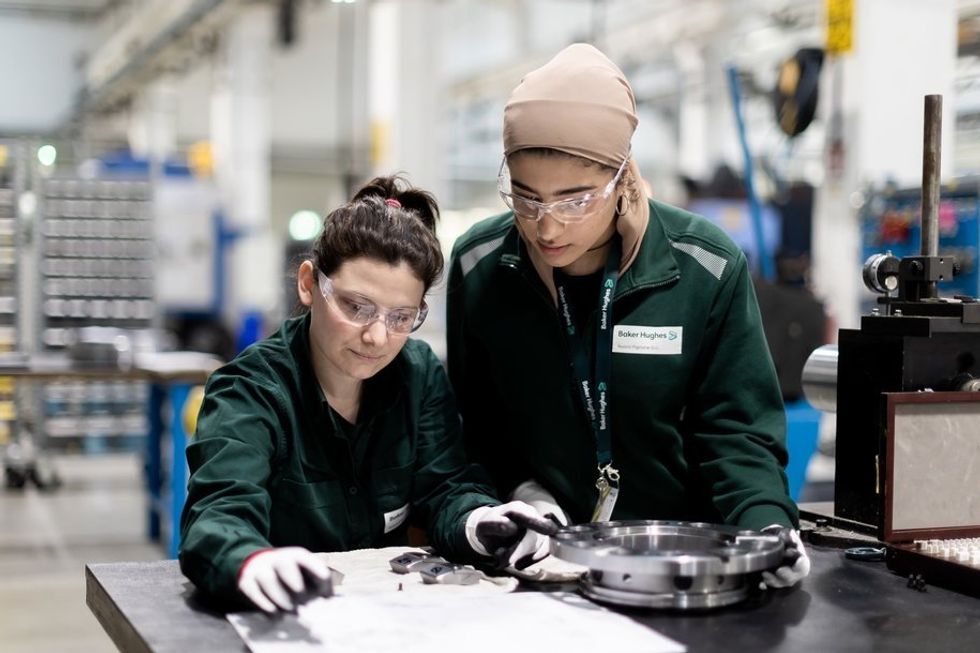
Missed these storied about Baker Hughes? Photo courtesy of Baker Hughes

As you might have seen, Baker Hughes had two pieces of news last week.

Houston-based energy technology company Baker Hughes is rolling out two new products — pressure sensors for the hydrogen sector.

“Hydrogen plays a key role in the transition to a more sustainable, lower-emissions future but also poses challenges for infrastructure and equipment due to hydrogen embrittlement,” Gordon Docherty says. Read more.

Additionally, the Baker Hughes Foundation revealed details on a $75,000 grant to Houston Minority Supplier Development Council, or HMSDC, and a $100,000 grant to Washington, D.C.-based WEConnect International. HMSDC supports economic growth of minority-owned businesses, and WEConnect International is focused on women-owned companies. Read more.

Trending News

A View From HETI

Helix Earth's technology has the potential to cut AC energy use by up to 50 percent. Photo by Sergei A/Pexels

Renewable equipment manufacturer Helix Earth Technologies is one of three Houston-based companies to secure federal funding through the Small Business Innovation Research (SBIR) Phase II grant program in recent months.

The company—which was founded based on NASA technology, spun out of Rice University and has been incubated at Greentown Labs—has received approximately $1.2 million from the National Science Foundation to develop its high-efficiency retrofit dehumidification systems that aim to reduce the energy consumption of commercial AC units. The company reports that its technology has the potential to cut AC energy use by up to 50 percent.

"This award validates our vision and propels our impact forward with valuable research funding and the prestige of the NSF stamp of approval," Rawand Rasheed, Helix CEO and founder, shared in a LinkedIn post. "This award is a reflection our exceptional team's grit, expertise, and collaborative spirit ... This is just the beginning as we continue pushing for a sustainable future."

Two other Houston-area companies also landed $1.2 million in NSF SBIR Phase II funding during the same period:

  • Resilitix Intelligence, a disaster AI startup that was founded shortly after Hurricane Harvey, that works to "reduce the human and economic toll of disasters" by providing local and state organizations and emergency response teams with near-real-time, AI-driven insights to improve response speed, save lives and accelerate recovery
  • Conroe-based Fluxworks Inc., founded in 2021 at Texas A&M, which provides magnetic gear technology for the space industry that has the potential to significantly enhance in-space manufacturing and unlock new capabilities for industries by allowing advanced research and manufacturing in microgravity

The three grants officially rolled out in early September 2025 and are expected to run through August 2027, according to the NSF. The SBIR Phase II grants support in-depth research and development of ideas that showed potential for commercialization after receiving Phase I grants from government agencies.

However, congressional authority for the program, often called "America's seed fund," expired on September 30, 2025, and has stalled since the recent government shutdown. Government agencies cannot issue new grants until Congress agrees on a path forward. According to SBIR.gov, "if no further action is taken by Congress, federal agencies may not be able to award funding under SBIR/STTR programs and SBIR/STTR solicitations may be delayed, cancelled, or rescinded."

Trending News