







quick catch up

3 things to know this week in Houston's energy transition ecosystem

Here's what you need yo know this week. Photo via Getty Images

Editor's note: It's a new week — start it strong with three quick things to know in Houston's energy transition ecosystem: Baker Hughes makes headlines for new hydrogen tech and grants, three people to know in energy, and more.

Who to know

Last week, EnergyCapital had three stories introducing you to key players within the energy transition:

  • Patrick Sullivan, president and of Hawaii-based Oceanit, explained the impact the company is having on the energy transition in Houston and beyond. Read more.
  • Ken Gilmartin, CEO of Wood, shared his company’s strategic mission for the future and their recent wins in the energy space that are driving the energy transition forward. Read more.
  • Tania Ortiz Mena was named president of Sempra Infrastructure, which is based in Houston. Read more.

What to attend

Here are two events not to miss this month. Photo via Getty Images

Put these upcoming events on your radar.

  • October 10-11 — SPRINT Robotics World Conference and Exhibition will show that many robots are in use and that the industry is accelerating and starting to scale. Learn more.
  • October 30-31 — Fuze is a must-attend event for executives, investors, and founders serious about solving the energy crisis and boosting company efficiency. Learn more.

Baker Hughes makes moves
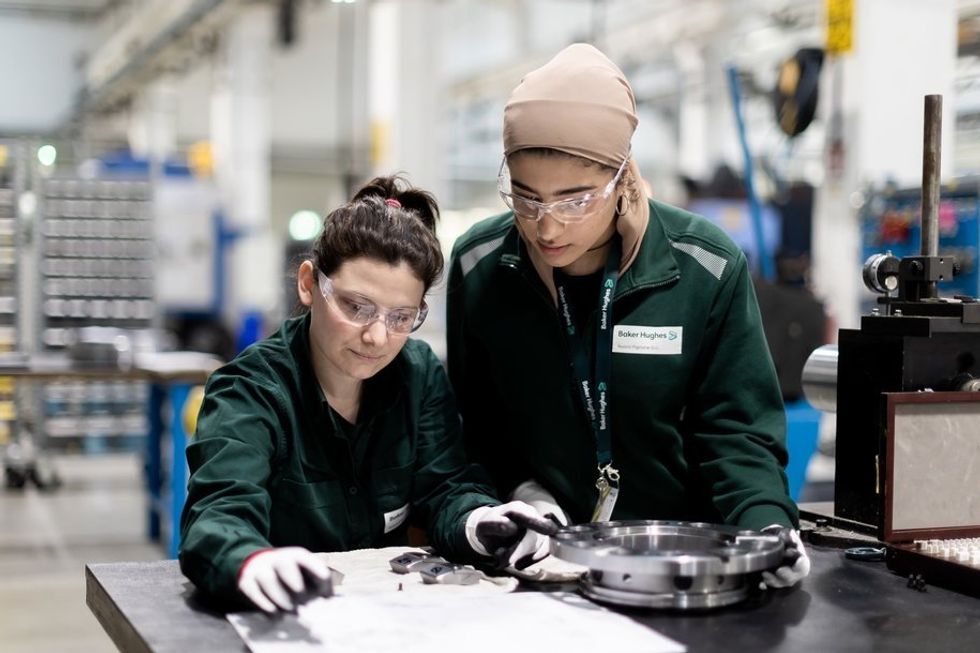
Missed these storied about Baker Hughes? Photo courtesy of Baker Hughes

As you might have seen, Baker Hughes had two pieces of news last week.

Houston-based energy technology company Baker Hughes is rolling out two new products — pressure sensors for the hydrogen sector.

“Hydrogen plays a key role in the transition to a more sustainable, lower-emissions future but also poses challenges for infrastructure and equipment due to hydrogen embrittlement,” Gordon Docherty says. Read more.

Additionally, the Baker Hughes Foundation revealed details on a $75,000 grant to Houston Minority Supplier Development Council, or HMSDC, and a $100,000 grant to Washington, D.C.-based WEConnect International. HMSDC supports economic growth of minority-owned businesses, and WEConnect International is focused on women-owned companies. Read more.

Trending News

A View From HETI

Rice University scientists' “recharge-to-recycle” reactor has major implications for the electric vehicle sector. Photo courtesy Jorge Vidal/Rice University.

Engineers at Rice University have developed a cleaner, innovative process to turn end-of-life lithium-ion battery waste into new lithium feedstock.

The findings, recently published in the journal Joule, demonstrate how the team’s new “recharge-to-recycle” reactor recharges the battery’s waste cathode materials to coax out lithium ions into water. The team was then able to form high-purity lithium hydroxide, which was clean enough to feed directly back into battery manufacturing.

The study has major implications for the electric vehicle sector, which significantly contributes to the waste stream from end-of-life battery packs. Additionally, lithium tends to be expensive to mine and refine, and current recycling methods are energy- and chemical-intensive.

“Directly producing high-purity lithium hydroxide shortens the path back into new batteries,” Haotian Wang, associate professor of chemical and biomolecular engineering, co-corresponding author of the study and co-founder of Solidec, said in a news release. “That means fewer processing steps, lower waste and a more resilient supply chain.”

Sibani Lisa Biswal, chair of Rice’s Department of Chemical and Biomolecular Engineering and the William M. McCardell Professor in Chemical Engineering, also served as co-corresponding author on the study.

“We asked a basic question: If charging a battery pulls lithium out of a cathode, why not use that same reaction to recycle?” Biswal added in the release. “By pairing that chemistry with a compact electrochemical reactor, we can separate lithium cleanly and produce the exact salt manufacturers want.”

The new process also showed scalability, according to Rice. The engineers scaled the device to 20 square centimeters, then ran a 1,000-hour stability test and processed 57 grams of industrial black mass supplied by industry partner Houston-based TotalEnergies. The results produced lithium hydroxide that was more than 99 percent pure. It also maintained an average lithium recovery rate of nearly 90 percent over the 1,000-hour test, showing its durability. The process also worked across multiple battery chemistries, including lithium iron phosphate, lithium manganese oxide and nickel-manganese-cobalt variants.

Looking ahead, the team plans to scale the process and consider ways it can sustain high efficiency for greater lithium hydroxide concentrations.

“We’ve made lithium extraction cleaner and simpler,” Biswal added in the release. “Now we see the next bottleneck clearly. Tackle concentration, and you unlock even better sustainability.

Trending News