








The 2024 edition of CERAWeek by S&P Global wrapped up last Friday in Houston, and a handful of themes emerged as topical and disruptive amid the energy transition.
Here are five takeaways from the conference, according to EnergyCapital reporting.
Funding the energy transition continues to be a challenge.

Photo courtesy of CERAWeek
The biggest obstacle to the energy transition is — and might always be — funding it. A panel at Agora on Thursday, March 21, moderated by Barbara Burger set out to discuss the role of venture capital amid the future of energy.
Daniel Goldman, managing partner at Clean Energy Ventures, said that the first plants for these new, revolutionary technologies are going to be more expensive than its subsequent plants.
"But you have to built it," Goldman says. "'First of a kind' can be very different from the end plant, because you need to manage risk. ... But those first plants are going to be quite costly, and you're going to have to recognize that as an investor."
Microsoft and Breakthrough Ventures Founder Bill Gates would address this in his talk later that day, pointing out that traditional infrastructure investors are used to knowing what a plant would cost before its built. But in clean tech, outside of solar and wind, there's too much unknown to give the estimation those investors are looking for.
"Nothing's at the maturity level that you can do that," Gates says.
The DOE's role of de-risking green tech.
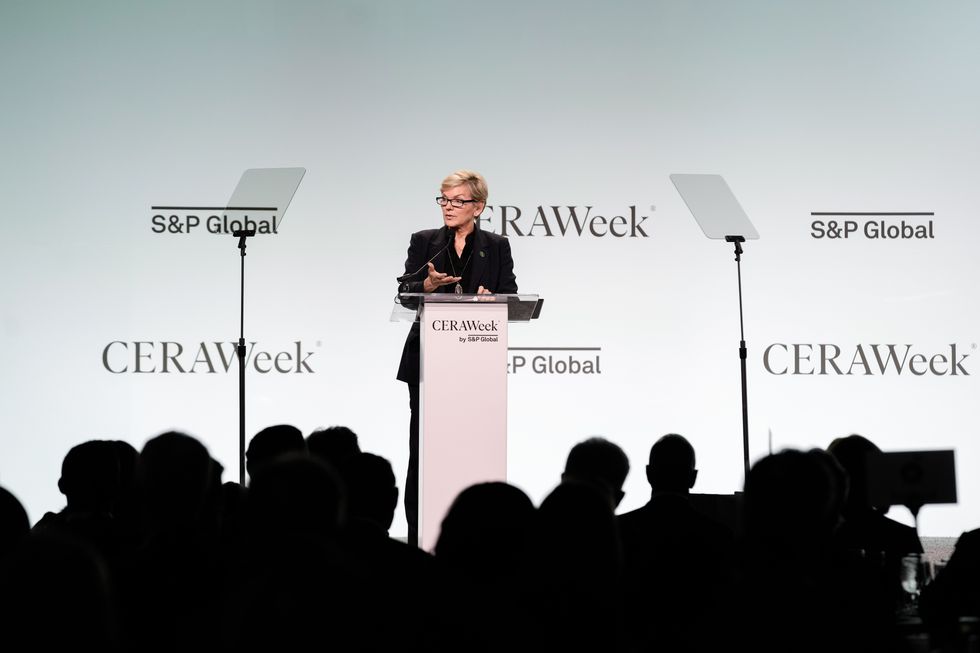
Photo courtesy of CERAWeek
The United States Department of Energy had a significant presence at CERAWeek, with Secretary of Energy Jennifer M. Granholm making two major announcements on Monday, March 18, the first day of the conference. One of the announcements was the DOE's latest Pathways to Commercial Liftoff report, which are initiatives established to provide investors with information of how specific energy technologies commercialize and what challenges they each have to overcome as they scale.
"We develop these Liftoff Reports through a combination of modeling and hundreds and hundreds of interviews with people across the whole investment lifecycle—from early-stage capital to commercial banks and institutional investors," Granholm says in her address, announcing geothermal energy as the subject of the ninth report.
Intended to "create a common fact base and a tool for ongoing dialogue with the private sector on the pathways to commercial liftoff," according to the DOE, these reports can be instrumental for enterprises in the field.
A panel at Agora on Thursday, March 21, featuring geothermal energy innovators discussed the impact of the report. Tim Latimer, CEO and founder of Houston-based Fervo Energy, says the report included details from his company's work.
To Latimer, the report showcases geothermal energy's ability to compete from a cost perspective.
"I think geothermal is already winning that cost discussion," Latimer says. "You're talking about $45 per megawatt hour unsubsidized cost for round-the-clock, 24/7 carbon-free energy. I think that's an achievable ambition the DOE set out, and I think it's an unbeatable value proposition.
Hot topic: Geothermal energy.

Photo courtesy of CERAWeek
Geothermal energy was discussed throughout the week following Granholm's address, in part because of its expected cost efficiency, but also because it's a type of energy that should provide a smooth transition from traditional oil and gas.
John Redfern, CEO of Eavor Technologies, global geothermal technology company headquartered in Canada, says on the geothermal panel that the geothermal industry can build off existing infrastructure.
"Most of it is building blocks that we're recycling from the oil industry — resources, people, technologies," Redfern says. "So, it's more about implementing rather than inventing some new, novel product."
Latimer agrees, adding that Fervo "is fully in the deployment phase."
"The breakthrough needed to make geothermal ready for primetime have already happened," Latimer says.
AI is everywhere — especially the energy transition.

Photo courtesy of CERAWeek
The topic of artificial intelligence was everywhere, so much that by Thursday, panelists joked about every discussion including at least one mention of the technology.
Gates was one speaker who addresses the subject, which isn't all too surprising, since Microsoft owns a portion of OpenAI, which created ChatGPT. One thing left to be known is how directly AI will affect the energy transition — and on what timeline.
AI's current applications are within white collar activities, Gates explains, citing writing a regulatory permit or looking at evidence in a lawsuit. He explains that current AI capabilities could continually grow or remain stagnant for a while, he isn't sure.
"The thing that’s daunting is we don’t know how quickly it will improve," he adds.
Gates didn't comment on energy specific AI applications but noted that AI has advanced far past robotics, which would target blue collar roles.
Big tech sees green.

Photo courtesy of CERAWeek
And speaking of AI, big tech companies have been making moves to lower carbon footprints, and that was made clear by the activations at CERAWeek. Microsoft and Amazon each had designated houses at the conference, alongside Oxy, Chevron, Aramco, and other traditional energy players.
At Microsoft, Houston-based Amperon, which recently announced a partnership with the tech company, presented and pitched their company. The Microsoft and Amazon houses showcased each company's low-carbon technologies.
- Houston energy data software platform expands into Europe, hires new execs - Energy Capital ›
- Top CERAWeek 2025 panels to attend for Houstonians - Energy Capital ›
- CERAWeek announces winners of clean tech pitch competition - Energy Capital ›
- Barbara Burger shares CERAWeek 2025 takeaways - Energy Capital ›
- 40+ teams named to pitch at Energy Venture Day during CERAWeek - Energy Capital ›