A team from UH has published two breakthrough studies that could help cut costs and boost efficiency in carbon capture. Photo courtesy UH.

Editor's note: As 2025 comes to a close, we're revisiting the biggest headlines and major milestones of the energy sector this year. Here are the most exciting scientific breakthroughs made by Houstonians this year that are poised to shape the future of energy:

Rice University team develops eco-friendly method to destroy 'forever chemicals' in water

Rice University researchers have developed a new method for removing PFAS from water that works 100 times faster than traditional filters. Photo via Rice University.

Rice University researchers have teamed up with South Korean scientists to develop the first eco-friendly technology that captures and destroys toxic “forever chemicals,” or PFAS, in water. The Rice-led study centered on a layered double hydroxide (LDH) material made from copper and aluminum that could rapidly capture PFAS and be used to destroy the chemicals.

UH researchers make breakthrough in cutting carbon capture costs
UH carbon capture cost cutting

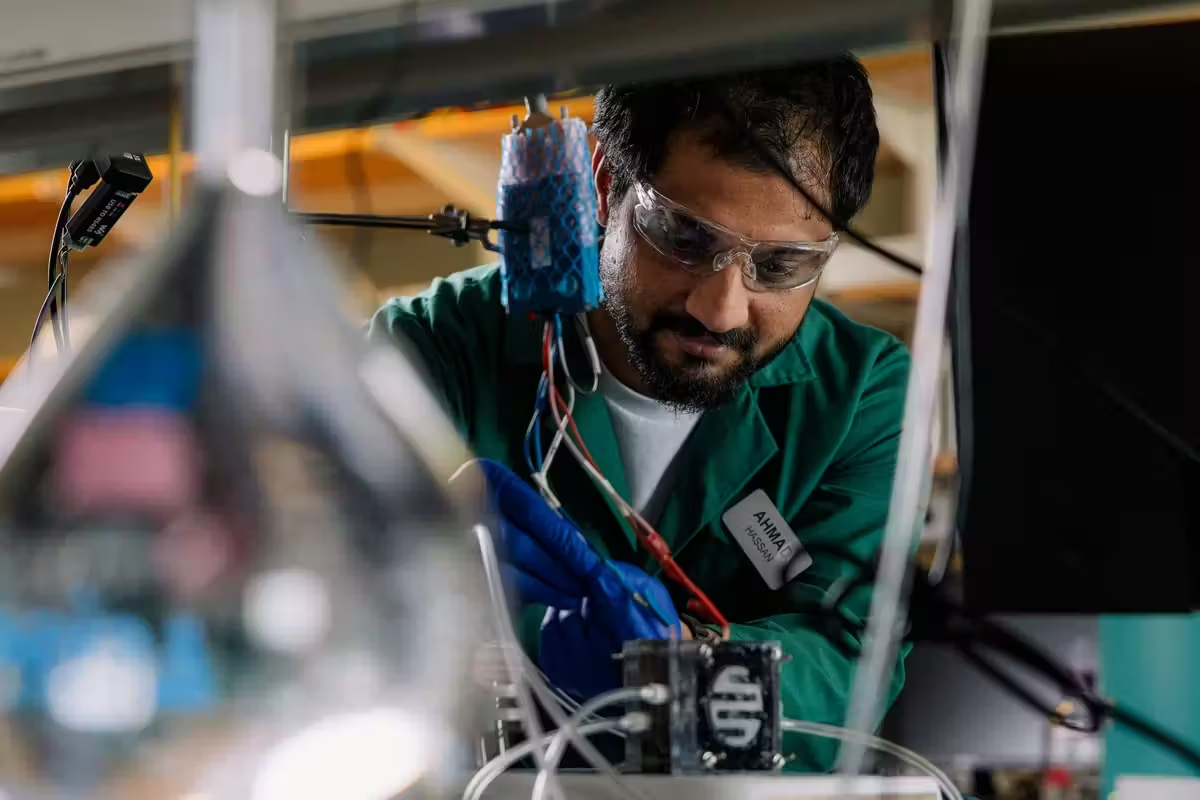
A team from UH has published two breakthrough studies that could help cut costs and boost efficiency in carbon capture. Photo courtesy UH.

A team of researchers at the University of Houston has made two breakthroughs in addressing climate change and potentially reducing the cost of capturing harmful emissions from power plants. Led by Professor Mim Rahimi at UH’s Cullen College of Engineering, the team first introduced a membraneless electrochemical process that cuts energy requirements and costs for amine-based carbon dioxide capture during the acid gas sweetening process.The second breakthrough displayed a reversible flow battery architecture that absorbs CO2 during charging and releases it upon discharge.

Houston team’s discovery brings solid-state batteries closer to EV use

Houston researchers have uncovered why solid-state batteries break down and what could be done to slow the process. Photo via Getty Images.

A team of researchers from the University of Houston, Rice University and Brown University has uncovered new findings that could extend battery life and potentially change the electric vehicle landscape. Their work deployed a powerful, high-resolution imaging technique known as operando scanning electron microscopy to better understand why solid-state batteries break down and what could be done to slow the process.

Houston researchers make breakthrough on electricity-generating bacteria
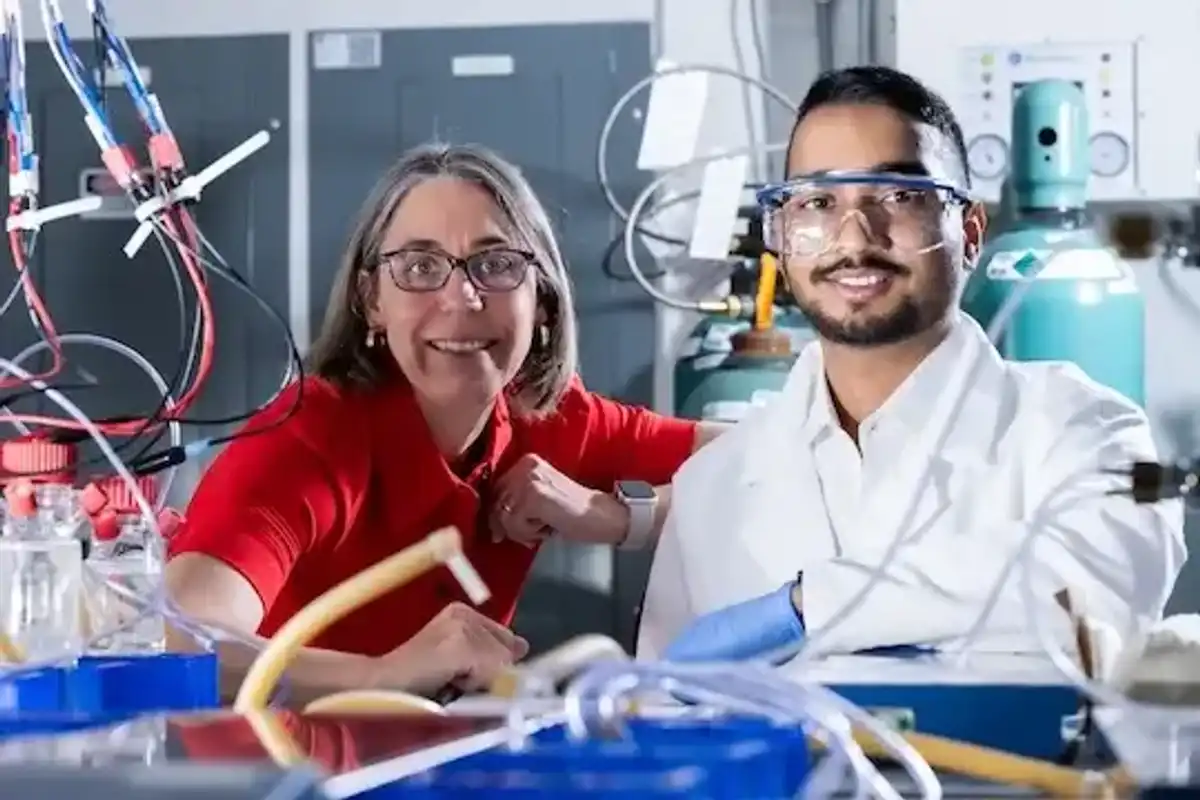
A team of Rice researchers, including Caroline Ajo-Franklin and Biki Bapi Kundu, has uncovered how certain bacteria breathe by generating electricity. Photo by Jeff Fitlow/Rice University.

Research from Rice University that merges biology with electrochemistry has uncovered new findings on how some bacteria generate electricity. Research showed how some bacteria use compounds called naphthoquinones, rather than oxygen, to transfer electrons to external surfaces in a process known as extracellular respiration. In other words, the bacteria are exhale electricity as they breathe. This process has been observed by scientists for years, but the Rice team's deeper understanding of its mechanism is a major breakthrough, with implications for the clean energy and industrial biotechnology sectors, according to the university.

Rice researchers' quantum breakthrough could pave the way for next-gen superconductors

Researchers from Rice University say their recent findings could revolutionize power grids, making energy transmission more efficient. Image via Getty Images.

A study from researchers at Rice University could lead to future advances in superconductors with the potential to transform energy use. The study revealed that electrons in strange metals, which exhibit unusual resistance to electricity and behave strangely at low temperatures, become more entangled at a specific tipping point, shedding new light on these materials. The materials share a close connection with high-temperature superconductors, which have the potential to transmit electricity without energy loss, according to the researchers. By unblocking their properties, researchers believe this could revolutionize power grids and make energy transmission more efficient.

UH researchers develop breakthrough material to boost efficiency of sodium-ion batteries

A team at the University of Houston is changing the game for sodium-ion batteries. Photo via Getty Images

A research lab at the University of Houston developed a new type of material for sodium-ion batteries that could make them more efficient and boost their energy performance. The Canepa Research Laboratory is working on a new material called sodium vanadium phosphate, which improves sodium-ion battery performance by increasing the energy density. This material brings sodium technology closer to competing with lithium-ion batteries, according to the researchers.

Houston researchers make headway on developing low-cost sodium-ion batteries

Houston researchers make headway on developing low-cost sodium-ion batteries

Rice's Atin Pramanik and a team in Pulickel Ajayan's lab shared new findings that offer a sustainable alternative to lithium batteries by enhancing sodium and potassium ion storage. Photo by Jeff Fitlow/Courtesy Rice University

A new study by researchers from Rice University’s Department of Materials Science and NanoEngineering, Baylor University and the Indian Institute of Science Education and Research Thiruvananthapuram has introduced a solution that could help develop more affordable and sustainable sodium-ion batteries. The team worked with tiny cone- and disc-shaped carbon materials from oil and gas industry byproducts with a pure graphitic structure. The forms allow for more efficient energy storage with larger sodium and potassium ions, which is a challenge for anodes in battery research. Sodium and potassium are more widely available and cheaper than lithium.

Houston scientists develop 'recharge-to-recycle' reactor for lithium-ion batteries
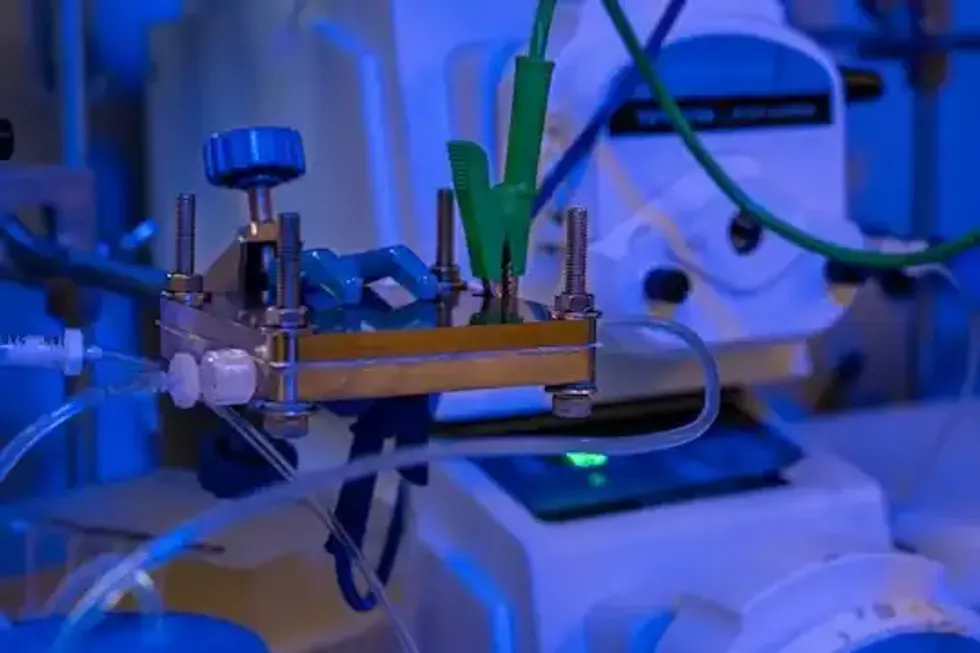
Rice University scientists' “recharge-to-recycle” reactor has major implications for the electric vehicle sector. Photo courtesy Jorge Vidal/Rice University.

Engineers at Rice University have developed a cleaner, innovative process to turn end-of-life lithium-ion battery waste into new lithium feedstock. The findings demonstrate how the team’s new “recharge-to-recycle” reactor recharges the battery’s waste cathode materials to coax out lithium ions into water. The team was then able to form high-purity lithium hydroxide, which was clean enough to feed directly back into battery manufacturing. The study has major implications for the electric vehicle sector, which significantly contributes to the waste stream from end-of-life battery packs.

Houston researchers develop strong biomaterial that could replace plastic
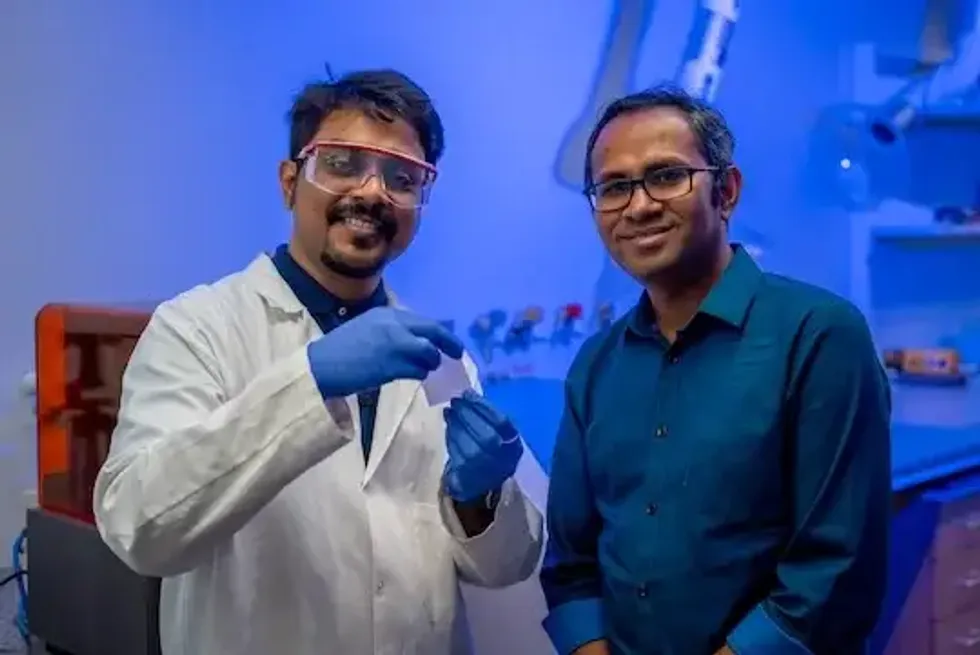
A team led by M.A.S.R. Saadi and Muhammad Maksud Rahman has developed a biomaterial that they hope could be used for the “next disposable water bottle." Photo courtesy Rice University.

Collaborators from two Houston universities are leading the way in engineering a biomaterial into a scalable, multifunctional material that could potentially replace plastic. The study introduced a biosynthesis technique that aligns bacterial cellulose fibers in real-time, which resulted in robust biopolymer sheets with “exceptional mechanical properties.” Ultimately, the scientists hope this discovery could be used for the “next disposable water bottle,” which would be made by biodegradable biopolymers in bacterial cellulose, an abundant resource on Earth. Additionally, the team sees applications for the materials in the packaging, breathable textiles, electronics, food and energy sectors.

Houston researchers reach 'surprising' revelation in materials recycling efforts
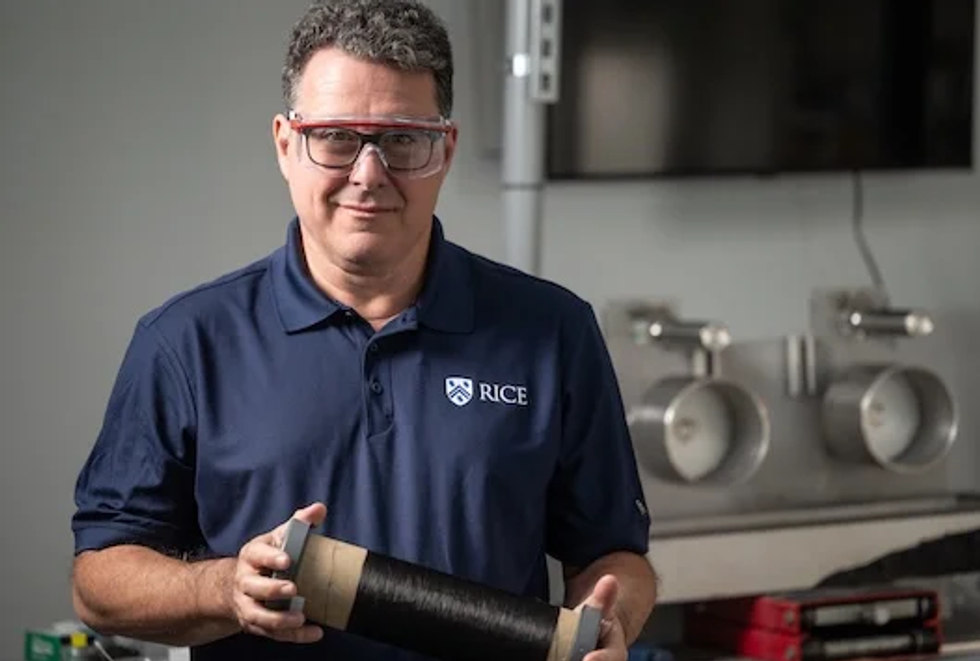
A team led by Matteo Pasquali, director of Rice’s Carbon Hub, has unveiled how carbon nanotube fibers can be a sustainable alternative to materials like steel, copper and aluminum. Photo by Jeff Fitlow/ Courtesy Rice University

Researchers at Rice University have demonstrated how carbon nanotube (CNT) fibers can be fully recycled without any loss in their structure or properties. The discovery shows that CNT fibers could be used as a sustainable alternative to traditional materials like metals, polymers and the larger, harder-to-recycle carbon fibers, which the team hopes can pave the way for more sustainable and efficient recycling efforts.

The Welch Foundation has awarded funding through two of its newest grant programs. Photo via Getty Images.

Houston foundation doles out $700K for Texas chemical research

fresh funding

Houston-based The Welch Foundation has issued $700,000 in additional funding to support chemical research through two of its newest grant programs.

The foundation has named the recipients of its Welch eXperimental (WelchX) Collaboration Retreat and Pilot Grants and the Welch Postdoctoral Fellows of the Life Sciences Research Foundation Grants.

The WelchX grants were awarded to teams of two Texas researchers who presented "innovative and collaborative ideas" addressing challenges in the clean energy space, according to the foundation.

Researchers from Texas universities gathered in Houston earlier this summer to discuss the theme “Chemical Research for Grand Challenges." They then paired off into nine teams and submitted proposals for the $100,000 pilot grants. The seven selected teams, several with ties to Houston, and their research topics include:

  • Yimo Han, Rice University, and Yuanyue Liu, The University of Texas at Austin, “Stabilizing Copper Electrocatalysts for CO2 Conversion”
  • Ognjen Miljanic, University of Houston, and Indrajit Srivastava, Texas Tech University, “Ping-Pong' Afterglow Luminescence in Self-Assembled Molecular Cubes”
  • Raúl Hernández Sánchez, Rice University, and Andy Thomas, Texas A&M University, “Accelerating Magnetic Resonance Imaging Contrast Agent Discovery via Rapid Injection NMR: Improving the Detection of Lithium for Disease Diagnostics”
  • Benjamin Janesko, Texas Christian University, and MD Masud Rana, Lamar University, “Cyber Twin Chemical Ensembles for Near-Infrared-Emitting Graphene Quantum Dot Therapeutics”
  • Ivan Korendovych, Baylor University, and Dino Villagrán, The University of Texas at El Paso, “Selective Bio-Inspired Electrochemical Probes for PFAS Analysis and Degradation”
  • Samantha Kristufek, Texas Tech University, and Kayla Green, Texas Christian University, “CIRCUIT: Critical Ion Recovery using Conductive and Ultrafiltration Intelligent Technology”
  • Fang Xu, The University of Texas at San Antonio, and Hong Wang, University of North Texas, “Visualize Molecular Adsorption on Supported Ni-porphyrin Model Catalysts via Substitute Effect”

The Welch Postdoctoral Fellows of the Life Sciences Research Foundation provides three-year fellowships to recent PhD graduates to support clinical research careers in Texas.

The foundation previously announced that it would name fellows from Rice University and Baylor University who would receive $100,000 annually for three years. This year's recipients and their research topics include:

  • Teng Yuan, Rice University, “Unlocking New Chemistry of Nonheme Iron Enzymes for α-Amino Acids and γ-Lactones Synthesis”
  • Katelyn Baumler, Baylor University, "Crystal Growth of Ln2Fe4Sb5 Phases Toward the Study of Novel Quantum Properties”

“As these programs become more established, it is thrilling to see the new research our awardees are exploring,” Adam Kuspa, president of The Welch Foundation, said in a news release. “The Foundation is very pleased by the applications that we continue to receive describing exciting new research projects to advance chemical research.”

This additional funding comes on the heels of the foundation doling out $27 million for chemical research, equipment and postdoctoral fellowships earlier this summer. The foundation made 85 grants to faculty at 16 Texas institutions at the time. Read more here.

--

This article originally appeared on our sister site, Innovationmap.com.

Ad Placement 300x100
Ad Placement 300x600

CultureMap Emails are Awesome

New Gulf Coast recycling plant partners with first-of-kind circularity hub

now open

TALKE USA Inc., the Houston-area arm of German logistics company TALKE, officially opened its Recycling Support Center earlier this month.

Located next to the company's Houston-area headquarters, the plant will process post-consumer plastic materials, which will eventually be converted into recycling feedstock. Chambers County partially funded the plant.

“Our new recycling support center expands our overall commitment to sustainable growth, and now, the community’s plastics will be received here before they head out for recycling. This is a win for the residents of Chambers County," Richard Heath, CEO and president of TALKE USA, said in a news release.

“The opening of our recycling support facility offers a real alternative to past obstacles regarding the large amount of plastic products our local community disposes of. For our entire team, our customers, and the Mont Belvieu community, today marks a new beginning for effective, safe, and sustainable plastics recycling.”

The new plant will receive the post-consumer plastic and form it into bales. The materials will then be processed at Cyclyx's new Houston Circularity Center, a first-of-its-kind plastic waste sorting and processing facility being developed through a joint venture between Cyclix, ExxonMobil and LyondellBasell.

“Materials collected at this facility aren’t just easy-to-recycle items like water bottles and milk jugs. All plastics are accepted, including multi-layered films—like chip bags and juice pouches. This means more of the everyday plastics used in the Chambers County community can be captured and kept out of landfills,” Leslie Hushka, chief impact officer at Cyclyx, added in a LinkedIn post.

Cyclyx's circularity center is currently under construction and is expected to produce 300 million pounds of custom-formulated feedstock annually.

Houston quantum simulator research reveals clues for solar energy conversion

energy flow

Rice University scientists have used a programmable quantum simulator to mimic how energy moves through a vibrating molecule.

The research, which was published in Nature Communications last month, lets the researchers watch and control the flow of energy in real time and sheds light on processes like photosynthesis and solar energy conversion, according to a news release from the university.

The team, led by Rice assistant professor of physics and astronomy Guido Pagano, modeled a two-site molecule with one part supplying energy (the donor) and the other receiving it (the acceptor).

Unlike in previous experiments, the Rice researchers were able to smoothly tune the system to model multiple types of vibrations and manipulate the energy states in a controlled setting. This allowed the team to explore different types of energy transfer within the same platform.

“By adjusting the interactions between the donor and acceptor, coupling to two types of vibrations and the character of those vibrations, we could see how each factor influenced the flow of energy,” Pagano said in the release.

The research showed that more vibrations sped up energy transfer and opened new paths for energy to move, sometimes making transfer more efficient even with energy loss. Additionally, when vibrations differed, efficient transfer happened over a wider range of donor–acceptor energy differences.

“The results show that vibrations and their environment are not simply background noise but can actively steer energy flow in unexpected ways,” Pagano added.

The team believes the findings could help with the design of organic solar cells, molecular wires and other devices that depend on efficient energy or charge transfer. They could also have an environmental impact by improving energy harvesting to reduce energy losses in electronics.

“These are the kinds of phenomena that physical chemists have theorized exist but could not easily isolate experimentally, especially in a programmable manner, until now,” Visal So, a Rice doctoral student and first author of the study, added in the release.

The study was supported by The Welch Foundation,the Office of Naval Research, the National Science Foundation CAREER Award, the Army Research Office and the Department of Energy.

The EPA is easing pollution rules — here’s how it’s affecting Texas

In the news

The first year of President Trump’s second term has seen an aggressive rollback of federal environmental protections, which advocacy groups fear will bring more pollution, higher health risks, and less information and power for Texas communities, especially in heavily industrial and urban areas.

Within Trump’s first 100 days in office, his new Environmental Protection Agency administrator, Lee Zeldin, announced a sweeping slate of 31 deregulatory actions. The list, which Zeldin called the agency’s “greatest day of deregulation,” targeted everything from soot standards and power plant pollution rules to the Endangerment Finding, the legal and scientific foundation that obligates the EPA to regulate climate-changing pollution under the Clean Air Act.

Since then, the agency froze research grants, shrank its workforce, and removed some references to climate change and environmental justice from its website — moves that environmental advocates say send a clear signal: the EPA’s new direction will come at the expense of public health.

Cyrus Reed, conservation director of the Lone Star Chapter of the Sierra Club, said Texas is one of the states that feels EPA policy changes directly because the state has shown little interest in stepping up its environmental enforcement as the federal government scales back.

“If we were a state that was open to doing our own regulations there’d be less impact from these rollbacks,” Reed said. “But we’re not.”

“Now we have an EPA that isn’t interested in enforcing its own rules,” he added.

Richard Richter, a spokesperson at the state’s environmental agency, Texas Commission on Environmental Quality, said in a statement that the agency takes protecting public health and natural resources seriously and acts consistently and quickly to enforce federal and state environmental laws when they’re violated.

Methane rules put on pause

A major EPA move centers on methane, a potent greenhouse gas that traps heat far more efficiently than carbon dioxide over the short term. It accounts for roughly 16% of global greenhouse gas emissions and is a major driver of climate change. In the U.S., the largest source of methane emissions is the energy sector, especially in Texas, the nation’s top oil and gas producer.

In 2024, the Biden administration finalized long-anticipated rules requiring oil and gas operators to sharply reduce methane emissions from wells, pipelines, and storage facilities. The rule, developed with industry input, targeted leaks, equipment failures, and routine flaring, the burning off of excess natural gas at the wellhead.

Under the rule, operators would have been required to monitor emissions, inspect sites with gas-imaging cameras for leaks, and phase out routine flaring. States are required to come up with a plan to implement the rule, but Texas has yet to do so. Under Trump’s EPA, that deadline has been extended until January 2027 — an 18-month postponement.

Texas doesn’t have a rule to capture escaping methane emissions from energy infrastructure. Richter, the TCEQ spokesperson, said the agency continues to work toward developing the state plan.

Adrian Shelley, Texas director of the watchdog group Public Citizen, said the rule represented a rare moment of alignment between environmentalists and major oil and gas producers.

“I think the fossil fuel industry generally understood that this was the direction the planet and their industry was moving,” he said. Shelley said uniform EPA rules provided regulatory certainty for changes operators saw as inevitable.

Reed, the Sierra Club conservation director, said the delay of methane rules means Texas still has no plan to reduce emissions, while neighboring New Mexico already has imposed its own state methane emission rules that require the industry to detect and repair methane leaks and ban routine venting and flaring.

These regulations have cut methane emissions in the New Mexico portion of the Permian Basin — the oil-rich area that covers West Texas and southeast New Mexico — to half that of Texas, according to a recent data analysis by the Environmental Defense Fund. That’s despite New Mexico doubling production since 2020.

A retreat from soot standards

Fine particulate matter or PM 2.5, one of six pollutants regulated under the Clean Air Act, has been called by researchers the deadliest form of air pollution.

In 2024, the EPA under President Biden strengthened air rules for particulate matter by lowering the annual limit from 12 to 9 micrograms per cubic meter. It was the first update since 2012 and one of the most ambitious pieces of Biden’s environmental agenda, driven by mounting evidence that particulate pollution is linked to premature death, heart disease, asthma, and other respiratory illnesses.

After the rule was issued, 24 Republican-led states, including Kentucky and West Virginia, sued to revert to the weaker standard. Texas filed a separate suit asking to block the rule’s recent expansion.

State agencies are responsible for enforcing the federal standards. The TCEQ is charged with creating a list of counties that exceed the federal standard and submitting those recommendations to Gov. Greg Abbott, who then finalizes the designations and submits them to the EPA.

Under the 9 microgram standard, parts of Texas, including Dallas, Harris (which includes Houston), Tarrant (Fort Worth), and Bowie (Texarkana) counties, were in the process of being designated nonattainment areas — which, when finalized, would trigger a legal requirement for the state to develop a plan to clean up the air.

That process stalled after Trump returned to office. Gov. Greg Abbott submitted his designations to EPA last February, but EPA has not yet acted on his designations, according to Richter, the TCEQ spokesperson.

In a court filing last year, the Trump EPA asked a federal appeals court to vacate the stricter standard, bypassing the traditional notice and comment administrative process.

For now, the rule technically remains in effect, but environmental advocates say the EPA’s retreat undermines enforcement of the rule and signals to polluters that it may be short-lived.

Shelley, with Public Citizen, believes the PM2.5 rule would have delivered the greatest health benefit of any EPA regulation affecting Texas, particularly through reductions in diesel pollution from trucks.

“I still hold out hope that it will come back,” he said.

Unraveling the climate framework

Beyond individual pollutants, the Trump EPA has moved to dismantle the federal architecture for addressing climate change.

Among the proposals is eliminating the Greenhouse Gas Reporting Program, which requires power plants, refineries, and oil and gas suppliers to report annual emissions. The proposal has drawn opposition from both environmental groups and industry, which relies on the data for planning and compliance.

Colin Leyden, Texas state director and energy lead at the nonprofit Environmental Defense Fund, said eliminating the program could hurt Texas industry. If methane emissions are no longer reported, then buyers and investors of natural gas, for example, won’t have an official way to measure how much methane pollution is associated with that gas, according to Leyden. That makes it harder to judge how “clean” or “climate-friendly” the product is, which international buyers are increasingly demanding.

“This isn’t just bad for the planet,” he said. “It makes the Texas industry less competitive.”

The administration also proposed last year rescinding the Endangerment Finding, issued in 2009, which obligates the EPA to regulate climate pollution. Most recently, the EPA said it will stop calculating how much money is saved in health care costs as a result of air pollution regulations that curb particulate matter 2.5 and ozone, a component of smog. Both can cause respiratory and health problems.

Leyden said tallying up the dollar value of lives saved when evaluating pollution rules is a foundational principle of the EPA since its creation.

“That really erodes the basic idea that (the EPA) protects health and safety and the environment,” he said.

___

This story was originally published by The Texas Tribune and distributed through a partnership with The Associated Press.