grid deal

Woodlands company licenses free patents to ERCOT to boost grid reliability

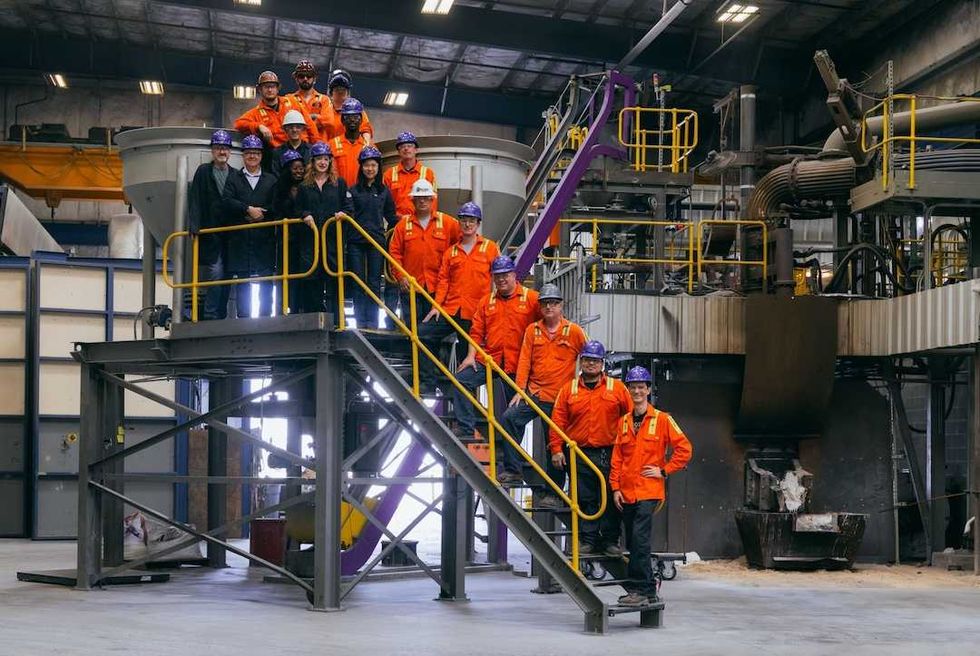
The Woodlands-based Lancium has licensed patents to ERCOT that help increase or decrease power consumption during peak periods or emergencies. Photo courtesy of ERCOT

Lancium, a company based in The Woodlands that specializes in infrastructure for connecting large-scale data centers to power grids, is licensing a portfolio of patents to the Electric Reliability Council of Texas (ERCOT) at no cost.

In a news release, Lancium says the intellectual property agreement “ensures ERCOT can sublicense these patents freely, thereby expanding market participation opportunities without risk of patent infringement disputes.”

“This agreement exemplifies Lancium’s dedication to supporting grid stability and innovation across the ERCOT region,” Michael McNamara, CEO of Lancium, said in a news release. “While these patents represent significant technological advancements, we believe that enabling ERCOT and its market participants to operate freely is more valuable for the long-term reliability and resilience of the Texas grid.”

The licensed patents encompass Lancium technologies that support load resources in ERCOT’s market, which covers about 90 percent of Texas. Specifically, the patents deal with controllable load resources. A controlled load resource allows ERCOT and other grids to increase or decrease power consumption during peak periods or emergencies.

ERCOT predicts power demand in Texas will nearly double by 2030, “in part due to more requests to plug into the grid from large users like data centers, crypto mining facilities, hydrogen production plants, and oil and gas companies,” The Texas Tribune reported.

Trending News

A View From HETI

Ching-Wu Chu, a professor of physics at the University of Houston and founding director and chief scientist at Texas Center for Superconductivity. Photo courtesy of UH

University of Houston researchers have set a new benchmark in the field of superconductivity.

Researchers from the UH physics department and the Texas Center for Superconductivity (TcSUH) have broken the transition temperature record for superconductivity at ambient pressure. The accomplishment could lead to more efficient ways to generate, transmit and store energy, which researchers believe could improve power grids, medical technologies and energy systems by enabling electricity to flow without resistance, according to a release from UH.

To break the record, UH researchers achieved a transition temperature 151 Kelvin, which is the highest ever recorded at ambient pressure since the discovery of superconductivity in 1911.

The transition temperature represents the point just before a material becomes superconducting, where electricity can flow through it without resistance. Scientists have been working for decades to push transition temperature closer to room temperature, which would make superconducting technologies more practical and affordable.

Currently, most superconductors must be cooled to extremely low temperatures, making them more expensive and difficult to operate.

UH physicists Ching-Wu Chu and Liangzi Deng published the research in the Proceedings of the National Academy of Sciences earlier this month. It was funded by Intellectual Ventures and the state of Texas via TcSUH and other foundations. Chu, founding director and chief scientist at TcSUH, previously made the breakthrough discovery that the material YBCO reaches superconductivity at minus 93 K in 1987. This helped begin a global competition to develop high-temperature superconductors.

“Transmitting electricity in the grid loses about 8% of the electricity,” Chu, who’s also a professor of physics at UH and the paper’s senior author, said in a news release. “If we conserve that energy, that’s billions of dollars of savings and it also saves us lots of effort and reduces environmental impacts.”

Chu and his team used a technique known as pressure quenching, which has been adapted from techniques used to create diamonds. With pressure quenching, researchers first apply intense pressure to the material to enhance its superconducting properties and raise its transition temperature.

Next, researchers are targeting ambient-pressure, room-temperature superconductivity of around 300 K. In a companion PNAS paper, Chu and Deng point to pressure quenching as a promising approach to help bridge the gap between current results and that goal.

“Room-temperature superconductivity has been seen as a ‘holy grail’ by scientists for over a century,” Rohit Prasankumar, director of superconductivity research at Intellectual Ventures, said in the release. “The UH team’s result shows that this goal is closer than ever before. However, the distance between the new record set in this study and room temperature is still about 140 C. Closing this gap will require concerted, intentional efforts by the broader scientific community, including materials scientists, chemists, and engineers, as well as physicists.”

Trending News