








Editor's note: It's been a busy news week for energy transition in Houston, and some of this week's headlines resonated with EnergyCapital readers on social media and daily newsletter. Trending news included news of clean energy deals, a global firm names a new exec, and more.
Houston company acquired by private equity firm, plans to expand support of energy transition

The deal and financial support will help Saber to expand its services within the energy transition, including the ability to build out renewables and battery resources amid the electrification of the U.S. economy. Photo via Getty Images
A Houston-based infrastructure services platform has been acquired by an energy industry-focused private equity firm.
Saber Power Services announced last month that it has been acquired by an investor group led by Greenbelt Capital Management from funds managed by Oaktree Capital Management. The acquisition was in partnership with funds managed by Schroders Capital, StepStone Group, and Wafra Inc., according to the company's news release.
Saber, founded in 2010, is an electrical services firm that provides design, construction, testing, and maintenance services and solutions across the energy spectrum — renewables, battery storage, utility, industrial, and energy infrastructure markets. The company's customers are located throughout Texas and the Southeast. Read more.
Global consulting firm names new Houston energy practice leader

Alvarez & Marsal announced the appointment of Jay Johnson as senior adviser to its energy practice. Photo via alvarezandmarsal.com
A top global professional services firm named a Houston-based energy leader amid industry evolution and regulatory changes.
Alvarez & Marsal, or A&M, announced the appointment of Jay Johnson as senior adviser to its energy practice.
“I enjoy bringing together teams of people to solve the complex challenges facing companies today,” Johnson says in a news release. “I’m looking forward to working with A&M’s energy team to build leadership and capabilities to address industry challenges.” Read more.
Houston energy SaaS startup wins local pitch competition
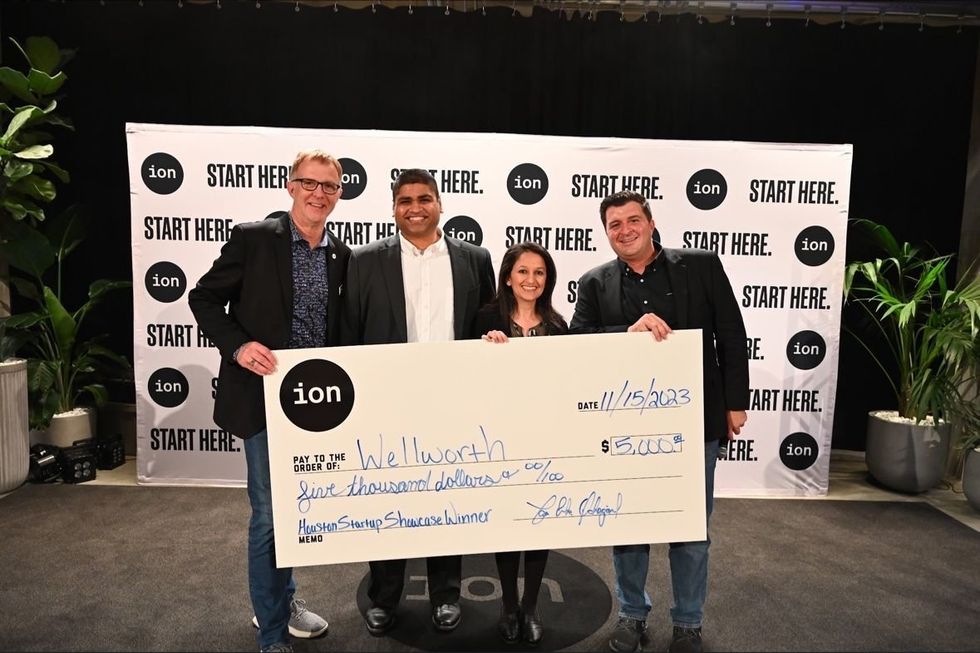
Houston-based WellWorth was selected as the winner of this year’s Houston Startup Showcase. Photo via LinkedIn
The Ion hosted its annual startup pitch competition, and one company walked away with a win.
WellWorth, a financial modeling and analysis software-as-a-service company for the upstream energy sector, won the Houston Startup Showcase + Expo and secured a $5,000 prize. The startup's technology introduces a more streamlined approach to NAV modeling or corporate financial modeling for its users.
“Having worked in investment banking, I have seen firsthand how the limitations of Excel models and a lack of bespoke tools have led to inefficient workflows in upstream Oil & Gas finance," says Samra Nawaz, CEO and Co-founder of WellWorth, in a statement. "We decided to solve this problem by building a cloud-based platform that helps energy finance leaders improve decision-making around raising, managing, and deploying capital.” Read more.
ExxonMobil’s Low Carbon Solution president makes inaugural TIME100 Climate list

The Houston-based executive makes the list of along with John Kerry, Bill Gates, and more. Photo via exxonmobil.com
A Houston energy executive has made the cut on an inaugural ranking of top climate action leaders.
TIME magazine’s first-ever TIME100 Climate list, which highlights “100 of the world’s most influential leaders driving climate action in business,” and ExxonMobil’s president of Low Carbon Solution business Dan Ammann has made it onto the list.
“The real credit goes to the ExxonMobil Low Carbon Solutions team for the progress we’ve made so far,“ Amann says in a LinkedIn post. “It’s great to see the world recognizing that ExxonMobil has a major role to play in accelerating the world’s path to net zero.” Read more.
Transocean calls for energy innovators, extends deadline for submissions

Transocean is looking for Houston innovators to help them on their decarbonization journey. Photo via Transocean
A major energy corporation has put its feelers out for Houston innovators solving for challenges within the decarbonization of offshore drilling operations.
Transocean, a Switzerland-based offshore energy leader with its United States headquarters in Houston, kicked off its Transocean Open Innovation Challenge this fall. The original deadline has been extended to December 15, and the program is in partnership with the Ion. Read more.