Houston is home to a growing number of startups reshaping what it means to be called the "Energy Capital of the World."
As part of the 2026 Houston Innovation Awards, our Energy Transition Business category honors those innovative startups that are providing solutions within renewables, climatetech, clean energy, alternative materials, circular economy and more.
Five clean energy startups have been named finalists for the 2026 award. The finalists, selected by our esteemed panel of judges, range from a lower-emission steel producer to a diagnostics platform developer working to support batteries used in data centers.
Read more about these innovative businesses, their initiatives, and their inspirational founders below. The 2026 winners will be announced on InnovationMap.com in mid-November.
Capwell Services
Methane capture company Capwell Services works to eliminate vented oil and gas emissions economically for operators. According to the company, methane emissions are vented from most oil and gas facilities due to safety protocols, and operators are not able to capture the gas cost-effectively, leading operators to emit more than 14 million metric tons of methane per year in the U.S. and Canada. Founded in 2022, Capwell specializes in low and intermittent flow vents for methane capture.
The company began as a University of Pennsylvania senior design project led by CEO Andrew Lane. It has since participated in programs with Greentown Labs, the Rice Clean Energy Accelerator and the Creative Destruction Lab Energy Cohort at Texas A&M University. The company moved to Houston in 2023 and raised a pre-seed round. It deployed two commercial units this year, according to its application.
FlowCellutions
Energytech startup FlowCellutions is developing a chemistry-agnostic diagnostics platform for flow and metal-air batteries supporting data centers and critical infrastructure. The platform is designed to help reduce operating costs, prevent failures and costly downtime, and extend battery lifetime from approximately seven years to more than 30 years. It has deployed four paid pilots and plans to take insights from the programs to develop its next-gen sensor platform technology.
CEO Becca Segel founded the company in 2022. It is a member of Greentown Labs, and Segel was a 2025 Activate Fellow. The company has raised over $2 million in non-dilutive funding and received a $1.5 million NSF SBIR Fast-Track award earlier this year.
Hertha Metals
Hertha Metals produces lower-cost, lower-emission steel and high-purity iron. The company has developed a single-step process that uses natural gas as a direct reductant instead of metallurgical coal, which cuts production costs by more than 25 percent and emissions by up to 50 percent, according to the company. The same process produces high-purity iron needed for high-purity steels and rare earth magnets. The company says it aims to "re-industrialize America’s production of critical materials."
Hertha Metals was founded by CEO Laureen Meroueh in 2022 and emerged from stealth last year with more than $17 million in venture capital funding. The company closed a $133.65 million Series A this month and also broke ground on its $100M high-purity iron factory known as Chalyx in Conroe.
Mars Materials
Clean chemical manufacturing business Mars Materials is working to convert captured carbon into resources, such as carbon fiber and wastewater treatment chemicals. The company develops and produces its drop-in chemical products in Houston and uses an in-licensed process for the National Renewable Energy Lab to produce acrylonitrile, which is used to produce plastics, synthetic fibers, and rubbers.
Founded in 2019 by CEO Aaron Fitzgerald, CTO Kristian Gubsch, and vice president of operations Trey Sheridan, the company has secured over $7.2M in financing and is backed by Bill Gates’ Breakthrough Energy, Shell, Black & Veatch, and other organizations. It won in the Minority-founded Business Category in last year's Houston Innovation Awards.
Solidec
Chemical manufacturing company Solidec has developed autonomous generators that extract molecules from water and air and convert them into pure chemicals and fuels that are free of carbon emissions on-site, eliminating the need for transport, storage, and permitting. The company was founded around innovations developed by Rice University associate professor Haotian Wang.
The company was selected for the Chevron Technology Ventures’ Catalyst Program, Greentown Labs, NSF I-Corps and was part of the first cohort of the Activate Houston program. It won first place at the 2024 startup pitch competition at CERAWeek. Solidec was founded in 2023 by Wang, who serves as an advisor, CEO Ryan DuChanois, and CTO Yang Xia. It closed a $2.5 million seed round in 2025.









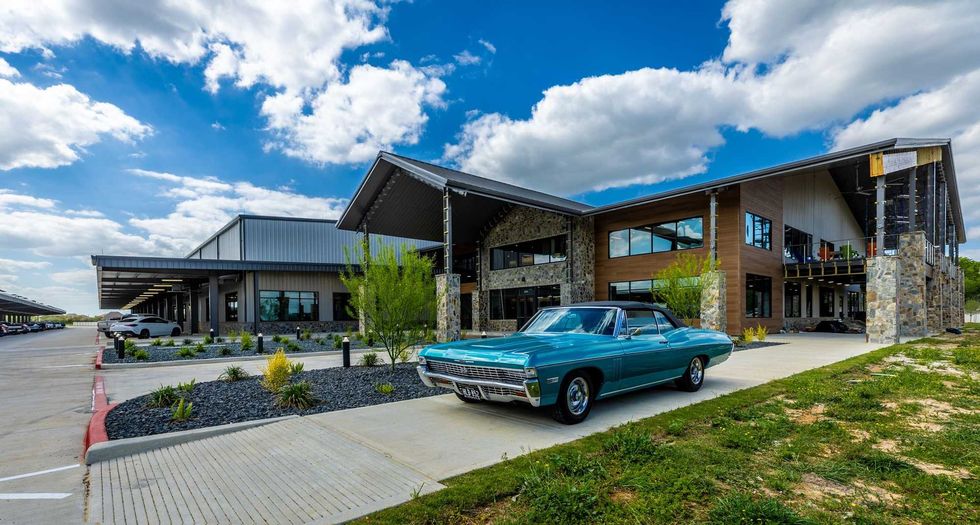 The new headquarters is designed as a "factory ranch" and features a solar generation plant to offset half of its power consumption. Photo via LinkedIn