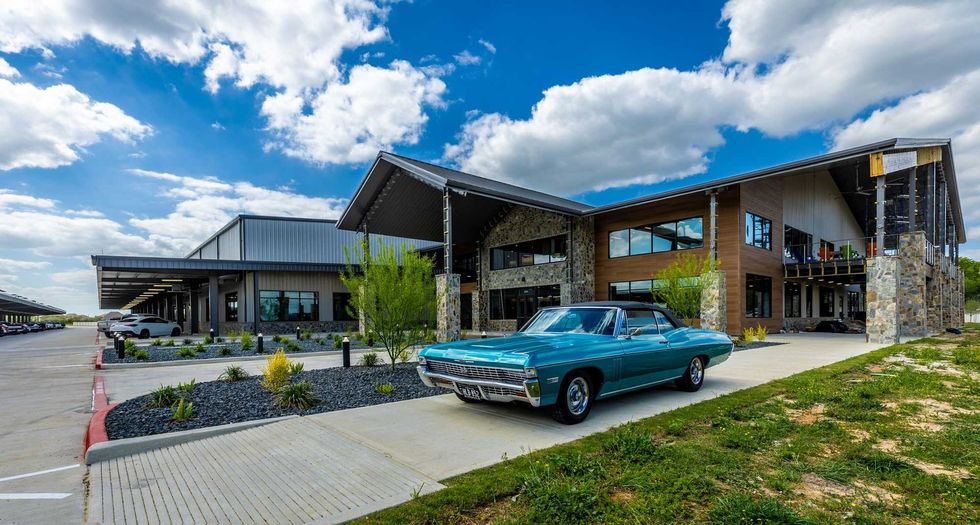
Drake Plastics opened its new headquarters last month. Photo via LinkedIn

Ultra-high-performance plastics company Drake Plastics officially opened its new state-of-the-art, 140,000-square-foot manufacturing center and corporate office in Cypress last month.

Dubbed “Drake HQ, ” the new facility was built to align with Harris County’s clean energy goals and features a 1.3-megawatt solar generation plant designed to offset 50 percent of the plant’s power consumption.

The facility is designed as a “factory ranch,” and is intended to blend in with its natural surroundings. With the expanded campus, Drake says it looks to serve existing and new customers in the semiconductor, aerospace, energy and defense industries.

The new headquarters is designed as a "factory ranch" and features a solar generation plant to offset half of its power consumption. Photo via LinkedIn

“We are thrilled to open the doors of our new headquarters in the area where it all began,” Drake Plastics President Steven Quance said in a news release. “We are honored to have reinvested in the community that has supported our growth and success over the past three decades.”

Drake Plastics cut the ribbon on March 26 at the new facility, which also marked the company’s 30th anniversary in the Cypress area. The company launched in 1996 with four employees and has grown to employ more than 100 staff members, according to a LinkedIn post.

Drake Plastics is a globally recognized leader in ultra-high-performance polymer manufacturing and specializes in extrusion, injection molding, precision machining, machine building, engineering and distribution. According to the company, its new Cypress facilty is one of the largest in the world that processes these high-performance polymers.

Ad Placement 300x100
Ad Placement 300x600

CultureMap Emails are Awesome

3 Houston incubators supporting hard tech, energy transition, and beyond

Meet The Finalists

It takes a village to launch a business. That's where Houston's network of incubators and accelerators can step in, providing the resources, mentorship and community needed to push a fledgling company forward.

As part of InnovationMap's 2026 Houston Innovation Awards, the Incubator/Accelerator of the Year category honors a local organization that is championing and fueling the growth of Houston startups.

Three incubators and accelerators have been named finalists for the 2026 award. They support startups ranging from hard tech companies to food and youth concepts.

Read more about these organizations below. The 2026 winners will be announced on InnovationMap.com in mid-November.

Activate

Hard tech incubator Activate supports scientists in "the outset of their entrepreneurial journey." The Houston hub was introduced in 2024, and joins others in Boston, New York, and Berkley, California—where Activate is headquartered. It named its third Houston cohort this summer.

The two-year program graduated its first class of Houston fellows in 2026 and saw its first alumni IPO from Houston-based Fervo Energy, which previously participated in a Berkley cohort. Nationally, it has supported 346 fellows and 276 companies since 2015. Those companies have raised more than $6 billion in follow-on funding, according to Activate. In Houston, it has supported Houston startups like energy transition leaders Solidec and FlowCellutions. Activate Houston is led by managing director Jeremy Pitts, who co-founded Greentown Labs in Boston. It is based out of the Ion.

Impact Hub Houston

Impact Hub Houston supports early-stage ventures at various stages of development through innovative programs that address pressing societal issues. The nonprofit organization supports social impact startups through mentorship, connections and training opportunities.

There are more than 110 Impact Hubs globally with members spanning 72 countries. Launched in 2018, Impact Hub Houston says its membership tripled by the beginning of 2026. This year brought major milestones for the community, including the launch of its Ideas to Impact Accelerator, which supported 11 founders across the health, education, food systems, civic technology and workforce development sectors. It also received funding from more than 20 international Impact Hubs to develop SYNC, a collaboration platform that 25 Impact Hubs across five continents have committed to pilot. The organization has worked with local startups including Myoviva Health, The Change Lab and INNERVERSE Inc.

MarMo Innovation

Galveston-based business incubator MarMo Innovation is focused on removing barriers to entrepreneurship. It aims to provide affordable space, education, mentorship, market access, connections and real-world opportunities that help entrepreneurs move from idea to launch to sustainable growth. The "industry-agnostic" incubator was founded in 2022 and is led by Executive Director Erica Delgadillo.

This year, the organization moved from primarily serving as a coworking and community space into a more comprehensive entrepreneurial incubator by expanding its MarMo Market, MarMo Market Jr. and Lunch LineUp programs. A major focus for MarMo is food entrepreneurship. It is developing an Incubator Kitchen, which MarMo says will support programs like its Cottage to Commercial Bootcamp and Food Biz 101. The organization also expanded its board this year and says it is diversifying its revenue through memberships, events, markets, equipment and space rentals, sponsorships, grants and new entrepreneurial programming.

---

This article first appeared on InnovationMap.com.

Sage Geosystems taps Halliburton to advance Nevada geothermal project

power partnership

Houston-based Sage Geosystems has selected oil and gas powerhouse Halliburton to provide cementing and stimulation services at its enhanced geothermal project in Nevada known as Project Vector.

“Our technology and experience will support Sage as it advances its geopressured geothermal technology,” Shawn Skobel, vice president at Halliburton, said in a news release.

Halliburton will provide Sage with technical modeling, engineering design, and field execution support as part of its specialized cementing and stimulation services at Project Vector at Ormat Technologies' Blue Mountain geothermal power plant. Sage announced the location of the geothermal project in September.

At the time, Sage said it expected to begin drilling the first well at Project Vector this year, with the first electricity to be generated in 2027 and full-scale production to start in 2028.

The project will use Sage’s enhanced geothermal systems (EGS) method in a two-well system to convert geothermal heat into electricity. The project aims to help meet industrial and residential demand, especially as data centers strain energy grids.

Founded in 2020, Sage has raised $159 million across three funding rounds. Its technology aims to reach Earth’s natural heat source deep underground for more consistent power generation and utilizes engineered subsurface reservoirs to minimize water and energy losses and increase net power output. Through the process, Sage says it can enable reliable, 24/7 power generation.

“One of the keys to scaling next-generation geothermal is combining innovative subsurface technology with the proven capabilities and execution of the oil and gas industry,” Jason Peart, Chief Operating Officer of Sage Geosystems, added in the news release. “Halliburton brings decades of experience in well integrity and reservoir stimulation, two critical components of our development approach. By selecting an established industry leader, we are strengthening our ability to execute Project Vector and demonstrate that Sage’s technology can be replicated and deployed commercially across a broad range of geologies.”

Sage is building off prior success of its South Texas SMECI facility, which began operations in August. Project Vector supports Sage’s growing commercial pipeline, which includes a 150-megawatt geothermal power agreement with Meta.

New study shows Houston is still feeling effects of 2014-16 oil crash

lasting impact

A new study from Rice’s Kinder Institute shows that Houston is still feeling the economic effects of the 2014-2016 oil crash, more than a decade later.

Though Houston, nicknamed the Energy Capital of the World, has continued to grow over the time period, the city has still fallen behind other comparable metropolitan areas in earnings and job creation, according to the research. The report is one part of a three-part series that will take a look at regional economic mobility and suggest ideas to expand opportunity.

“When you look at what’s happened in other locations, we’re losing ground,” Flávio Cunha, director of the Center for Economic Mobility at Rice’s Kinder Institute for Urban Research, said in a release. “Our economy is growing, but it’s no longer growing at the rate it used to.”

Global oil prices fell 70 percent between 2014 and 2016, the report said, marking one of the three largest declines since World War II and the longest-lasting downturn since 1986. The report excluded pandemic-related gaps, and it mentions 2017’s Hurricane Harvey as a possible indicator that economic growth stalled after the 2014-2016 oil price crash recovery.

To understand the long-term impact of the crash, researchers compared Houston’s economic performance with 54 metropolitan areas like San Antonio, Pittsburgh and others with less dependence on the energy industry.

Some of the key findings in the report included:

  • Job creation: In 2019, Houston had approximately 240,000 fewer private-sector jobs than similar cities. Employment was 15 percent lower in goods-producing industries and 4 percent lower in the services industries than the control group.
  • Income shifts: Income per resident was 13 percent lower compared to the peer group. Workers who remained employed earned 10 percent less between 2015 and 2019 than in other metros. The 13 percent drop in income equates to roughly $76 billion a year in forgone income, or $10,700 per resident per year in 2025 dollars. The decline was a trend across every age group, education level and sex.
  • Population changes: The rate of people moving to Houston slowed, rather than a surge of people leaving.
  • Hiring changes: Hiring fell sharply for young workers ages 19-24.

Cunha says the most surprising finding was that these trends persisted a decade later. According to the report, by 2024, Houston’s wages and income per resident remained about a fifth and a sixth below those in peer cities, and jobs per resident had continued to lose ground.

“What really surprises me is not that there was this change. It’s that this change has been long-lasting,” he added. “We followed it up to 2024, and we still don’t detect that the economy has recovered from that one shock.”

Read the full report here.