







DAC deal

1PointFive signs latest deal, shares update on $1.3B carbon removal project

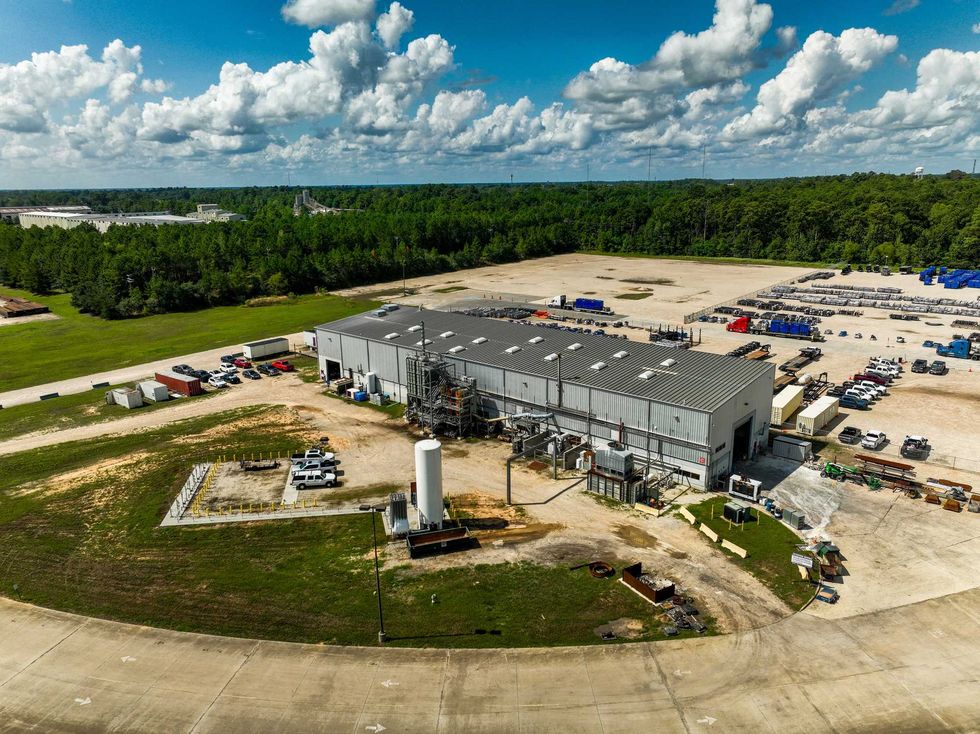
The first phase of 1PointFive's major direct air capture project is expected to come online in Q2. Photo via 1pointfive.com

Houston-based 1PointFive, a subsidiary of Occidental Petroleum Corp., has secured another buyer of carbon dioxide removal credits for its $1.3 billion STRATOS project as it moves toward operation.

Bain & Company, a Boston-based consulting firm, has agreed to purchase 9,000 metric tons of carbon dioxide removal (CDR) credits from the direct air capture (DAC) facility over three years, according to a news release. DAC technology pulls CO2 from the air at any location, not just where carbon dioxide is emitted.

The deal is Bain's first purchase of DAC removal credits. The company has developed a program that helps clients purchase carbon credits from a range of carbon-removal technologies.

"We are proud to partner with 1PointFive and add them to our portfolio of engineered carbon removal technologies," Sam Israelit, Bain’s chief sustainability officer, said in the news release. "Their track record for developing DAC technology, coupled with their deep understanding of what it takes to deliver large-scale infrastructure projects, uniquely positions them to be a leader in this emerging segment.”

“We believe this agreement demonstrates continued momentum for the solution while supporting the development of vital domestic infrastructure,” Anthony Cottone, president and general manager of 1PointFive, added in the release.

Bain joins others like Microsoft, Amazon, AT&T, Airbus, the Houston Astros and the Houston Texans that have agreed to buy CDR credits from STRATOS.

The Texas-based STRATOS project is being developed through a joint venture with investment manager BlackRock and is designed to capture up to 500,000 metric tons of CO2 per year. The U.S Environmental Protection Agency approved Class VI permits for the project last year.

1PointFive says STRATOS is "progressing through start-up activities." The company shared in a LinkedIn post that Phase 1 of the project is expected to go online in Q2, with Phase 2 ramping up through the remainder of 2026.
Trending News

A View From HETI

Hadi Ghasemi, a University of Houston professor, has uncovered a method to release heat from data centers and electronics at record performance. Photo courtesy UH.

A University of Houston professor has developed a new cooling method that can remove heat at least three times more effectively from AI data centers than current technologies.

Hadi Ghasemi, a distinguished professor of Mechanical & Aerospace Engineering at UH, published his findings in two articles in the International Journal of Heat and Mass Transfer. The findings solve a critical issue in the growing AI sector, according to UH.

High-powered AI data centers generate huge amounts of heat due to the GPU and operating systems they use with extreme power densities, which introduce complex thermal challenges. Traditionally, cooling methods, like microchannels, which use flow and spray cooling, have had limitations when exposed to extreme heat flux, according to UH.

Ghasemi’s research, however, found a more effective way to design thin-film evaporation structures to release heat from data centers and electronics at record performance.

Ghasem’s solution coupled topology optimization and AI modeling to determine the best shapes for thin film efficiency, ultimately landing on a branch-like structure—resembling a tree.

The model found that the “branches” needed to be about 50 percent solid and 50 percent empty space for optimum efficiency, and that they could sustain high heat fluxes with minimal thermal resistance.

“These structures could achieve high critical heat flux at much lower superheat compared to traditionally studied structures,” Ghasemi said in a news release. “The new structures can remove heat without having to get as hot as previous removal systems.

Ghasemi’s doctoral candidates, Amirmohammad Jahanbakhsh and Saber Badkoobeh Hezave, also worked on the project. The team believes their results show the impact of a physics-aware, AI design and can help ensure reliability, longevity and stability of AI data centers.

“Beyond achieving record performance, these new findings provide fundamental insight into the governing heat-transfer physics and establishes a rational pathway toward even higher thermal dissipation capacities,” Ghasemi added in the release

Trending News