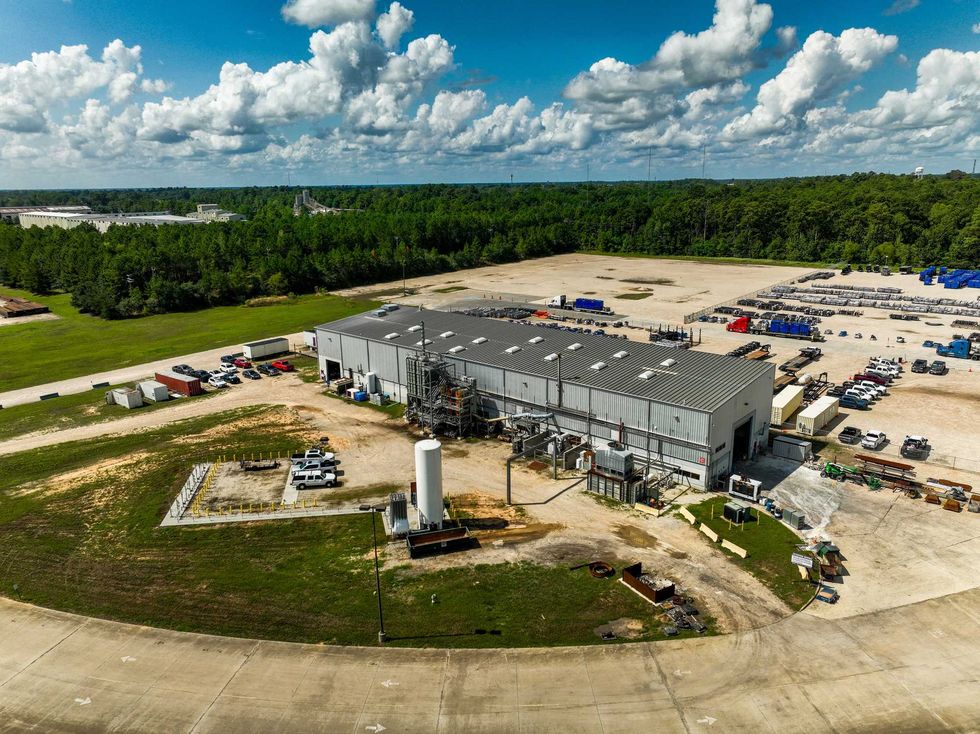
Primergy says Gemini is the biggest solar-and-storage duo in the U.S. Photo via primergysolar.com

A portfolio company of Quinbrook Infrastructure Partners, an energy-focused investment manager with U.S. offices in Houston and New York, has flipped the switch on its solar power and battery energy storage system in Nevada’s Mojave Desert.

The portfolio company, Oakland, California-based Primergy Solar, says its Gemini Solar + Storage project near Las Vegas is now fully operational.

Gemini’s 1.8 million solar panels can generate up to 690 megawatts of power, enough to meet 10 percent of Nevada’s peak power demand. The panels are paired with 380 megawatts of four-hour battery storage.

“Gemini creates a blueprint for holistic and innovative clean energy development at mega scale, and we are proud to have brought this milestone project to life and to have delivered so many positive impacts across job creation, environmental stewardship, and local community engagement,” David Scaysbrook, co-founder and managing partner of Quinbrook, says in a news release.

Primergy says Gemini is the biggest solar-and-storage duo in the U.S.

“Achieving full commercial operations marks a significant technical and financial milestone for our team. We successfully navigated challenging supply chain and inflation issues through proactive planning and collaboration to bring this project online,” Primergy CEO Ty Daul says.

Primergy develops, owns, and operates utility-scale solar power and battery storage projects across the U.S. It manages projects in several U.S. energy markets, including the one served by the Electric Reliability Council of Texas (ERCOT).

As Gemini was taking shape, Primergy and Quinbrook closed on $1.9 billion in debt and tax equity financing for construction and development.

In October 2022, APG, the largest pension asset manager in the Netherlands, acquired a 49 percent ownership stake in Gemini on behalf of pension fund client ABP.

In April 2024, the remaining 51 percent share of the project was acquired by the $600 million Quinbrook Valley of Fire Fund. Funds associated with Blackstone Strategic Partners and Ares Management Infrastructure Secondaries were the lead investors.

Ad Placement 300x100
Ad Placement 300x600

CultureMap Emails are Awesome

Fervo Energy leads Time’s top green tech companies of 2026

top spot

The accolades keep coming for Houston-based geothermal energy company Fervo Energy.

Fervo sits atop Time magazine’s and Statista’s 2026 list of America’s Top GreenTech Companies. Fervo ranked No. 6 on the list last year.

The ranking honors 250 companies in the U.S. based on their environmental impact, innovation and financial strength. Fervo joins five other Houston-area companies on the list.

  • No. 49 Quaise Energy, an MIT Energy Initiative spinout that’s developing a drilling system designed to convert existing power stations for geothermal power production
  • No. 71 Plus Power, which develops, owns and operates battery energy storage systems
  • No. 98 Utility Global, whose technology enables industrial decarbonization
  • No. 199 Solugen, whose technology converts plant-based feedstocks into carbon-negative chemicals
  • No. 215 Noodoe, which specializes in EV charging stations and software

Fervo says its approach to enhanced geothermal systems (EGS)—including horizontal drilling, AI-enabled drilling and exploration, advanced reservoir engineering, and fiber-optic sensing—demonstrates how validated technology can help deliver reliable zero-emission power.

“By applying drilling technology from the oil and gas industry, we have proven that we can produce 24/7 carbon-free energy resources in new geographies across the world,” Fervo co-founder and CEO Tim Latimer said last year.

Other recent recognitions for Fervo includes:

  • The 2025 Houston Innovation Awards named it Scaleup of the Year
  • MIT Technology Review put Fervo on its 2025 list of the 10 global climatech companies to watch
  • Time named Fervo one of the 100 Most Influential Companies of 2025
  • Fervo was hailed as the Global Cleantech Group 100 North American Company of the Year
  • Fervo was among Congruent Ventures’ and Silicon Valley Bank’s 50 by 2050 companies, all of which are poised to advance global decarbonization over a 25-year span
Just last month, Fervo secured $421 million in debt financing for the construction of its 500-megawatt Cape Station geothermal project in Utah. And in December, the company landed an oversubscribed $462 million Series E round of funding, pushing its valuation to an estimated $1.4 billion. Fervo filed for an IPO earlier this year.

3 strategies to strengthen the Gulf Coast as a global energy hub

The View from HETI

The Texas-Louisiana Gulf Coast is the backbone of America’s energy and chemical economy. Texas produces roughly 43% of U.S. crude oil and 28% of natural gas, while Texas and Louisiana together account for about half of the nation’s refining capacity, processing 9.3 million barrels of crude per day across 50 refineries. The region also produces approximately 80% of the nation’s primary petrochemicals and ships more than $117 billion in chemical products annually from Texas alone.

This unmatched concentration of refining, petrochemical manufacturing, pipelines, ports, and technical talent makes the Gulf Coast one of the most critical energy hubs in the world. But maintaining that leadership in a rapidly evolving global market will require intentional collaboration, faster technology commercialization, and strengthened supply chain resilience.

In fall 2025, the Greater Houston Partnership’s Houston Energy Transition Initiative (HETI) convened national laboratories, Gulf Coast universities, and industry leaders to examine how to reinforce the region’s long-term competitiveness. Participants included Argonne, Oak Ridge, Lawrence Berkeley, the National Energy Technology Laboratory (NETL), and the National Laboratory of the Rockies, alongside Gulf Coast academic institutions and energy and chemical companies. Here are the key findings and takeaways from the workshop.

1. Supply Chain Resilience Requires Structured Industry–Lab Collaboration

Resilience—diversity of supply, operational flexibility, and rapid recovery—was a recurring theme. Recent disruptions exposed vulnerabilities in tightly interconnected energy and manufacturing systems.

National laboratories provide capabilities that complement Gulf Coast industrial scale, particularly at early and mid technology readiness levels (TRLs 1–7), before full commercial deployment. Examples include:

  • Advanced manufacturing and AI-enabled validation of critical components (Oak Ridge).
  • Materials scale-up and techno-economic modeling to move from lab discovery to industrial relevance (Argonne).
  • Pilot-scale testing for severe-service alloys, chemical conversion, and process innovation (NETL).
  • Integrated energy systems modeling to assess grid resilience and system disruptions (National Laboratory of the Rockies).

Recommendation: Organize targeted Gulf Coast industry missions to national laboratories focused on critical supply chains—power equipment, high-heat industrial processes, novel catalysts, refining, and grid infrastructure—to identify joint development opportunities and reduce time to commercialization.

2. Modeling, AI, and Open-Access Platforms Can Bridge the Technology Gap

A persistent barrier to innovation is the gap between scientific discovery, applied development, and commercial deployment. Universities often operate at TRLs 1–3, national labs at 1–7, and industry at 7–9. Bridging these silos requires shared modeling tools, high-performance computing, and structured feedback loops.

National labs maintain open-access platforms capable of:

  • Simulating grid expansion, investment, and dispatch decisions.
  • Modeling cradle-to-gate industrial material flows.
  • Optimizing complex energy and chemical systems.
  • De-risking carbon capture, critical mineral recovery, and advanced manufacturing integration.

Recommendation: HETI should convene structured training and feedback sessions on these public modeling platforms—ensuring Gulf Coast industry can apply, improve, and help guide further development of tools critical to regional competitiveness. Federal initiatives such as the Genesis Mission, focused on AI-accelerated scientific discovery, further expand opportunities for Gulf Coast participation.

3. Time to Commercialization Is the Ultimate Competitive Metric

The lithium-ion battery is a cautionary example: while pioneered in U.S. labs, large-scale manufacturing leadership shifted overseas. Without strategic intervention, U.S. firms are projected to capture less than 30% of domestic lithium battery cell value by 2030.

Successful DOE-backed consortium models show that mission-aligned, multi-partner collaboration reduces development timelines and strengthens domestic manufacturing know-how. However, public–private partnership mechanisms such as CRADAs and Strategic Partnership Projects can be time-intensive.

Recommendation: The Gulf Coast should actively engage DOE and national laboratories to streamline public–private partnership pathways, improve intellectual property clarity, and expand industry access to laboratory infrastructure.

The Path Forward: A Gulf Coast Consortium Model
The workshop’s central conclusion was clear: the Gulf Coast should formalize collaboration through a regional industry–academia–laboratory consortium.

Such a model could:

  • Co-locate national lab researchers within the region.
  • Share modeling data and analytical capabilities.
  • Establish open-access pilot facilities that complement lab infrastructure.
  • Harmonize IP frameworks to accelerate licensing and deployment.

With its dense industrial ecosystem, technical workforce, and decision-making concentration, the Gulf Coast is uniquely positioned to serve as a national demonstration hub for advanced energy and chemical manufacturing.

If industry, universities, and national laboratories align around a shared regional strategy, the Gulf Coast can:

  • Accelerate commercialization timelines.
  • Strengthen critical supply chains.
  • Unleash a world-class technical workforce.
  • Reinforce U.S. leadership in strategic energy and chemical sectors.

———

This article originally appeared on the Greater Houston Partnership's Houston Energy Transition Initiative blog. A full report on the key learnings and recommendations from the workshop can be found here: https://bit.ly/4uEDEqk.

Houston cleantech company closes $12M seed round

fresh funding

Houston-based Helix Earth Technologies has closed a $12 million Seed 2 funding round to scale manufacturing of its energy-efficient commercial HVAC add-on technology.

Veriten, a Houston-based energy investment firm, led the round. Rua Ventures, Carnrite Ventures, Skywriter LLC and Textbook Ventures also participated.

Helix Earth—which was founded based on NASA technology, spun out of Rice University and has been incubated at Greentown Labs—is developing high-efficiency retrofit dehumidification systems that aim to reduce the energy consumption of commercial HVAC units. The company reports that its technology can lead to "healthier indoor air, lower energy bills, reduced building maintenance, and more comfortable spaces for building owners and occupants."

"Building owners are dealing with rising energy costs, uncontrolled humidity, and aging infrastructure with no viable, cost-effective path forward. We are in the field today solving these problems for commercial customers, and this capital puts us on an aggressive path to scale,” Rawand Rasheed, Helix Earth co-founder and CEO, said in a news release.

“The strength of this round reinforces our team's conviction that we can transform innovation-starved sectors with transformational solutions that deliver order-of-magnitude improvements to owners and operators, for both their bottom line and the environment,” Rasheed added.

Maynard Holt, Veriten’s founder and CEO, said that the investment firm is tripling its investment in Helix Earth.

"The team has built breakthrough technology with real applicability across multiple industries,” Holt said in the release. “Their first product will have an immediate and measurable impact on our energy system, and they are already pursuing adjacent innovations to help heavy industries operate more efficiently and with less waste. This is a well-rounded team with a proven track record of strong execution and disciplined capital management.”

Helix Earth also closed a $5.6 million seed funding round in 2024, led by Veriten.

Last year, the company secured a $1.2 million Small Business Innovation Research (SBIR) Phase II grant and won in the Smart Cities, Transportation & Sustainability contest at the 2025 SXSW Pitch Showcase. Rasheed was also named to the Forbes 30 Under 30 Energy and Green Tech list for 2025.