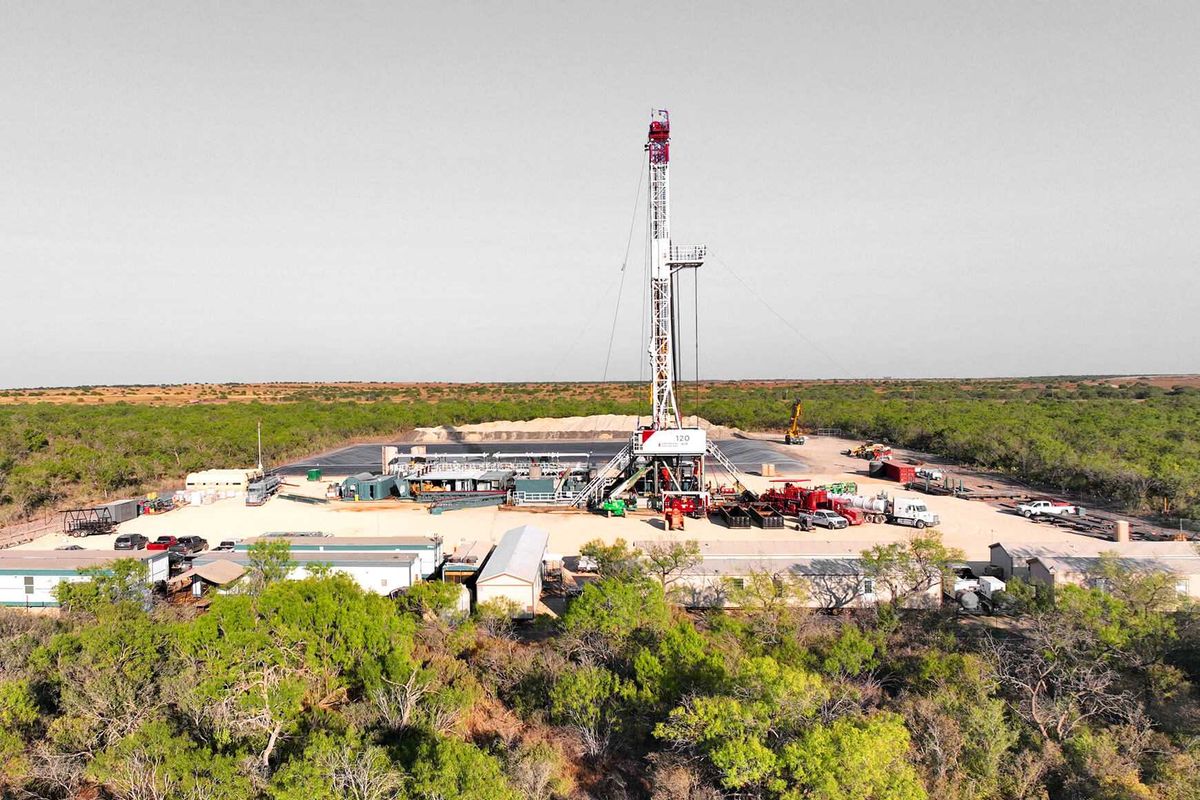
Vicki Hollub, president and CEO of Occidental, said the company's Stratos DAC project is on track to begin capturing CO2 later this year. Photo via 1pointfive.com

Houston-based Occidental Petroleum is gearing up to start removing CO2 from the atmosphere at its $1.3 billion direct air capture (DAC) project in the Midland-Odessa area.

Vicki Hollub, president and CEO of Occidental, said during the company’s recent second-quarter earnings call that the Stratos project — being developed by carbon capture and sequestration subsidiary 1PointFive — is on track to begin capturing CO2 later this year.

“We are immensely proud of the achievements to date and the exceptional record of safety performance as we advance towards commercial startup,” Hollub said of Stratos.

Carbon dioxide captured by Stratos will be stored underground or be used for enhanced oil recovery.

Oxy says Stratos is the world’s largest DAC facility. It’s designed to pull 500,000 metric tons of carbon dioxide from the air and either store it underground or use it for enhanced oil recovery. Enhanced oil recovery extracts oil from unproductive reservoirs.

Most of the carbon credits that’ll be generated by Stratos through 2030 have already been sold to organizations such as Airbus, AT&T, All Nippon Airways, Amazon, the Houston Astros, the Houston Texans, JPMorgan, Microsoft, Palo Alto Networks and TD Bank.

The infrastructure business of investment manager BlackRock has pumped $550 million into Stratos through a joint venture with 1PointFive.

As it gears up to kick off operations at Stratos, Occidental is also in talks with XRG, the energy investment arm of the United Arab Emirates-owned Abu Dhabi National Oil Co., to form a joint venture for the development of a DAC facility in South Texas. Occidental has been awarded up to $650 million from the U.S. Department of Energy to build the South Texas DAC hub.

The South Texas project, to be located on the storied King Ranch, will be close to industrial facilities and energy infrastructure along the Gulf Coast. Initially, the roughly 165-square-mile site is expected to capture 500,000 metric tons of carbon dioxide per year, with the potential to store up to 3 billion metric tons of CO2 per year.

“We believe that carbon capture and DAC, in particular, will be instrumental in shaping the future energy landscape,” Hollub said.

Ad Placement 300x100
Ad Placement 300x600

CultureMap Emails are Awesome

Rice, UH launch joint effort to accelerate plastics recycling solutions

plastics partnership

Institutes at two Houston universities are joining forces to help position the city as a global leader in plastics recycling innovation.

The Center for Energy Studies (CES) at Rice University’s Baker Institute for Public Policy and the University of Houston’s Energy Transition Institute (UH-ETI) have announced a strategic partnership that aims to develop real-world solutions for plastic recycling.

The universities will kick off the new initiative with the Annual Sustainability Summit: Innovations and Collaborations in Circularity & Supply Chain Resilience event April 22 at the Baker Institute.

“Houston sits at the center of the global plastics and petrochemical value chain, which makes it uniquely positioned to lead in circular solutions,” Rachel Meidl, deputy director of CES, said in a news release. “This partnership is about moving beyond theory and bringing together data, policy and industry insight to accelerate technologies and frameworks that can scale.”

The partnership—which was made official during CERAWeek—will integrate policy, economics, science and engineering. The universities will work to “share data, insights, networks and connections to advance global work in protecting the environment, economy and society,” according to a news release from Rice.

Initially, the universities will focus on evaluating scalable advanced recycling pathways, developing policy frameworks to improve plastics circularity, analyzing emerging technology and using industry stakeholders for deployment.

Plastics circularity aligns with Rice and UH’s energy transition efforts to advance a circular economy. UH's ETI recently published a white paper that analyzes how the U.S. currently handles plastics recycling and advocates for a new approach. Ramanan Krishnamoorti, author of the paper and vice president of energy and innovation at UH, said the partnership with Rice’s Baker Institute could help bring some of the ideas outlined in the paper to reality.

“Our research has shown that a uniform approach may be the best way for the U.S. to tackle plastic waste,” Krishnamoort said in a news release. “By partnering with Rice’s Baker Institute for Public Policy, we will be better positioned to deliver real-world solutions that advance a circular plastics economy.”

Fervo Energy adds former eBay CEO Meg Whitman, other leaders to board

power players

As it prepares for a highly anticipated IPO, Houston-based geothermal power provider Fervo Energy has added four heavyweights to its board of directors.

The most notable new board member is Meg Whitman, former CEO of eBay, Hewlett-Packard, and Spring-based HPE, and former U.S. ambassador to Kenya. She joined the Fervo board as lead independent director.

One of the other high-profile new board members at Fervo is Jessica Uhl. She was chief financial officer of Shell from 2017 to 2022 and spent a little over a year as president of GE Vernova, a GE energy spinoff. She is a former board member of GE, Goldman Sachs and Shell. Today, Uhl advises investment firms on energy matters.

Another energy industry veteran, Trey Lowe, also joined the Fervo board. Lowe is senior vice president and chief technology officer at oil and gas producer Devon Energy, a Fervo investor that’s moving its headquarters from Oklahoma City to Houston. Before Devon, Lowe worked in the U.S. and Norway for Houston-based energy technology company SLB.

The fourth new director at Fervo is Robert Keehan, who spent 37 years at professional services firm PwC. He most recently was PwC’s chief global auditor and earlier was a partner in the firm’s energy practice.

Keehan and Uhl will serve as independent directors, which are non-executive governance and oversight roles, while Lowe is a non-independent director, which is a more hands-on role.

With the four new directors, Fervo has seven board members.

The arrival of the four new board members comes at a monumental time for Fervo, a provider of utility-scale geothermal energy:

“Energy markets are demanding dependable, carbon-free power at an unprecedented scale, and Fervo is uniquely positioned to supply it,” Tim Latimer, co-founder and CEO of Fervo, said in December.

8 Houston companies earn CleanTech Breakthrough Awards

winner, winners

Eight cleantech companies with Houston headquarters were recognized in this year’s CleanTech Breakthrough Awards program.

CleanTech Breakthrough, part of market intelligence platform Tech Breakthrough, honors innovative and influential energy, climate, and cleantech companies, products and services.

This year’s winners from Houston are:

  • CleanTech Analytics Company of the Year: Amperon, a provider of AI-powered energy forecasting software
  • Overall Hydrogen Solution of the Year: Eclipse Energy, which converts maxed-out oilfields into low-cost sources of hydrogen
  • Energy Production Company of the Year: Fervo Energy, a provider of geothermal power
  • Production Solution of the Year: Quaise Energy, a developer of a drilling system for converting traditional power stations into geothermal energy plants
  • Green Materials Solution of the Year: Solidec, which uses air, water, and electricity to produce chemicals
  • Hydrogen Production Solution of the Year: VEMA Hydrogen, a producer of renewable hydrogen
  • CleanTech Analytics Innovation Award: Finland-based Wärtsilä, a provider of advanced energy storage systems and services, which maintains its U.S. headquarters in Houston
  • Energy Production Platform of the Year: France-based energy giant TotalEnergies, which maintains its U.S. headquarters in Houston

Other Texas companies made the list, including Austin-headquartered Base Power, founded by Justin Lopas and Zach Dell. Zach Dell is the son of Austin billionaire and Houston native Michael Dell, chairman and CEO of Dell Technologies. The company recently started servicing Houston and established an office in Katy.

CleanTech Breakthrough says its annual awards program honors “the visionaries and leaders accelerating the transition to a cleaner, more sustainable future.”

“In a world increasingly focused on sustainability and environmental responsibility, innovation in clean technology has never been more critical,” said Bryan Vaughn, managing director of CleanTech Breakthrough. “This year’s winners represent the very best in ingenuity and execution, delivering solutions that not only reduce environmental impact but also drive efficiency, scalability and real-world results.”

See the full list of the 2026 winners here.