Texas falls among the middle of the pack when it comes to EV adoption, according to a new report. Photo via Unsplash
Even though Texas is home to Tesla, a major manufacturer of electric vehicles, motorists in the Lone Star State aren’t in the fast lane when it comes to getting behind the wheel of an EV.
U.S. Department of Energy data compiled by Visual Capitalist shows Texas has 689.9 EV registrations per 100,000 people, putting it in 20th place for EV adoption among the 50 states and the District of Columbia. A report released in 2023 by the University of Houston and Texas Southern University found that a little over 5 percent of Texans drove EVs.
California leads all states for EV adoption, with 3,025.6 registrations per 100,000 people, according to Visual Capitalist. In second place is Washington, with an EV adoption rate of 1,805.4 per 100,000.
A recent survey by AAA revealed lingering reluctance among Americans to drive all-electric vehicles.
In the survey, just 16 percent of U.S. adults reported being “very likely” or “likely” to buy an all-electric vehicle as their next car. That’s the lowest level of interest in EVs recorded by AAA since 1999. The share of consumers indicating they’d be “very unlikely” or “unlikely” to buy an EV rose to 63 percent, the highest level since 2022.
Factors cited by EV critics included:
High cost to repair batteries (62 percent).
High purchase price (59 percent).
Ineffective transportation for long-distance travel (57 percent).
Lack of convenient public charging stations (56 percent).
Fear of battery running out of power while driving (55 percent).
“Since AAA began tracking consumer interest in fully electric vehicles, we’ve observed fluctuations in enthusiasm,” said Doug Shupe, corporate communications manager for AAA Texas. “While automakers continue investing in electrification and expanding EV offerings, many drivers still express hesitation — often tied to concerns about cost, range, and charging infrastructure.”
Fervo Energy’s flagship project in Utah just generated its first geothermal power.
The electricity is now flowing to the power grid from one of Cape Station’s three generation units, Houston-based Fervo said in a news release. This represents an early but important milestone for the project, as the unit isn’t scheduled to deliver contracted power until Oct. 1.
The achievement, coming four months after Fervo’s roughly $2.2 billion IPO, demonstrates the viability of enhanced geothermal systems (EGS).
“This is a gamechanger for the geothermal industry. It establishes EGS as the defining new power generation technology of our time, and we believe it shows that the commercial and technical maturity of EGS is ready to meet the urgent need for reliable, clean power,” Tim Latimer, co-founder and CEO of Fervo, said in the release.
The plant’s two other units are scheduled to launch commercial operations on Jan. 1.
The three units make up the project’s 99-megawatt first phase. The next phase, which will add 400 megawatts of capacity, is under construction. The second phase is set to go online in 2028.
Altogether, Cape Station will provide more than 4 gigawatts of capacity, with 900 megawatts already spoken for. The 900 megawatts of contracted electricity would be enough to power nearly 1 million U.S. homes per year.
“Cape Station works because we treated the subsurface like an engineering challenge,” Jack Norbeck, co-founder and chief technology officer of Fervo, added in the release. “Years of drilling, completion design, subsurface modeling, and flow testing led to this moment, and this is the validation that matters most.”
Enhanced geothermal continuously draws on heat that’s deep underground, producing electricity around the clock regardless of weather or time of day. That makes it one of the only carbon-free resources capable of constant power delivery, which is critical for data centers and AI infrastructure.
While hundreds of thousands descend on New York for Climate Week, Houston offered a different proposition: come where the work is being built. And last week Houston proved that it’s solving for more energy and fewer emissions; reliability and affordability; speed and durability. We are solving for the “&.”
That equation sharpened last week. On Sept. 14, the Environmental Protection Agency announced it had repealed most 2024 federal carbon-pollution standards for power plants and proposed rescinding remaining greenhouse-gas requirements. Policy matters, but it can pivot. The need to build does not.
HECW is a proving ground, not another conference stop. As I wrote in the Houston Chronicle, Mayor Sylvester Turner planted the seed by insisting we bring people together across the city and industry to drive Houston’s energy future. He knew false choices have no place here: oil and gas and clean technology; prosperity and stewardship; industry and lower emissions.
ECW joined the Climate Week Network this year, connecting Houston to a growing community of more than 500,000 people across 22-plus cities. We now have a seat at the global table—and a responsibility to use it well, building with other cities and the wider clean-energy-solutions world rather than merely talking at them.
The capital is already moving. Since 2017, Houston Energy Transition Initiative member companies have invested more than $95 billion in low-carbon infrastructure, technologies, and research and development. This is where the transition is financed, engineered, tested and operated. But the work requires more than capital. It requires capital allocators who understand the difference between a promising idea and a project that can scale, hire and endure.
Last week was Houston’s show and tell. At ARTECHOUSE, The &Bassador Reception & Awards brought art, technology, culture, philanthropy and energy together. Then the week went beyond downtown.
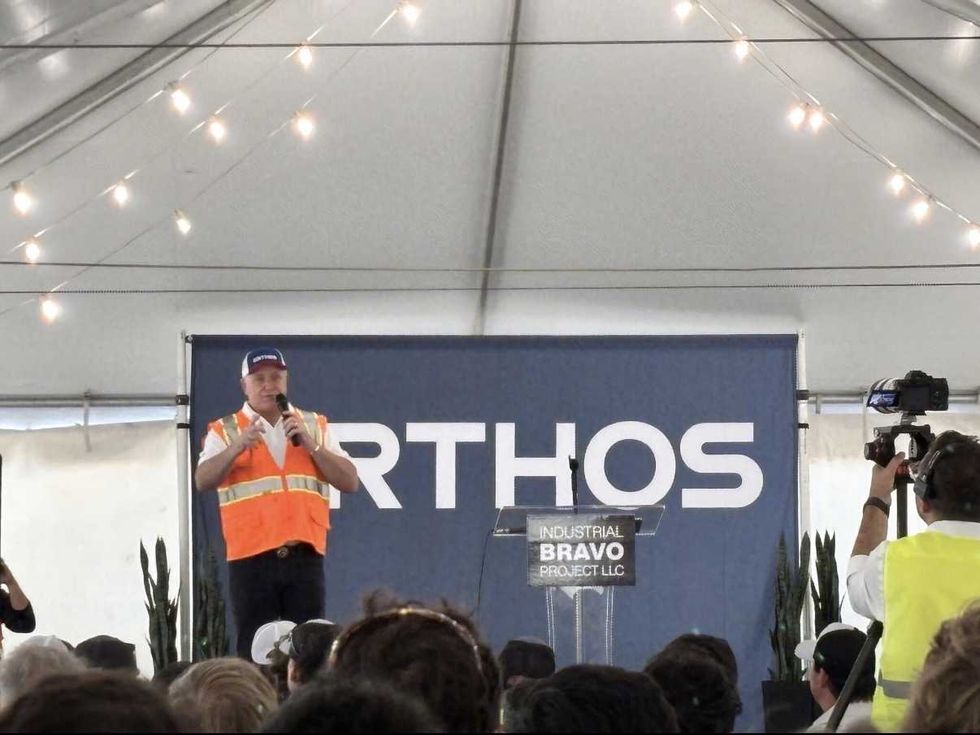
Sugar Land Town Square became the launchpad for the Metro Innovation Tour & Market: a place for an ecosystem conversation about smart cities, clean energy, equitable access and next-generation mobility before participants boarded three tour routes across greater Houston. It was also the starting point for the Bay City South Innovation Tour to Erthos Project Bravo in Matagorda County, where small groups saw Earth Mount solar modules being installed in real time. The conversation did not end at a panel. It went to the project site.
The HTX Tech Tours included a visit to the Erthos Project Bravo in Matagorda County. Photo courtesy
Approximately 100 startups from around the world pitched at Rice Alliance, Greentown Labs and Halliburton Labs events. At Astros Night at Daikin Park, builders, backers, and believers traded conference rooms for the diamond, creating an experience, not just another event. That is how this work becomes civic fabric.
Activation also means making the energy story felt, not merely explained. AY Young brought the Battery Tour for live performances. It was a reminder that the “Power of &” is not confined to a boardroom or a laboratory. Art and technology, culture and commerce, a new generation and established industry can share the same stage—and help more people see themselves in the work ahead.
Perhaps no activation made the “Power of &” more immediate and real than the Houston, We Have Solutions open mic night. At Creatopia’s Innovation Studio, people took the mic—or simply listened—to share what they were building, the problem they could not stop thinking about, and the connection they hoped to make. It put founders, artists, community builders, researchers and future-makers in one room. That is collaboration in real time: different kinds of expertise meeting before anyone knows exactly what the solution will be.
FOX26 helped carry that story beyond the rooms we convened, hosting Erthos COO Jessica Knight, Mars Materials co-founder Aaron Fitzgerald, and investors Taylor Chapman and Juliana Garaizar to discuss building and backing the future in Houston. Our region should be proud—not as self-congratulation, but because the world is beginning to experience energy and climate solutions firsthand.
This was also a week to give back. Allies in Energy awarded $27,500 to nine organizations advancing energy and climate literacy, civil dialogue, workforce pathways and community action. NRG Energy’s Brighter Communities provided a founding gift to expand the week and fund local grants. It took partners, hosts, sponsors, volunteers, funders and community organizations. That is the “Power of &”: collaboration that leaves a stronger community behind.
The “Power of &” cannot stop at Houston’s city limits. Louisiana’s participation—through its support of the Digital Delta Symposium & Expo—made clear that Houston’s builder ecosystem is regional by necessity. Gulf Coast infrastructure, supply chains, talent, and industrial decisions do not recognize state lines. Neither should our collaboration. If we are serious about building more energy with fewer emissions, we must align capital, resources and opportunity across the entire Gulf Coast.
That same commitment to practical collaboration means listening, learning and adjusting. A builder’s mindset does not protect a plan simply because it came first; it improves the conditions for the work to succeed. That is why Houston Energy and Climate Week will move to April 4–10, 2027—better weather, more time and space for connection, and a stronger city-wide experience for the people building what comes next.
But the real test begins now. Can we keep widening the circle? Can we continue to turn research into projects, pilots into infrastructure, capital into good jobs and climate ambition into results that families and communities can see? Can we make every new solution stronger by bringing in the people who must finance it, build it, operate it, live beside it and benefit from it?
That is the work ahead. Turner understood that Houston does not move forward by asking who wins the argument. It moves forward by asking who is ready to solve the problem. His legacy—and the promise of the “&”—is an invitation to choose collaboration over division, action over performance and possibility over false choices.
The future does not need another city to talk about it. It needs Houston to keep building it. And it will only be built if we keep choosing the "&."
Responding to public outcry, Gov. Greg Abbott has stepped up his campaign against data centers by temporarily halting approval of environmental permits for data center projects.
This and previous moves by Abbott essentially amount to a temporary freeze on the development of new data centers in Texas. His actions come at a time when Texas’ stature as a data center hub has been soaring.
On Monday, Abbott directed the Texas Commission on Environmental Quality to stop issuing permits for data center developments until the Electric Reliability Council of Texas (ERCOT) and Public Utility Commission of Texas complete their review of projects seeking power grid connections.
With regulatory reviews underway and environmental permitting now frozen, state regulators currently cannot approve or deny requests from data center developers, Abbott said.
In a letter to the environmental quality commission’s executive director, Kelly Keel, Abbott said this directive is “consistent with my whole-of-government approach to ensure Texans’ natural resources and way of life are protected.”
Abbott previously ordered the Texas Water Development Board to require data centers to meet reporting requirements for water use. He also told the board to impose penalties for failure to comply with those requirements and to collaborate with ERCOT on its review.
Abbott launched his crackdown on data centers in August by ordering the Public Utility Commission and ERCOT to review data center projects in Texas. The audits will examine all data centers in the queue for interconnections before any more projects can move forward. Interconnections enable data centers to share power, data and computing resources.
In calling for those audits, Abbott cited concerns over data centers’ use of water and electricity, and the centers’ effect on infrastructure expenses and consumers’ utility rates.
“Simply put, Texans must come first,” the governor said.
During next year’s legislation session, Abbott will push for the elimination of state financial incentives for data center projects.
Ed Hirs, an energy fellow at the University of Houston, told Reuters that Abbott was backtracking on “his earlier pronouncements about data centers leading to lower electricity prices.”
Abbott’s actions come amid growing public backlash over data centers. A recent University of Houston survey found that nearly 63 percent of Houston-area residents opposed construction of a data center within a mile of their home.









 The HTX Tech Tours included a visit to the Erthos Project Bravo in Matagorda County. Photo courtesy