resiliency plan

CenterPoint launches real-time tracker to map Houston’s power grid upgrades

CenterPoint Energy has launched a new Community Progress Tracker. Screenshot via centerpointenergy.com

Houstonians can now track electronic infrastructure improvements via CenterPoint’s new Community Progress Tracker, part of the company’s ongoing Greater Houston Resiliency Initiative.

The tracker allows users to search by zip code and see completed work in real time, as well as updates on upcoming projects that highlight infrastructure improvements and efforts to strengthen the power grid in the face of extreme weather. Users can view icons on a map that track automation and intelligence projects, storm-resilient pole and equipment installations, undergrounding work and tree trimmings.

CenterPoint had installed 10,000 storm-resilient poles, cleared 1,600 miles of higher-risk vegetation, completed 99 miles of power line undergrounding and hardened 220 miles of power lines by the end of Q1 2026, according to the company.

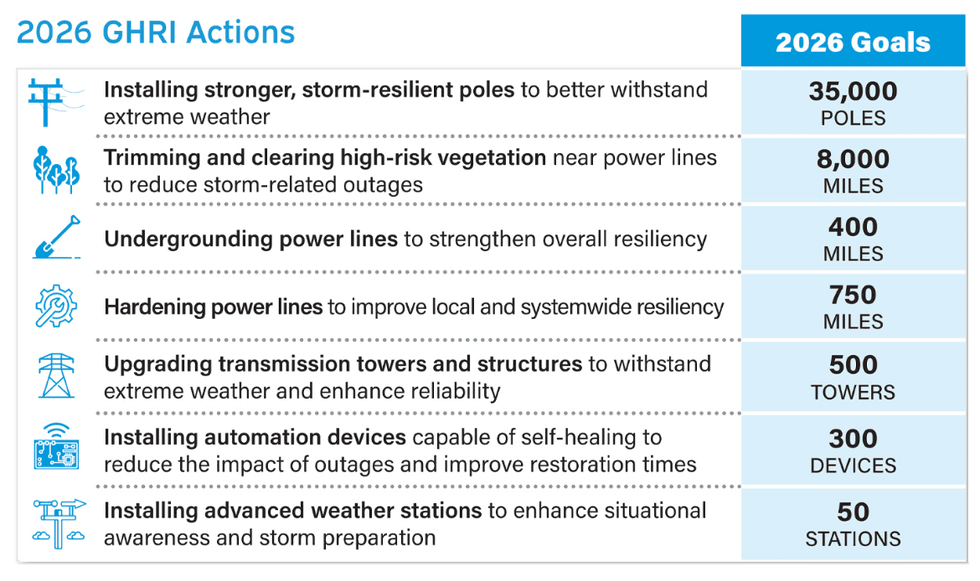
For the rest of 2026, CenterPoint aims to install 35,000 stronger, storm-resilient poles, clear high-risk vegetation from 8,000 miles of power lines and harden 500 transmission structures against storms.

Via centerpointenergy.com

“We are proud of the progress made in 2025, which helped deliver more than 100 million fewer outage minutes when compared to 2024, and we are determined to make even more progress in 2026 as we work toward our defining goal: building the nation's most resilient coastal grid,” Nathan Brownell, CenterPoint's vice president of resilience and capital delivery, said in a news release. “To date, we are ahead of schedule in making critical 2026 GHRI improvements, and we will continue to build the stronger, smarter infrastructure necessary to further improve systemwide reliability and strengthen resiliency, reducing the likelihood and impact of outages for our customers.”

Trending News

A View From HETI

A new report estimates that more than 90 percent of data center-related carbon dioxide emissions could potentially be mitigated through carbon capture and storage. Photo via Unsplash

A new study out of Rice University points to carbon capture and storage methods as pivotal solutions to addressing emissions from AI-driven data centers.

The study was authored by Hon Chung Lau, an adjunct professor in the Department of Chemical and Biomolecular Engineering at Rice University and founder of Low Carbon Energies LLC, and Steve C. Tsai, an energy transition consultant at Low Carbon Energies LLC, and published in the journal Energy & Fuels.

According to the study, U.S. data center power capacity could more than quadruple in five years, growing from 40 gigawatts in 2025 to 169 gigawatts by 2030. Without proper regulation of emissions, the report estimates that carbon dioxide produced by fossil-fuel power plants supplying electricity to data centers could grow at the same scale, increasing from 90 million metric tons to more than 404 million metric tons over the same time period.

The researchers analyzed publicly available data on announced U.S. data centers, which included energy sources, locations, and projected power capacity before estimating data center-related carbon emissions based on each state’s electricity mix. From there, they examined whether those emissions could be captured and stored underground in saline aquifers.

The team estimates that 34 states have enough saline aquifer storage capacity to store more than 100 years of projected data center-related carbon dioxide emissions beyond 2030. Aquifers could store an estimated 59 million metric tons of data center-related carbon dioxide, or about 66 percent of the sector’s emissions in 2025. However, that calculation could grow to 299 million metric tons, or about 74 percent of projected data center-related emissions by 2030.

The researchers found that more than 90 percent of data center-related carbon dioxide emissions could potentially be mitigated through carbon capture and storage when out-of-state storage options are included, even though they note that carbon capture isn’t the only solution.

“It does show that the geology exists to make a meaningful impact, especially in states where data center growth is strongest,” Lau said in a news release.

Rapid growth in states including Texas, Virginia, Pennsylvania, Ohio, Arizona, Colorado, Utah and Illinois was considered in the study. According to the findings, Texas would need to add 25 gigawatts of power capacity by 2030 to meet projected data center demand, as data centers require reliable electricity 24/7.

“Data centers are becoming one of the defining energy challenges of the AI era,” Lau added in the news release. “The question is not only whether we can build enough computing infrastructure, but whether we can power it in a way that is reliable, affordable and compatible with decarbonization goals.”

Trending News