







Hurricane season began June 1. Photo via Pexels

As hurricane season descends upon the region, CenterPoint Energy has shared the latest update on its Greater Houston Resiliency Initiative (GHRI) that’s been working to make grid upgrades and introduce weather-related tech since 2024.

As of April 2026, CenterPoint had:

  • Replaced more than 65,000 poles with stronger storm-resistant infrastructure
  • Trimmed or cleared more than 10,000 miles of vegetation
  • Undergrounded more than 500 miles of power lines
  • Installed more than 600 automation devices
  • Installed more than 150 weather stations

In May, CenterPoint announced its new Community Progress Tracker, which helps residents track electronic infrastructure improvements. In terms of other technology, CenterPoint has announced its partnership with weather, wildfire and flood modeling software Technosylva. The software is expected to help CenterPoint track weather conditions in advance to better prepare crews.

CenterPoint has also added 150 weather stations to improve weather monitoring, conducted a full-scale hurricane response exercise involving more than 400 employees and completed more than 25,000 hours of FEMA training across more than 800 employees. The company opened a new year-round Emergency Operations Center to help coordinate with emergency response partners, local and state officials, and media during major weather events.

“We are proud of the progress made in 2025, which helped deliver more than 100 million fewer outage minutes when compared to 2024, and we are determined to make even more progress in 2026 as we work toward our defining goal: building the nation's most resilient coastal grid,” Nathan Brownell, CenterPoint's vice president of resilience and capital delivery, previously said in a news release.

According to the company, the GHRI aims to improve overall grid resiliency and reliability and to reduce outages for customers. CenterPoint projects its efforts can reduce customer outages by 150 million by the end of 2026.
CenterPoint Energy has launched a new Community Progress Tracker. Screenshot via centerpointenergy.com

CenterPoint launches real-time tracker to map Houston’s power grid upgrades

resiliency plan

Houstonians can now track electronic infrastructure improvements via CenterPoint’s new Community Progress Tracker, part of the company’s ongoing Greater Houston Resiliency Initiative.

The tracker allows users to search by zip code and see completed work in real time, as well as updates on upcoming projects that highlight infrastructure improvements and efforts to strengthen the power grid in the face of extreme weather. Users can view icons on a map that track automation and intelligence projects, storm-resilient pole and equipment installations, undergrounding work and tree trimmings.

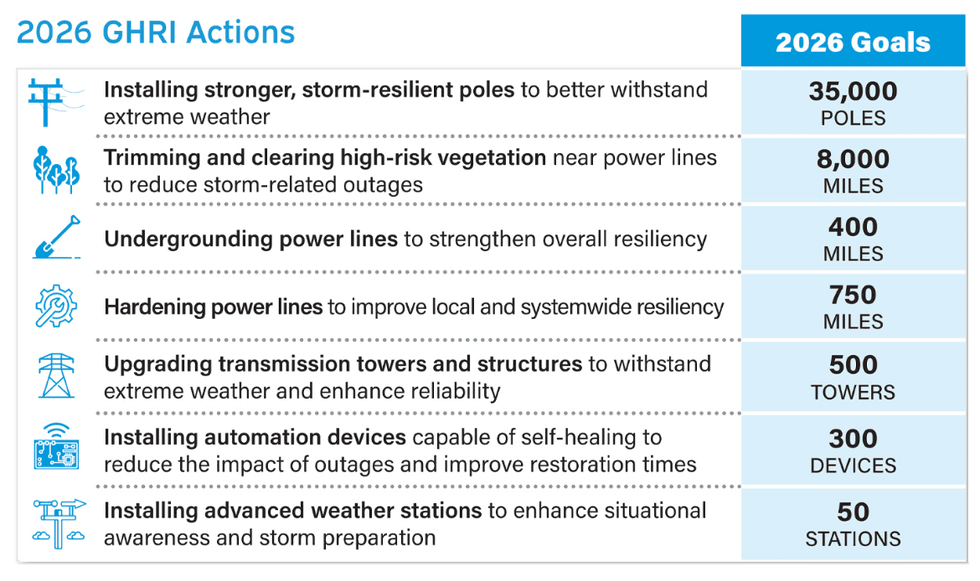
CenterPoint had installed 10,000 storm-resilient poles, cleared 1,600 miles of higher-risk vegetation, completed 99 miles of power line undergrounding and hardened 220 miles of power lines by the end of Q1 2026, according to the company.

For the rest of 2026, CenterPoint aims to install 35,000 stronger, storm-resilient poles, clear high-risk vegetation from 8,000 miles of power lines and harden 500 transmission structures against storms.

Via centerpointenergy.com

“We are proud of the progress made in 2025, which helped deliver more than 100 million fewer outage minutes when compared to 2024, and we are determined to make even more progress in 2026 as we work toward our defining goal: building the nation's most resilient coastal grid,” Nathan Brownell, CenterPoint's vice president of resilience and capital delivery, said in a news release. “To date, we are ahead of schedule in making critical 2026 GHRI improvements, and we will continue to build the stronger, smarter infrastructure necessary to further improve systemwide reliability and strengthen resiliency, reducing the likelihood and impact of outages for our customers.”
Ad Placement 300x100
Ad Placement 300x600

CultureMap Emails are Awesome

Houston's KBR to provide tech for Singapore SAF plant

SAF agreement

Houston engineering and technology contractor KBR has been picked as the technology provider for what’s expected to be Asia's first commercial-scale ethanol-to-jet sustainable aviation fuel (SAF) plant.

The proposed plant on Jurong Island in Singapore is being developed by Keppel Ltd.’s Infrastructure Division and Aster Chemicals and Energy. KBR will provide technology licensing and Front-End Engineering Design (FEED) services based on its PureSAF technology.

The plant has a planned production capacity of up to 100,000 tons of SAF per year. The plant is subject to final investment decisions and regulatory approvals.

“We are looking forward to working with Keppel and Aster on this key project and to support Singapore’s ambition of becoming Asia’s leading SAF hub and advancing the ongoing efforts to decarbonize the country’s aviation ecosystem,” Stuart Bradie, KBR president and CEO, said in a news release.

According to KBR, its PureSAF Technology can process multiple feedstocks like bioethanol, syngas, carbon dioxide and hydrogen and convert them to SAF, diesel and gasoline.

The technology was developed by Swedish Biofuels AB and commercialized by KBR.

“KBR’s PureSAF is a feedstock-flexible, bankable technology that is designed to deliver a 100% drop in jet fuel, ready to power aircraft without blending,” Bradie added in the news release. “We are constantly innovating our SAF solution to make it compatible with feedstock availability in different regions and to enable the aviation industry to transition to low-carbon jet fuel with a cost-optimized approach.

KBR has also entered into a memorandum of intent with Keppel’s Infrastructure Division, which states that the companies will collaborate again on decarbonization efforts across biofuels, plastic recycling, digitalization via AI, and SAF.

KBR announced in October that it would spin off its Mission Technology Solutions business, nicknamed SpinCo. The scaled-down KBR, nicknamed RemainCo, would concentrate solely on sustainability technology and services designed to reduce carbon emissions and support energy transition efforts. SpinCo named its new CEO and CFO earlier this month.

Houston energy expert discusses why hydrogen still has a future

Guets Column

Not long ago, hydrogen was hailed as the next big thing in clean energy. Investors poured in, and countries from Japan to Germany built ambitious hydrogen strategies. It wasn’t a new discovery; hydrogen has been used for over a century in refineries and fertilizers, but it suddenly found itself reborn as the world began working toward decarbonization.

When hydrogen burns, the only byproduct is water. Green hydrogen, produced with renewable power, could replace fossil fuels in everything from trucks to ships to steel mills. But the momentum has cooled. Costs remain stubbornly high, several projects have been delayed or canceled, and policy support has wavered. In the U.S., a change in administration has created uncertainty. In Europe, some governments are slowing funding or revising hydrogen mandates. Even the International Maritime Organization (IMO) recently postponed a key vote on fuel-carbon standards.

Yet as Mike Graff , former Chairman and CEO of American Air Liquide, said in an Energy Forum episode with Ed Emmett at Rice University’s Baker Institute, “The world is always looking to make sure that energy is first available, it’s affordable, and then it’s clean. And I see hydrogen over time evolving in that manner.” He also noted that “companies have produced hydrogen and utilized hydrogen for over 100 years, and they’ve done that very safely… I think we can continue that moving forward.”

China has doubled down on hydrogen as part of its industrial strategy, building massive electrolyzer manufacturing capacity and funding dozens of pilot projects across transportation and heavy industry. Japan and South Korea also stand out as examples of how sustained policy support can drive hydrogen progress.

Where Hydrogen Fits Today

To understand hydrogen’s role now, it helps to remember what it actually does. About 76 percent of global hydrogen is produced from natural gas and used in refineries, fertilizer plants, and chemical production. This so-called “gray hydrogen” is essential but carbon-intensive.

What’s new is the rise of low-carbon hydrogen, “blue” hydrogen made from natural gas with carbon capture, and “green” hydrogen produced by splitting water with renewable electricity. These methods are expensive, but they’re growing. According to the International Energy Agency, global low-emissions hydrogen output rose about 10 percent in 2024.

Hydrogen is also expanding beyond industry. As Graff explained, it already powers thousands of forklifts in warehouses across the U.S. and is beginning to appear in commercial trucking, locomotives, and even aviation prototypes. “You can now drive 600 to 800 miles on a hydrogen fuel-cell truck,” he noted, “and refuel in 30 minutes, just like you would refill for diesel.”

The Cost Challenge and a Gulf Coast Opportunity

So why the slowdown? One word: economics.

Even with generous tax credits, green hydrogen can cost two to three times more than conventional fuels. Electrolyzers are still expensive, though costs are falling as Chinese suppliers introduce low-cost alternatives.

Infrastructure is another hurdle. Pipelines, storage, and fueling networks need to be built from scratch.

But those same challenges point to opportunity, especially along the U.S. Gulf Coast. The region already has one of the world’s largest hydrogen pipeline systems and a well-established energy infrastructure. Texas, in particular, has a head start. It already hosts nearly 1,000 miles of hydrogen pipelines, about 64 percent of the U.S. total, and some of the world’s largest hydrogen storage sites at Moss Bluff, Spindletop, and Clemens. Out of 140 hydrogen plants operating nationwide, 43 are in Texas, supported by extensive refining and natural gas infrastructure. This combination of assets gives the Gulf Coast an unmatched foundation to scale low-carbon hydrogen and integrate production, storage, and end use across industries.

As Ken Medlock , Senior Director of the Center for Energy Studies at Rice University’s Baker Institute, explains in his report: Developing a Robust Hydrogen Market in Texas, Texas has all the critical elements needed to lead in a low-carbon hydrogen economy, including existing infrastructure, a skilled workforce, and proximity to industrial demand centers. That combination gives it a distinct advantage in scaling up hydrogen production and use.

Governments around the world are showing renewed confidence in hydrogen. The European Commission awarded nearly €3 billion to 13 major projects, while Japan and South Korea continue expanding fueling networks. China is leading one of the most ambitious buildouts, with more than 50 planned hydrogen projects and a rapidly growing fleet of fuel-cell vehicles. Despite recent setbacks, global investment has surpassed $100 billion, and projects in places such as Chile, where strong renewables and low-cost Chinese equipment help make projects feasible, are moving toward final investment decisions.

What Comes Next

Hydrogen’s future won’t depend on replacing every fuel, but on filling the gaps where batteries and biofuels fall short.

Transportation: This is where momentum is strongest today. Batteries dominate cars, but hydrogen fuel cells excel in heavy trucks, ships, and planes. As Graff noted, “You can design a commercial vehicle with the same utility as diesel but powered by hydrogen.” Airbus and Boeing are testing hydrogen propulsion concepts, and several ports are experimenting with hydrogen bunkering for cargo ships.

Industry: Steel, cement, and chemicals account for a quarter of global emissions. Hydrogen-based direct-reduced-iron (DRI) steelmaking is being piloted in Europe and Asia and could transform how these materials are produced at scale.

Storage: Hydrogen can store energy for days or weeks, serving as backup for renewables like wind and solar. But storage remains very costly and may only prove viable for the “last mile” of greenhouse gas reduction or grid stability.

These uses may sound niche, but that’s how technologies scale. They start small, gain an economic foothold, and expand as costs decline.

Conclusion

Hydrogen's early, perhaps irrational, exuberance may have cooled, but amidst the rubble of cancelled projects are the beginnings of an industry that could play a vital niche role on the journey towards a lower carbon intensity energy future. As costs fall and infrastructure around the world expands, hydrogen's role will expand into the nooks and crannies of the energy industry.

It won't replace every fuel, but it doesn't have to. Success will come from steady, project-by-project progress.

-----------

Scott Nyquist is a senior advisor at McKinsey & Company and vice chairman, Houston Energy Transition Initiative of the Greater Houston Partnership. The views expressed herein are Nyquist's own and not those of McKinsey & Company or of the Greater Houston Partnership. This article originally appeared on LinkedIn.

Houston energy startup launches to power AI data centers with Microsoft agreement

power move

Buoyed by a purchase agreement from Microsoft, Houston-based Joulent recently launched to build power plants that meet the electricity demands of AI data centers and other computing-heavy industries.

Joulent builds dedicated power-generating facilities that feed directly into data centers and other power-dependent facilities, eliminating the need for companies to siphon power from grids. Joulent’s plants combine generation, storage and smart controls in a modular, scalable setup, according to a news release.

Investment firm Engine No. 1 established Joulent in collaboration with energy technology company GE Vernova.

Joulent’s first project, the Project Kilby natural gas facility in West Texas, will be co-located with a Microsoft data center. It’ll deliver about 2.67 gigawatts of power under a 20-year deal between Microsoft and Energy Forge One, a subsidiary of Houston-based Chevron. Engine No. 1 and Chevron teamed up to build the plant.

GE Vernova will supply most of the plant’s power capacity, with additional capacity coming from Solar Turbines, a subsidiary of Irving-based construction and mining equipment manufacturer Caterpillar.

“Leadership in the AI era will be determined by who can deliver energy and compute the fastest, most reliably, and at the lowest cost,” Chris James, founder and CEO of Engine No. 1 and Joulent, said in a news release.

“By building new power-generating facilities, Joulent enables customers across industries to power the next chapter of American innovation, while reducing pressure on existing grids and maintaining affordability for ratepayers.”