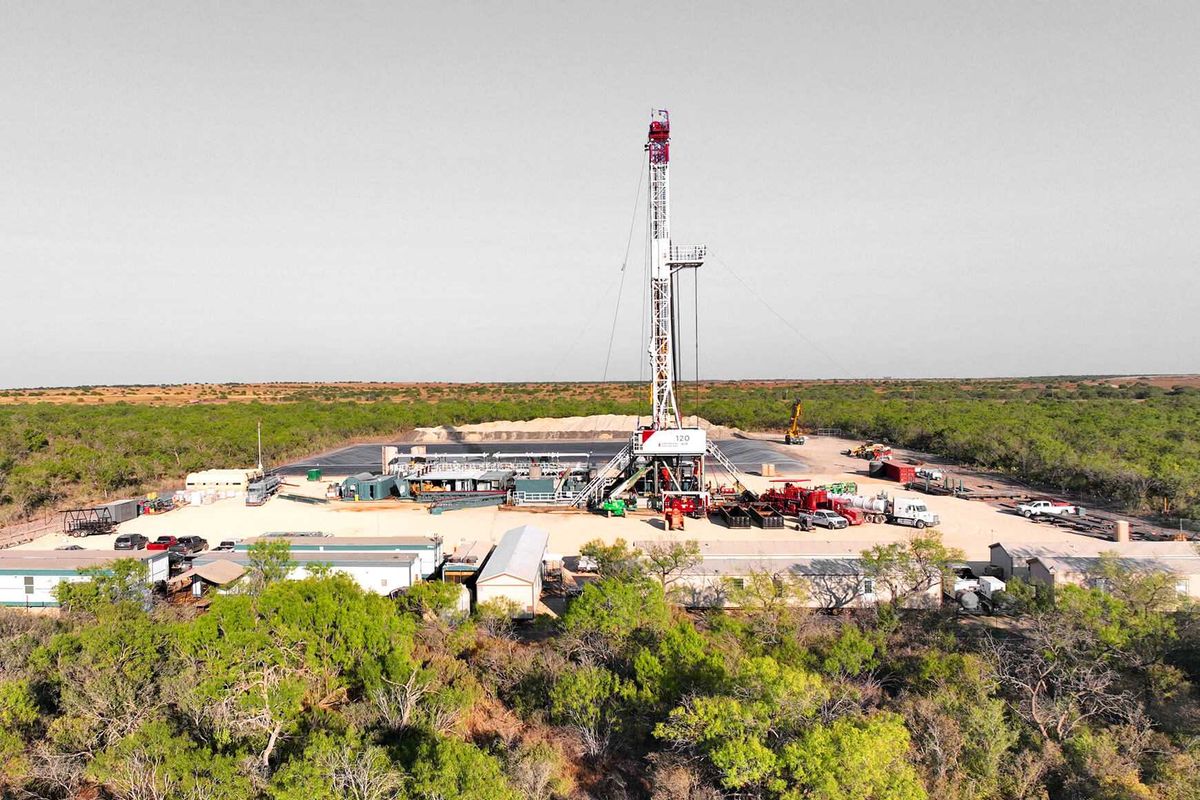
A forecast from Energy Innovation Policy & Technology shows that Texas is expected to see a decline in solar, wind and battery-powered storage by 2035 due to clean energy tax credit repeals in the 'One Big Beautiful Bill Act.' Photo via Getty Images.

Texas is expected to see a 77-gigawatt decrease in power generation capacity within the next 10 years under the federal "One Big Beautiful Bill Act," which President Trump recently signed into law, a new forecast shows.

Primarily due to the act’s repeal of some clean energy tax credits, a forecast, published by energy policy research organization Energy Innovation Policy & Technology, predicts that Texas is expected to experience a:

  • 54-gigawatt decline in capacity from solar power by 2035
  • 23-gigawatt decline in capacity from wind power by 2035
  • 3.1-gigawatt decline in capacity from battery-stored power by 2035
  • 2.5-gigawatt increase in capacity from natural gas by 2035

The legislation “will reduce additions of new, cost-effective electricity capacity in Texas, raising power prices for consumers and decreasing the state’s GDP and job growth in the coming years,” the forecast says.

The forecast also reports that the loss of sources of low-cost renewable energy and the resulting hike in natural gas prices could bump up electric bills in Texas. The forecast envisions a 23 percent to 54 percent hike in electric rates for residential, commercial and industrial customers in Texas.

Household energy bills are expected to increase by $220 per year by 2030 and by $480 per year by 2035, according to the forecast.

Energy Innovation Policy & Technology expects job growth and economic growth to also take a hit under the "Big Beautiful Bill."

The nonprofit organization foresees annual losses of $5.9 billion in Texas economic output (as measured by GDP) by 2030 and $10 billion by 2035. In tandem with the impact on GDP, Texas is projected to lose 42,000 jobs by 2030 and 94,000 jobs by 2035 due to the law’s provisions, according to the organization.

The White House believes the "Big Beautiful Bill" will promote, not harm, U.S. energy production. The law encourages the growth of traditional sources of power such as oil, natural gas, coal and hydropower.

“The One Big Beautiful Bill Act is a historic piece of legislation that will restore energy independence and make life more affordable for American families by reversing disastrous Biden-era policies that constricted domestic energy production,” Interior Secretary Doug Burgum said in a news release.

Promoters of renewable energy offer an opposing viewpoint.

“The bill makes steep cuts to solar energy and places new restrictions on energy tax credits that will slow the deployment of residential and utility-scale solar while undermining the growth of U.S. manufacturing,” says the Solar Energy Industries Association.

Jason Grumet, CEO of the American Clean Power Association, complained that the legislation limits energy production, boosts prices for U.S. businesses and families, and jeopardizes the reliability of the country’s power grid.

“Our economic and national security requires that we support all forms of American energy,” Grumet said in a statement. “It is time for the brawlers to get out of the way and let the builders get back to work.”

Ad Placement 300x100
Ad Placement 300x600

CultureMap Emails are Awesome

5+ must-attend Houston energy events in March: CERAWeek and more

Mark Your Calendar

Editor's note: March is a major month for energy industry events in Houston, including CERAWeek and more must-attend summits and forums. Mark your calendars for the top events of the month, and register now.

March 2-4 — The Future Energy Summit

The Future Energy Summit is a premier global event bringing together visionaries, industry leaders, and energy experts to shape the future of energy. The second edition of the conference will provide a platform for groundbreaking discussions, cutting-edge technologies, and transformative strategies that will accelerate the energy transition.

This event begins March 2. Register here.

March 5 — 2026 Houston CISO Forum

The Energy Conference Network hosts an exclusive, executive-level cybersecurity leadership event for those in the energy industry. The 50-person, half-day forum will bring together chief information security officers, senior cybersecurity leaders, and industry experts for candid conversations, actionable insights, and peer collaboration.

This event takes place March 5 at Hyatt Regency Houston West. Limited registration available here.

March 10-12 — World Hydrogen & Carbon Americas

S&P Global Energy brings together two leading events — Carbon Management Americas and World Hydrogen North America — to form a new must-attend event for those in the hydrogen and carbon industries. More than 800 senior leaders from across the energy value chain will attend this event featuring immersive roundtable discussions, hands-on training, real-world case studies, and unparalleled networking opportunities.

This event begins March 10 at Marriott Marquis Houston. Register here.

March 23-27 — CERAWeek 2026

CERAWeek 2026 will focus on "Convergence and Competition: Energy, Technology and Geopolitics." The industry's foremost thought leaders will convene in Houston to cultivate relationships and exchange transformative ideas during the annual event. CERAWeek 2026 will explore breakthroughs, cross-industry connections, and powerful partnerships that are accelerating the transformation of the global energy system. 2026 highlights include an appearance by tech magnate Bill Gates.

This event begins March 23. Register here.

March 24-25 — 2026 Energy Venture Day and Pitch Competition

The Energy Venture Day and Pitch Competition, co-hosted by the Rice Alliance, Ion, HETI, and TEX-E, offers two days of exciting pitches from more than 40 global energy ventures that are transforming the industry. On Tuesday, March 24, you can attend a fast-paced pitch preview event at the Ion, followed by the official Pitch Competition at 1 pm on Wednesday, March 25, at George R. Brown Convention Center.

More details available here.

How this Houston expert helps startups turn AI hype into real impact

now streaming

Artificial intelligence is now everywhere. It is mentioned in every startup pitch deck, and every corporate roadmap claims to use it. However, many early-stage businesses struggle with the simple question, “What does AI actually mean for my business?”

In a recent podcast episode of EnergyTech Startups, Merab Momen, founder of AI CTO Services and a long time AI practitioner, explains why most founders misunderstand AI, how startups can practically apply it and why Houston is quietly becoming a serious hub for AI-driven innovation.

Filling the AI Leadership Gap

Merab’s career has spanned decades of technology transitions. He worked on neutral networks in the 1990s, constructed computer vision systems long before they were common, and helped install AI solutions inside huge industrial companies. However, he noticed a huge problem when generative AI started to explode into the mainstream-The requirement of a real partner by the founders for AI integration but inability to rely on a full-time CTO and project-based consultants.

“I really needed something which is much more engaging where I can give that partner-level advice to the founders,” he said. By giving firms on-demand access to high-level AI knowledge and expertise, his methodology enables them to analyse tools, steer clear of cost blunders and eventually transition to a permanent technology leader when the time is right.

AI is Older than Most People Think

Despite its recent rise in popularity, AI is nothing new. AI actually began in the 1950s. Merab in his conversation explained how he worked on his first AI project back in the year 1996 that worked perfectly, but the processing power wasn’t just there to make it practical. He continued how he utilized the swarm intelligence models to optimize supply chains, now referred to as MLPOs and data engineering.

From Language Models to Physical World

Much of the public conversation about AI revolves around chatbots and text generation. But Merab sees far greater potential in AI’s interaction with the physical world, especially in industrial settings. He emphasized edge computing and vision language models (VLMs) as significant advances in manufacturing and energy. This physical shift is opening doors for new opportunities for robotics, automated inspections, and industrial safety applications. Merab added that Houston is uniquely positioned for this transition.

Why Houston has an AI Advantage

Silicon Valley may dominate the AI headlines, but Merab believes Houston’s advantage lies beneath the surface. The city doesn’t lag in AI utilization; it just operates in industries where results show differently.

Machine learning isn’t new to Houston’s core industries. Energy companies, manufacturers, logistics providers, and healthcare systems have been using advanced analytics for decades. The difference lies in them innovating in industrial sectors rather than consumer technology.

What’s Next

With the AI CTO Services growing, Merab is working with startups across industries to deploy AI in practical, business-first ways.

He is more interested in assisting founders in finding answers to critical issues than following new trends.

For Houston’s energy and climate tech community, it needs to transform AI enthusiasm into real-world impact.

Listen to the full conversation with Mehrab Momin on the Energy Tech Startups Podcast to learn more.

---

Energy Tech Startups Podcast is hosted by Jason Ethier and Nada Ahmed. It delves into Houston's pivotal role in the energy transition, spotlighting entrepreneurs and industry leaders shaping a low-carbon future.


Houston company tapped to run renewables project with Meta power agreement

power deal

Houston-based Consolidated Asset Management Services (CAMS) has been selected to operate Plano-based Nexus Renewable Power's major renewables development, known as Project Goody.

CAMS will provide comprehensive asset management, operations, maintenance, regulatory compliance and remote operations services for the $220 million solar and battery storage project located in Lamar County, Texas, northeast of Dallas.

“The project underscores CAMS’ commitment to supporting dependable, grid-strengthening energy infrastructure across the United States,” Brian Ivany, EVP of CAMS Renewables, said in a news release. “Our team is proud to support Nexus and excited to apply our subject matter expertise and hands-on approach to ensure operational excellence and long-term success of the Goody project.”

Project Goody, or MRG Goody Solar and Storage, will feature a 172-megawatt solar facility paired with 237 megawatts of battery energy storage. The project will be connected to the ERCOT grid. Meta, the parent company of Facebook, has signed on as the power offtaker for the project.

Nexus Renewable Power develops, finances and operates solar and energy storage assets. It currently operates projects generating 325 megawatts of solar and 350 megawatts of battery storage, with another 300 megawatts of solar and 1 gigawatt of battery storage projects under construction, according to its website. Project Goody is the first in a series of renewable developments underway, according to Nexus.

CAMS manages and operates energy infrastructure assets for its clients. Last year, it added InfraRed Capital Partners, which owns the 202-megawatt Mesteño Wind Project in the Rio Grande Valley, to its customer list. It also rolled out services to help deliver power to meet the growing demand from AI data centers.