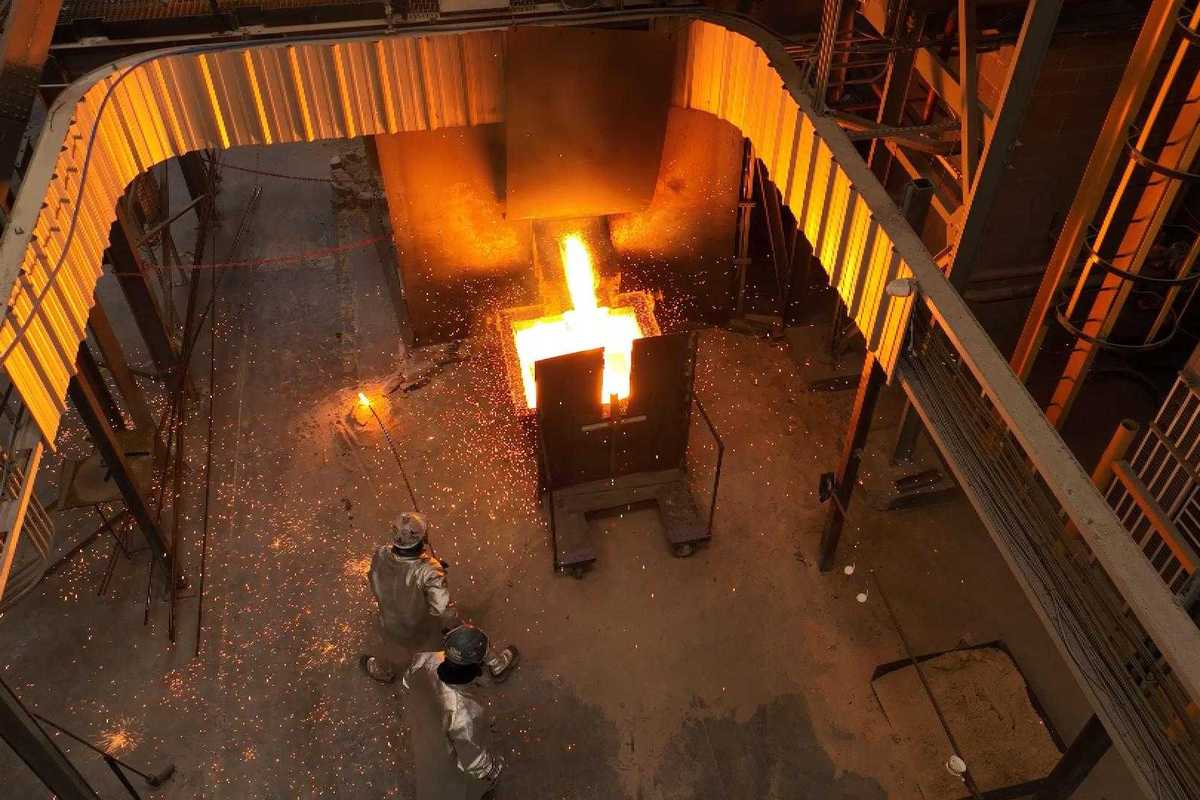
A forecast from Energy Innovation Policy & Technology shows that Texas is expected to see a decline in solar, wind and battery-powered storage by 2035 due to clean energy tax credit repeals in the 'One Big Beautiful Bill Act.' Photo via Getty Images.

Texas is expected to see a 77-gigawatt decrease in power generation capacity within the next 10 years under the federal "One Big Beautiful Bill Act," which President Trump recently signed into law, a new forecast shows.

Primarily due to the act’s repeal of some clean energy tax credits, a forecast, published by energy policy research organization Energy Innovation Policy & Technology, predicts that Texas is expected to experience a:

  • 54-gigawatt decline in capacity from solar power by 2035
  • 23-gigawatt decline in capacity from wind power by 2035
  • 3.1-gigawatt decline in capacity from battery-stored power by 2035
  • 2.5-gigawatt increase in capacity from natural gas by 2035

The legislation “will reduce additions of new, cost-effective electricity capacity in Texas, raising power prices for consumers and decreasing the state’s GDP and job growth in the coming years,” the forecast says.

The forecast also reports that the loss of sources of low-cost renewable energy and the resulting hike in natural gas prices could bump up electric bills in Texas. The forecast envisions a 23 percent to 54 percent hike in electric rates for residential, commercial and industrial customers in Texas.

Household energy bills are expected to increase by $220 per year by 2030 and by $480 per year by 2035, according to the forecast.

Energy Innovation Policy & Technology expects job growth and economic growth to also take a hit under the "Big Beautiful Bill."

The nonprofit organization foresees annual losses of $5.9 billion in Texas economic output (as measured by GDP) by 2030 and $10 billion by 2035. In tandem with the impact on GDP, Texas is projected to lose 42,000 jobs by 2030 and 94,000 jobs by 2035 due to the law’s provisions, according to the organization.

The White House believes the "Big Beautiful Bill" will promote, not harm, U.S. energy production. The law encourages the growth of traditional sources of power such as oil, natural gas, coal and hydropower.

“The One Big Beautiful Bill Act is a historic piece of legislation that will restore energy independence and make life more affordable for American families by reversing disastrous Biden-era policies that constricted domestic energy production,” Interior Secretary Doug Burgum said in a news release.

Promoters of renewable energy offer an opposing viewpoint.

“The bill makes steep cuts to solar energy and places new restrictions on energy tax credits that will slow the deployment of residential and utility-scale solar while undermining the growth of U.S. manufacturing,” says the Solar Energy Industries Association.

Jason Grumet, CEO of the American Clean Power Association, complained that the legislation limits energy production, boosts prices for U.S. businesses and families, and jeopardizes the reliability of the country’s power grid.

“Our economic and national security requires that we support all forms of American energy,” Grumet said in a statement. “It is time for the brawlers to get out of the way and let the builders get back to work.”

Ad Placement 300x100
Ad Placement 300x600

CultureMap Emails are Awesome

Rice, UH launch joint effort to accelerate plastics recycling solutions

plastics partnership

Institutes at two Houston universities are joining forces to help position the city as a global leader in plastics recycling innovation.

The Center for Energy Studies (CES) at Rice University’s Baker Institute for Public Policy and the University of Houston’s Energy Transition Institute (UH-ETI) have announced a strategic partnership that aims to develop real-world solutions for plastic recycling.

The universities will kick off the new initiative with the Annual Sustainability Summit: Innovations and Collaborations in Circularity & Supply Chain Resilience event April 22 at the Baker Institute.

“Houston sits at the center of the global plastics and petrochemical value chain, which makes it uniquely positioned to lead in circular solutions,” Rachel Meidl, deputy director of CES, said in a news release. “This partnership is about moving beyond theory and bringing together data, policy and industry insight to accelerate technologies and frameworks that can scale.”

The partnership—which was made official during CERAWeek—will integrate policy, economics, science and engineering. The universities will work to “share data, insights, networks and connections to advance global work in protecting the environment, economy and society,” according to a news release from Rice.

Initially, the universities will focus on evaluating scalable advanced recycling pathways, developing policy frameworks to improve plastics circularity, analyzing emerging technology and using industry stakeholders for deployment.

Plastics circularity aligns with Rice and UH’s energy transition efforts to advance a circular economy. UH's ETI recently published a white paper that analyzes how the U.S. currently handles plastics recycling and advocates for a new approach. Ramanan Krishnamoorti, author of the paper and vice president of energy and innovation at UH, said the partnership with Rice’s Baker Institute could help bring some of the ideas outlined in the paper to reality.

“Our research has shown that a uniform approach may be the best way for the U.S. to tackle plastic waste,” Krishnamoort said in a news release. “By partnering with Rice’s Baker Institute for Public Policy, we will be better positioned to deliver real-world solutions that advance a circular plastics economy.”

Fervo Energy adds former eBay CEO Meg Whitman, other leaders to board

power players

As it prepares for a highly anticipated IPO, Houston-based geothermal power provider Fervo Energy has added four heavyweights to its board of directors.

The most notable new board member is Meg Whitman, former CEO of eBay, Hewlett-Packard, and Spring-based HPE, and former U.S. ambassador to Kenya. She joined the Fervo board as lead independent director.

One of the other high-profile new board members at Fervo is Jessica Uhl. She was chief financial officer of Shell from 2017 to 2022 and spent a little over a year as president of GE Vernova, a GE energy spinoff. She is a former board member of GE, Goldman Sachs and Shell. Today, Uhl advises investment firms on energy matters.

Another energy industry veteran, Trey Lowe, also joined the Fervo board. Lowe is senior vice president and chief technology officer at oil and gas producer Devon Energy, a Fervo investor that’s moving its headquarters from Oklahoma City to Houston. Before Devon, Lowe worked in the U.S. and Norway for Houston-based energy technology company SLB.

The fourth new director at Fervo is Robert Keehan, who spent 37 years at professional services firm PwC. He most recently was PwC’s chief global auditor and earlier was a partner in the firm’s energy practice.

Keehan and Uhl will serve as independent directors, which are non-executive governance and oversight roles, while Lowe is a non-independent director, which is a more hands-on role.

With the four new directors, Fervo has seven board members.

The arrival of the four new board members comes at a monumental time for Fervo, a provider of utility-scale geothermal energy:

“Energy markets are demanding dependable, carbon-free power at an unprecedented scale, and Fervo is uniquely positioned to supply it,” Tim Latimer, co-founder and CEO of Fervo, said in December.

8 Houston companies earn CleanTech Breakthrough Awards

winner, winners

Eight cleantech companies with Houston headquarters were recognized in this year’s CleanTech Breakthrough Awards program.

CleanTech Breakthrough, part of market intelligence platform Tech Breakthrough, honors innovative and influential energy, climate, and cleantech companies, products and services.

This year’s winners from Houston are:

  • CleanTech Analytics Company of the Year: Amperon, a provider of AI-powered energy forecasting software
  • Overall Hydrogen Solution of the Year: Eclipse Energy, which converts maxed-out oilfields into low-cost sources of hydrogen
  • Energy Production Company of the Year: Fervo Energy, a provider of geothermal power
  • Production Solution of the Year: Quaise Energy, a developer of a drilling system for converting traditional power stations into geothermal energy plants
  • Green Materials Solution of the Year: Solidec, which uses air, water, and electricity to produce chemicals
  • Hydrogen Production Solution of the Year: VEMA Hydrogen, a producer of renewable hydrogen
  • CleanTech Analytics Innovation Award: Finland-based Wärtsilä, a provider of advanced energy storage systems and services, which maintains its U.S. headquarters in Houston
  • Energy Production Platform of the Year: France-based energy giant TotalEnergies, which maintains its U.S. headquarters in Houston

Other Texas companies made the list, including Austin-headquartered Base Power, founded by Justin Lopas and Zach Dell. Zach Dell is the son of Austin billionaire and Houston native Michael Dell, chairman and CEO of Dell Technologies. The company recently started servicing Houston and established an office in Katy.

CleanTech Breakthrough says its annual awards program honors “the visionaries and leaders accelerating the transition to a cleaner, more sustainable future.”

“In a world increasingly focused on sustainability and environmental responsibility, innovation in clean technology has never been more critical,” said Bryan Vaughn, managing director of CleanTech Breakthrough. “This year’s winners represent the very best in ingenuity and execution, delivering solutions that not only reduce environmental impact but also drive efficiency, scalability and real-world results.”

See the full list of the 2026 winners here.