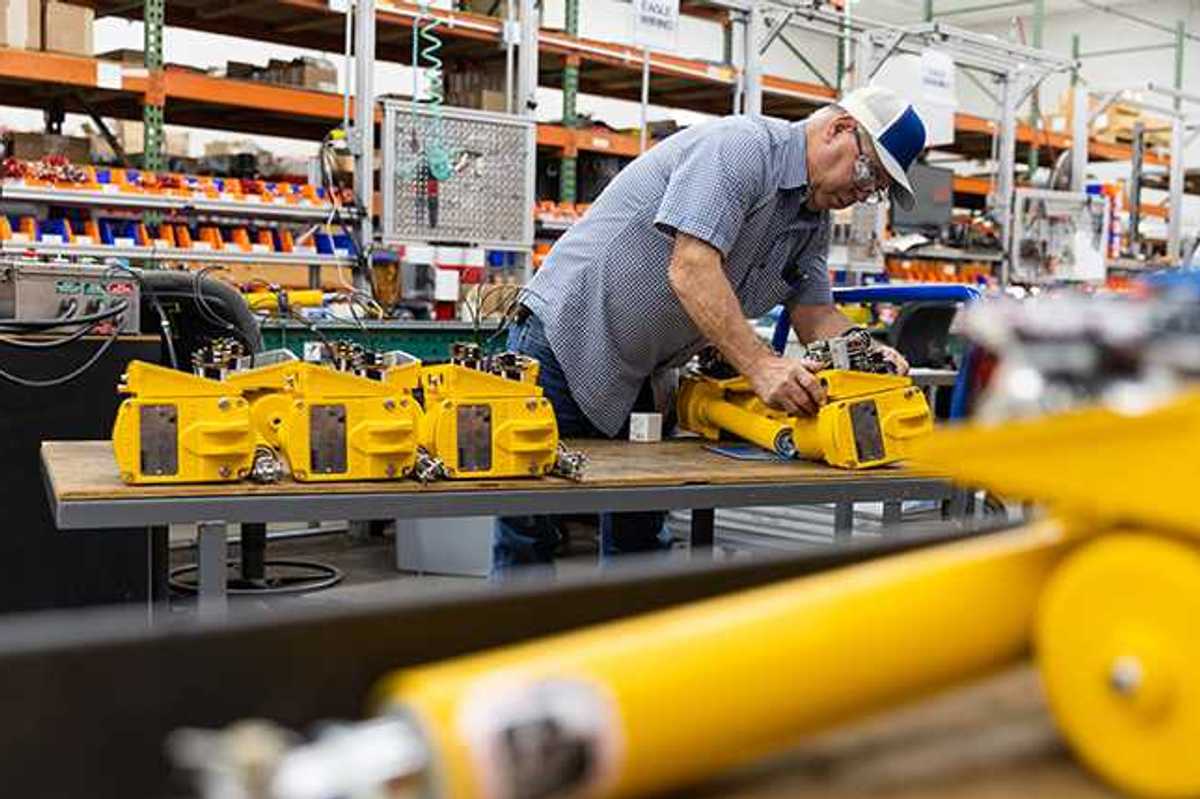
A 146-year-old Houston company is the first to land an investment from the Blackstone Energy Transition Partners V fund. Photo via dresserutility.com

Houston company lands first deal from new Blackstone energy transition fund

M&A activity

Asset manager Blackstone has agreed to buy Houston-based Dresser Utility Solutions from Connecticut private equity firm First Reserve for an undisclosed amount. First Reserve has a major presence in Houston.

The deal represents the first investment from Blackstone Energy Transition Partners V.

“Blackstone’s deep resources and experience in the utility sector make them an ideal partner as we continue to invest in innovation, expand our product portfolio, and deliver value for our customers,” Dresser CEO David Evans said in a news release.

Founded in 1880, Dresser provides metering technology, digital instrumentation and software, pressure and flow controls, and infrastructure repair products for gas and water utilities and industrial customers. The company employs about 850 people worldwide.

“As demands on the energy grid continue to grow, Dresser plays a critical role as a trusted partner to utilities managing essential infrastructure. The company’s products are foundational to the safe and reliable operation of gas and water networks, and its reputation for quality has helped build longstanding customer relationships,” David Foley, global head of Blackstone Energy Transition Partners, and JP Munfa, senior managing director, said in the release.

Blackstone Energy Transition Partners has invested more than $28 billion across the energy transition sector. New York-based Blackstone closed Blackstone Energy Transition Partners Fund IV at $5.6 billion in February 2025. Blackstone Energy Transition Partners Fund III closed in 2020 for $4.4 million, according to Pitchbook.

Other notable energy transition investments from Blackstone funds include Salt Lake City-based Energy Exemplar, French electronics manufacturing company Sediver, Plano-based Westwood Professional Services and others.

Two years ago, Dresser secured a $335 million credit facility from funds managed by asset manager Blue Owl Capital. At the time, Dresser said the money would go toward capital expenses, acquisitions and corporate needs.

This is the second notable investment Blackstone has made in a Houston-based energy company in recent months. In May, Blackstone and energy heavyweight Halliburton made a $1 billion equity investment in Houston power generation startup VoltaGrid, which provides behind-the-meter mobile power generation equipment for data centers, microgrids and industrial customers.

VoltaGrid has developed a modular power generation system that improves reliability and limits emissions. Photo via voltagrid.com

Houston startup lands $1B from Blackstone and Halliburton, plans acquisition

power deal

Houston-based power generation startup VoltaGrid has nailed down a $1 billion equity investment from asset management heavyweight Blackstone and Houston-based oilfield services provider Halliburton.

The investment comes in two forms:

  • A $775 million primary capital raise
  • A $225 million secondary capital purchase from existing investors

VoltaGrid, founded in 2020, provides behind-the-meter mobile power generation equipment for data centers, microgrids and industrial customers.

Aside from the $1 billion investment, VoltaGrid has agreed to buy Propell Energy Technology, a VoltaGrid supplier, for an undisclosed amount. Propell offers a natural gas power generation platform for AI data centers. VoltaGrid plans to add two manufacturing plants at Propell’s facilities in Granbury, a Dallas-Fort Worth suburb.

The investment and acquisition deals are expected to close in mid-2026.

Funds managed by Blackstone Tactical Opportunities are contributing to the $1 billion investment. William Nicholson, managing director of Blackstone, called VoltaGrid “a highly differentiated platform addressing one of the most important infrastructure needs of the AI era: reliable, rapidly deployable power. This investment is a strong example of Tac Opps’ focus on providing flexible, scaled capital to exceptional entrepreneurs and businesses operating in Blackstone’s highest-conviction investment themes.”

Nathan Ough, founder and CEO of VoltaGrid, said in a release that the Blackstone investment “is a powerful endorsement of the platform we have built and the role VoltaGrid is playing in delivering the energy infrastructure of the AI era.”

Last October, VoltaGrid and Halliburton said they had forged a partnership to supply power for data centers around the world, with the Middle East picked as the initial target. Two months later, the companies said they had arranged the manufacturing of 400 megawatts of natural gas power systems that’ll be delivered in 2028 to support new data centers in the Eastern Hemisphere.

Jeff Miller, president and CEO of Halliburton, said his company’s investment in VoltaGrid “reflects our shared focus on long-term solutions for the world’s most demanding power environments, and advances VoltaGrid’s ability to deliver reliable, distributed power at scale.”

Ad Placement 300x100
Ad Placement 300x600

CultureMap Emails are Awesome

Houston companies advance 200MW green ammonia plant in South Texas

coming soon

Two global companies with a major presence in Houston are teaming up on a green ammonia plant in Port of Victoria, Texas.

Topsoe, a Danish company with operations in Houston and Bayport, Texas, has been tapped to provide ammonia synthesis technology for the project being developed by First Ammonia, a New York-based company with offices in Houston and Denmark.

The flagship 200-megawatt plant will use renewable electricity to produce green hydrogen through electrolysis, which will then be combined with nitrogen from a nearby Air Liquide pipeline to make green ammonia, according to First Ammonia. It is expected to serve both U.S. and global markets.

According to First Ammonia, every 100,000 tons of electric ammonia produced avoids approximately 240,000 tons of CO2 emissions compared to fossil ammonia

The Topsoe technology used on site is designed to be able to increase production from 10 percent to 100 percent within 30 minutes, and decrease production at a similar rate, allowing the plant to respond to fluctuations from solar- or wind-based energy sources.

“Topsoe is the world leader in ammonia synthesis, and First Ammonia is delighted to continue our partnership with them in establishing a green ammonia industry in the US and around the world,” Joel Moser, CEO of First Ammonia, said in a news release.

Topsoe has previously signed on to supply its 100-megawatt solid oxide electrolyser (SOEC) to the First Ammonia project. However, the company announced in March that it did not extend the contract after multiple delays.

The First Ammonia project was originally expected to come online by 2027 and to produce 1.1 million tonnes of green ammonia. The project is now expected to reach financial before the end of 2026, with construction slated to begin in 2027 and commercial operations launching by 2029.

“As green ammonia projects move from ambition to execution, operational flexibility becomes increasingly important,” Yassir Ghiyati, chief commercial officer at Topsoe, added in a news release. “We’re proud to support First Ammonia with technology designed to enable efficient and reliable green ammonia production. We look forward to continuing to work with the First Ammonia team to help bring this important U.S project to life.”

NASA and Houston researcher tackle climate-driven water quality risks

water watch

Climate change means far more to public health than living with hotter days. Transformations in our weather are contributing to challenges in accessing safe drinking water in some communities.

One of the most dire situations is along the US–Mexico border. The National Aeronautics and Space Administration (NASA) is seeking to address that issue with its Water Quality Applications program. An 11-researcher project led by a UTHealth Houston School of Public Health faculty member has been selected to participate.

“Drinking water is one of the most fundamental public health protections, but producing safe drinking water involves a delicate balance,” Yun Hang, assistant professor of environmental and occupational health sciences, said in a news release. Her team’s proposal was one of 93 that were submitted for funding through NASA’s Research Opportunities in Space and Earth Sciences (ROSES)-2025 program.

This is the first time that NASA has worked with a team devoted to water quality applications. The group, which includes researchers from across the nation, will use satellite observations of Earth, as well as hydrologic modeling, to potentially anticipate and act on water quality conditions as they change. Challenges addressed over the course of the three-year program, which kicked off in June, might include problems with water quality due to climate variability and increased pressure on water resources.

Hang’s team will focus on a pair of borderlands: Paso del Norte and the Rio Grande Valley.

“Working closely with El Paso Water ensures that our research addresses real operational needs while helping utilities better prepare for climate-related water quality changes and continue providing safe drinking water to communities across the Texas border region,” Hang added in the release.

She and the team will use data gathered by NASA on both past and future Earth-observing missions, which will allow them to track environmental changes that may affect source water quality. Combined with past water treatment records and hydrologic models, the team will also utilize artificial intelligence to develop predictive tools that aim to stop issues before they become larger hurdles to water safety.

Another one of the project’s goals is to create visualization tools and source water summaries that can be utilized by those without scientific expertise. The tools will be produced in English and Spanish to further broaden their accessibility.

The hope is that the materials made by the team will also go far beyond the border, with protocols that can be adapted or adopted by other areas dealing with water quality issues.

---

This article originally appeared on our sister site, InnovationMap.com.

New research reveals what really drives data center location decisions

Guest Column

Recent power outages and the surge in AI-driven computing have made data center siting decisions more consequential than ever, especially as energy and water constraints tighten. Communities invest public dollars on the promise of jobs and growth, while firms weigh long-term commitments to land, power and connectivity.

Against that evolving backdrop, a critical question comes into focus: Where do data centers get built — and what actually drives those decisions?

A new study by Tommy Pan Fang (Rice Business) and Shane Greenstein (Harvard Business School) provides the first large-scale statistical analysis of data center location strategies across the United States. It offers policymakers and firms a clearer starting point for understanding how different types of data centers respond to economic and strategic incentives.

Published in the journal Strategy Science, the study examines two major types of infrastructure: third-party colocation centers that lease server space to multiple firms, and hyperscale cloud centers owned by providers like Amazon, Google and Microsoft.

Key takeaways:

  • Third-party colocation centers are physical facilities in close proximity to firms that use them, while cloud providers operate large data centers from a distance and sell access to virtualized computing resources as on‑demand services over the internet.
  • Hospitals and financial firms often require urban third-party centers for low latency and regulatory compliance, while batch processing and many AI workloads can operate more efficiently from lower-cost cloud hubs.
  • For policymakers trying to attract data centers, access to reliable power, water and high-capacity internet matter more than tax incentives.

What are the two main data center location strategies?

The study draws on pre-pandemic data from 2018 and 2019, a period of relative geographic stability in supply and demand. This window gives researchers a clean baseline before remote work, AI demand and new infrastructure pressures began reshaping internet traffic patterns.

The findings show that data centers follow a bifurcated geography:

  • Third-party centers cluster in dense urban markets, where buyers prioritize proximity to customers despite higher land and operating costs.
  • Cloud providers, by contrast, concentrate massive sites in a small number of lower-density regions, where electricity, land and construction are cheaper and economies of scale are easier to achieve.

Third-party data centers, in other words, follow demand. They locate in urban markets where firms in finance, healthcare and IT value low latency, secure storage, and compliance with regulatory standards.

Using county-level data, the researchers modeled how population density, industry mix and operating costs predict where new centers enter. Every U.S. metro with more than 700,000 residents had at least one third-party provider, while many mid-sized cities had none.

Map of data centers

This pattern challenges common assumptions. Third-party facilities are more distributed across urban America than prevailing narratives suggest.

“For industries where speed is everything, being too far from the physical infrastructure can meaningfully affect performance and risk,” Pan Fang says. “Proximity isn’t optional for sectors that can’t absorb delay.”

In critical operations, even slight pauses can have real consequences. For hospital systems, lag can affect performance and risk exposure. And in high-frequency trading, milliseconds can determine whether value is captured or lost in a transaction.

Why does distance matter for cloud data center costs?

For cloud providers, the picture looks very different. Their decisions follow a logic shaped primarily by cost and scale. Because cloud services can be delivered from afar, firms tend to build enormous sites in low-density regions where power is cheap and land is abundant.

These facilities can draw hundreds of megawatts of electricity and operate with far fewer employees than urban centers. “The cloud can serve almost anywhere,” Pan Fang says, “so location is a question of cost before geography.”

The study finds that cloud infrastructure clusters around network backbones and energy economics, not talent pools. Well-known hubs like Ashburn, Virginia — often called “Data Center Alley” — reflect this logic, having benefited from early network infrastructure that made them natural convergence points for digital traffic.

Local governments often try to lure data centers with tax incentives, betting they will create high-tech jobs. But the study suggests other factors matter more to cloud providers, including construction costs, network connectivity and access to reliable, affordable electricity.

When cloud centers need a local presence, distance can sometimes become a constraint. Providers often address this by working alongside third-party operators. “Third-party centers can complement cloud firms when they need a foothold closer to customers,” Pan Fang says.

That hybrid pattern — massive regional hubs complementing strategic colocation — may define the next phase of data center growth.

Looking ahead, shifts in remote work, climate resilience, energy prices and AI-driven computing may reshape where new facilities go. Some workloads may move closer to users, while others may consolidate into large rural hubs. Emerging data-sovereignty rules could also redirect investment beyond the United States.

“The cloud feels weightless,” Pan Fang says, “but it rests on real choices about land, power and proximity.”

---

This article originally appeared on Rice Business Wisdom. Written by Scott Pett. Pan Fang and Greenstein (2025). “Where the Cloud Rests: The Economic Geography of Data Centers,” Strategy Science.