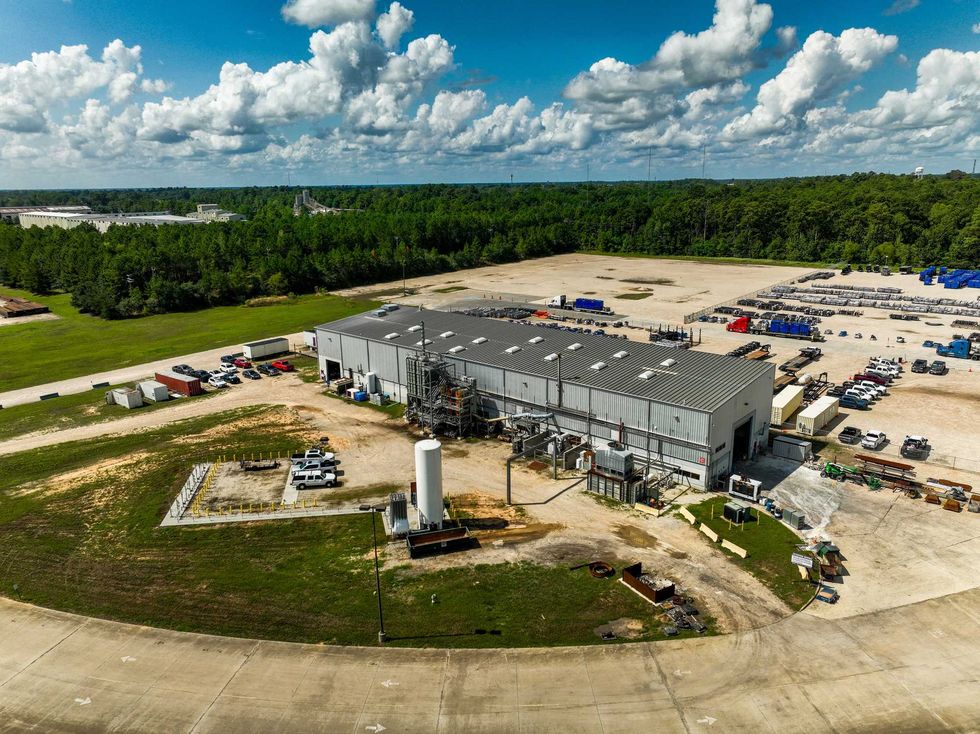
A new report shows the role Texas could play as the data-center sector enters "hyperdrive." Photo via JLL.com.

Everything’s bigger in Texas, they say—and that phrase now applies to the state’s growing data-center presence.

A new report from commercial real estate services provider JLL says Texas could overtake Northern Virginia as the world’s largest data-center market by 2030. Northern Virginia is a longtime holder of that title.

What’s driving Texas’ increasingly larger role in the data-center market? The key factor is artificial intelligence.

Companies like Google and Microsoft need more energy-hungry data centers to power AI innovations. In a 2023 article, Forbes explained that AI models consume a lot of energy because of the massive amount of data used to train them, as well as the complexity of those models and the rising volume of tasks assigned to AI.

“The data-center sector has officially entered hyperdrive,” Andy Cvengros, executive managing director at JLL and co-leader of its U.S. data-center business, said in the report. “Record-low vacancy sustained over two consecutive years provides compelling evidence against bubble concerns, especially when nearly all our massive construction pipeline is already pre-committed by investment-grade tenants.”

Dallas-Fort Worth has long dominated the Texas data-center market. But in recent years, West Texas has emerged as a popular territory for building data-center campuses, thanks in large part to an abundance of land and energy. Nearly two-thirds of data-center construction underway now is happening in “frontier markets” like West Texas, Ohio, Tennessee and Wisconsin, the JLL report says.

Northern Virginia, the current data-center champ in the U.S., boasted a data-center market with 6,315 megawatts of capacity at the end of 2025, the report says. That compares with 2,423 megawatts in Dallas-Fort Worth, 1,700 megawatts in the Austin-San Antonio corridor, 200 megawatts in West Texas, and 164 megawatts in Houston.

A new JLL report predicts that power will become the primary factor in selecting future data center sites, with renewables playing a major role. Photo courtesy JLL.

Renewables to play greater role in powering data centers, JLL says

Data analysis

Renewable energy is evolving as the primary energy source for large data centers, according to a new report.

The 2026 Global Data Center Outlook from commercial real estate services giant JLL points out that the pivot toward big data centers being powered by renewable energy stems from rising electricity costs and tightening carbon reduction requirements. In the data center sector, renewable energy, such as solar and wind power, is expected to outcompete fossil fuels on cost, the report says.

The JLL forecast carries implications for the Houston area’s tech and renewable energy sectors.

As of December, Texas was home to 413 data centers, second only to Virginia at 665, according to Visual Capitalist. Dozens more data centers are in the pipeline, with many of the new facilities slated for the Houston, Austin, Dallas-Fort Worth and San Antonio areas.

Amid Texas’ data center boom, several Houston companies are making inroads in the renewable energy market for data centers. For example, Houston-based low-carbon energy supplier ENGIE North America agreed last May to supply up to 300 megawatts of wind power for a Cipher Mining data center in West Texas.

The JLL report says power, not location or cost, will become the primary factor in selecting sites for data centers due to multi-year waits for grid connections.

“Energy infrastructure has emerged as the critical bottleneck constraining expansion [of data centers],” the report says. “Grid limitations now threaten to curtail growth trajectories, making behind-the-meter generation and integrated battery storage solutions essential pathways for sustainable scaling.”

Behind-the-meter generation refers to onsite energy systems such as microgrids, solar panels and solar battery storage. The report predicts global solar capacity will expand by roughly 100 gigawatts between 2026 and 2030 to more than 10,000 gigawatts.

“Solar will account for nearly half of global renewable energy capacity in 2026, and despite its intermittent properties, solar will remain a key source of sustainable energy for the data center sector for years to come,” the report says.

Thanks to cost and sustainability benefits, solar-plus-storage will become a key element of energy strategies for data centers by 2030, according to the report.

“While some of this energy harvesting will be colocated with data center facilities, much of the energy infrastructure will be installed offsite,” the report says.

Other findings of the report include:

  • AI could represent half of data center workloads by 2030, up from a quarter in 2025.
  • The current five-year “supercycle” of data center infrastructure development may result in global investments of up to $3 trillion by 2030.
  • Nearly 100 gigawatts worth of new data centers will be added between 2026 and 2030, doubling global capacity.

“We’re witnessing the most significant transformation in data center infrastructure since the original cloud migration,” says Matt Landek, who leads JLL’s data center division. “The sheer scale of demand is extraordinary.”

Hyperscalers, which operate massive data centers, are allocating $1 trillion for data center spending between 2024 and 2026, Landek notes, “while supply constraints and four-year grid connection delays are creating a perfect storm that’s fundamentally reshaping how we approach development, energy sourcing, and market strategy.”

Two new data center projects are coming to the ERCOT South Zone. Photo via Getty Images.

Houston energy firm to develop data center projects in Matagorda County

data center developments

Houston-based Barrio Energy will develop two new projects for 10-megawatt data center sites in Matagorda County.

Located in the ERCOT South Zone, the projects will assist in powering advanced computing operations, modular data centers and cryptocurrency mining, according to a news release.

Barrio Energy is a provider of energy infrastructure solutions for computing and data centers, and its new locations will build on its existing Texas sites in Monahans, George West, Lolita and Tyler. The Tyler location, a 12-megawatt data center connected to the ERCOT grid, opened in 2024.

“The ERCOT South Zone’s strong infrastructure and access to abundant power make it an optimal location for next-generation computing,” Ivan Pinney, CEO of Barrio Energy, said in a news release. “These developments expand our portfolio and contribute to local economic growth through job creation and technological innovation.”

Operations at the first of the two sites are expected to commence in Q4 2025, with the second site following in Q1 2026.

“We are excited to advance these two high-potential 10MW sites in Matagorda County, which perfectly align with our mission to provide scalable, efficient energy solutions for our clients,” Pinney added in the release.

Ad Placement 300x100
Ad Placement 300x600

CultureMap Emails are Awesome

How this Houston expert helps startups turn AI hype into real impact

now streaming

Artificial intelligence is now everywhere. It is mentioned in every startup pitch deck, and every corporate roadmap claims to use it. However, many early-stage businesses struggle with the simple question, “What does AI actually mean for my business?”

In a recent podcast episode of EnergyTech Startups, Merab Momen, founder of AI CTO Services and a long time AI practitioner, explains why most founders misunderstand AI, how startups can practically apply it and why Houston is quietly becoming a serious hub for AI-driven innovation.

Filling the AI Leadership Gap

Merab’s career has spanned decades of technology transitions. He worked on neutral networks in the 1990s, constructed computer vision systems long before they were common, and helped install AI solutions inside huge industrial companies. However, he noticed a huge problem when generative AI started to explode into the mainstream-The requirement of a real partner by the founders for AI integration but inability to rely on a full-time CTO and project-based consultants.

“I really needed something which is much more engaging where I can give that partner-level advice to the founders,” he said. By giving firms on-demand access to high-level AI knowledge and expertise, his methodology enables them to analyse tools, steer clear of cost blunders and eventually transition to a permanent technology leader when the time is right.

AI is Older than Most People Think

Despite its recent rise in popularity, AI is nothing new. AI actually began in the 1950s. Merab in his conversation explained how he worked on his first AI project back in the year 1996 that worked perfectly, but the processing power wasn’t just there to make it practical. He continued how he utilized the swarm intelligence models to optimize supply chains, now referred to as MLPOs and data engineering.

From Language Models to Physical World

Much of the public conversation about AI revolves around chatbots and text generation. But Merab sees far greater potential in AI’s interaction with the physical world, especially in industrial settings. He emphasized edge computing and vision language models (VLMs) as significant advances in manufacturing and energy. This physical shift is opening doors for new opportunities for robotics, automated inspections, and industrial safety applications. Merab added that Houston is uniquely positioned for this transition.

Why Houston has an AI Advantage

Silicon Valley may dominate the AI headlines, but Merab believes Houston’s advantage lies beneath the surface. The city doesn’t lag in AI utilization; it just operates in industries where results show differently.

Machine learning isn’t new to Houston’s core industries. Energy companies, manufacturers, logistics providers, and healthcare systems have been using advanced analytics for decades. The difference lies in them innovating in industrial sectors rather than consumer technology.

What’s Next

With the AI CTO Services growing, Merab is working with startups across industries to deploy AI in practical, business-first ways.

He is more interested in assisting founders in finding answers to critical issues than following new trends.

For Houston’s energy and climate tech community, it needs to transform AI enthusiasm into real-world impact.

Listen to the full conversation with Mehrab Momin on the Energy Tech Startups Podcast to learn more.

---

Energy Tech Startups Podcast is hosted by Jason Ethier and Nada Ahmed. It delves into Houston's pivotal role in the energy transition, spotlighting entrepreneurs and industry leaders shaping a low-carbon future.


Houston company tapped to run renewables project with Meta power agreement

power deal

Houston-based Consolidated Asset Management Services (CAMS) has been selected to operate Plano-based Nexus Renewable Power's major renewables development, known as Project Goody.

CAMS will provide comprehensive asset management, operations, maintenance, regulatory compliance and remote operations services for the $220 million solar and battery storage project located in Lamar County, Texas, northeast of Dallas.

“The project underscores CAMS’ commitment to supporting dependable, grid-strengthening energy infrastructure across the United States,” Brian Ivany, EVP of CAMS Renewables, said in a news release. “Our team is proud to support Nexus and excited to apply our subject matter expertise and hands-on approach to ensure operational excellence and long-term success of the Goody project.”

Project Goody, or MRG Goody Solar and Storage, will feature a 172-megawatt solar facility paired with 237 megawatts of battery energy storage. The project will be connected to the ERCOT grid. Meta, the parent company of Facebook, has signed on as the power offtaker for the project.

Nexus Renewable Power develops, finances and operates solar and energy storage assets. It currently operates projects generating 325 megawatts of solar and 350 megawatts of battery storage, with another 300 megawatts of solar and 1 gigawatt of battery storage projects under construction, according to its website. Project Goody is the first in a series of renewable developments underway, according to Nexus.

CAMS manages and operates energy infrastructure assets for its clients. Last year, it added InfraRed Capital Partners, which owns the 202-megawatt Mesteño Wind Project in the Rio Grande Valley, to its customer list. It also rolled out services to help deliver power to meet the growing demand from AI data centers.

Houston-area solar farm to move forward with $394M in construction financing

solar funding

Project SunRope, a 347-megawatt solar project outside of Houston, has landed $394 million in construction financing.

The project, located in Wharton County, about 60 miles outside of Houston, is slated to begin commercial operation in Q3 2027 and aims to support emission reductions, grid reliability and affordability in one of the highest electricity-demand regions in Texas and the U.S. It’s being developed through a joint venture between San Antonio-based OCI Energy and leading Israeli solar company Arava Power. New York-based ING Capital underwrote the financing package.

“The close of construction financing for Project SunRoper represents an important milestone for OCI Energy and our partners,” Sabah Bayatli, resident of OCI Energy, said in a news release. “This transaction reflects our continued commitment to deliver high-quality, utility-scale solar projects that strengthen grid reliability and provide affordable energy infrastructure.”

The construction financing is supported by a 20-year power purchase agreement with a Fortune 100 company, according to the release. Other collaborators include BHI and Bank of Hapoalim, which provided financing support and letters of credit to support the development of the project.

This is the second transaction between OCI Energy and ING, as they previously worked together on financing for the Alamo City Battery Energy Storage System, a 120-megawatt battery energy storage system under development in Bexar County.

“This project exemplifies the high‑quality renewable infrastructure we seek to finance – a strong sponsor partnership, a long‑term contracted revenue profile, and a well‑located asset in one of the most dynamic power markets in the United States,” Sven Wellock, managing director at ING, added in the release. “We are proud to build on our existing relationship with OCI Energy and to partner with Arava Power on its continued expansion in the U.S. market, advancing a project that will deliver reliable, affordable clean energy for years to come.”

OCI Energy operates several utility-scale solar and battery energy storage system projects outside of the San Antonio area, as well as in Georgia and New Jersey. It has five other projects under construction outside of San Antonio and Waco, with more than 20 under development throughout the state.