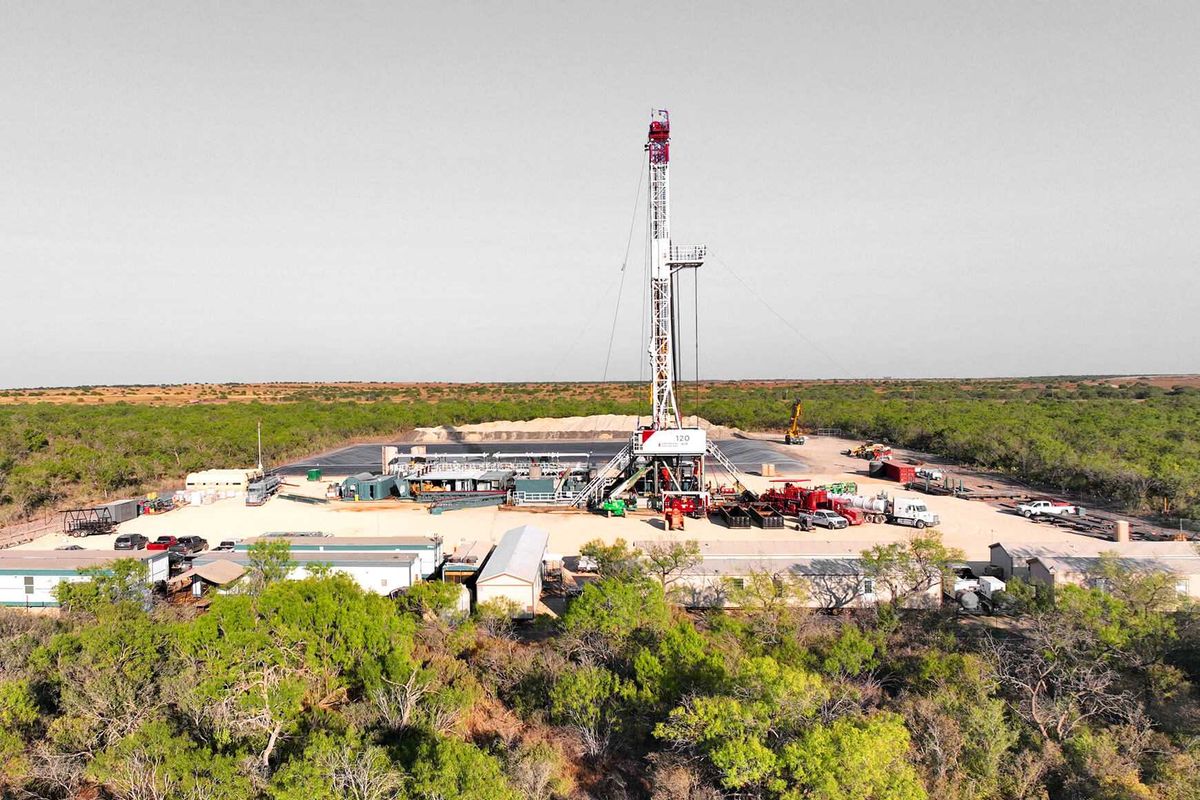
XGS Energy plans to “aggressively expand” its team in Houston this year thanks to its latest round of investments. Photo via Getty Images

XGS Energy, a California-headquartered geothermal power company with a major presence in Houston, has closed $13 million in new financing that included new investors Aligned Climate Capital, ClearSky, ClimateIC and WovenEarth Ventures, in addition to inside investors.

The company plans to “aggressively expand” its team in Houston this year, according to a news release.

“We are facing global energy supply challenges of unprecedented scale and urgency,” Kevin Kimsa, Managing Partner at ClimateIC, said in the release. “The XGS team is uniquely primed to meet the moment, bringing together innovative technology and leading engineering talent with the deep experience in infrastructure development and financing critical to deploying large-scale energy systems at speed.”

As part of the financing deal, Mano Nazar, ClearSky Senior Advisor and the former Chief Nuclear Officer of NextEra Energy, will join the XGS Energy Board of Directors.

“XGS’s advanced geothermal technology is uniquely positioned to deliver abundant energy to the grid faster than any other baseload energy technology at a time of unprecedented demand for energy resources,” Nazar said in a news release. “We are excited to partner with XGS to deliver on their mission of sustainable, reliable, and scalable geothermal energy.”

XGS is known for its next-gen closed-loop geothermal well architecture. The company saw massive growth in the Houston market last year and recently completed a 100-meter field demonstration in central Texas. The new funding supports the XGS’s multi-gigawatt project pipeline.

The recent financing also builds on an oversubscribed Series A round led by Constellation Technology Ventures, VoLo Earth Ventures, and Valo Ventures that closed last year.

Ad Placement 300x100
Ad Placement 300x600

CultureMap Emails are Awesome

Chevron CEO touts biofuels as part of its renewable energy efforts

Betting on biofuels

As Chevron Chairman and CEO Mike Wirth surveys the renewable energy landscape, he sees the most potential in biofuels.

At a recent WSJ CEO Council event, Wirth put a particular emphasis on biofuels—the most established form of renewable energy—among the mix of low-carbon energy sources. According to Biofuels International, Chevron operates nine biorefineries around the world.

Biofuels are made from fats and oils, such as canola oil, soybean oil and used cooking oil.

At Chevron’s renewable diesel plant in Geismar, Louisiana, a recent expansion boosted annual production by 278 percent — from 90 million gallons to 340 million gallons. To drive innovation in the low-carbon-fuels sector, Chevron opened a technology center this summer at its renewable energy campus in Ames, Iowa.

Across the board, Chevron has earmarked $8 billion to advance its low-carbon business by 2028.

In addition to biofuels, Chevron’s low-carbon strategy includes hydrogen, although Wirth said hydrogen “is proving to be very difficult” because “you’re fighting the laws of thermodynamics.”

Nonetheless, Chevron is heavily invested in the hydrogen market:

As for geothermal energy, Wirth said it shows “some real promise.” Chevron’s plans for this segment of the renewable energy industry include a 20-megawatt geothermal pilot project in Northern California, according to the California Community Choice Association. The project is part of an initiative that aims to eventually produce 600 megawatts of geothermal energy.

What about solar and wind power?

“We start with things where we have some reason to believe we can create shareholder value, where we’ve got skills and competency, so we didn’t go into wind or solar because we’re not a turbine manufacturer installing wind and solar,” he said in remarks reported by The Wall Street Journal.

In a September interview with The New York Times, Wirth touched on Chevron’s green energy capabilities.

“We are investing in new technologies, like hydrogen, carbon capture and storage, lithium and renewable fuels,” Wirth said. “They are growing fast but off a very small base. We need to do things that meet demand as it exists and then evolve as demand evolves.”

Houston robotics company partners with Marathon Petroleum to scale fleet

robot alliance

Houston- and Boston-based Square Robot Inc. has announced a partnership with downstream and midstream energy giant Marathon Petroleum Corp. (NYSE: MPC).

The partnership comes with an undisclosed amount of funding from Marathon, which Square Robot says will help "shape the design and development" of its submersible robotics platform and scale its fleet for nationwide tank inspections.

“Marathon’s partnership marks a major milestone in our mission to transform industrial tank inspection,” David Lamont, CEO of Square Robot, said in a news release. “They recognize the proven value of our robotic inspections—eliminating confined space entry, reducing the environmental impact, and delivering major cost efficiencies all while keeping tanks on-line and working. We’re excited to work together with such a great company to expand inspection capabilities and accelerate innovation across the industry.”

The company closed a $13 million series B last year. At the time of closing, Square Robot said it would put the funding toward international expansion in Europe and the Middle East.

Square Robot develops autonomous, submersible robots that are used for storage tank inspections and eliminate the need for humans to enter dangerous and toxic environments. Its newest tank inspection robot, known as the SR-3HT, became commercially available and certified to operate at a broader temperature range than previous models in the company's portfolio this fall.

The company was first founded in the Boston area in 2016 and launched its Houston office in 2019.