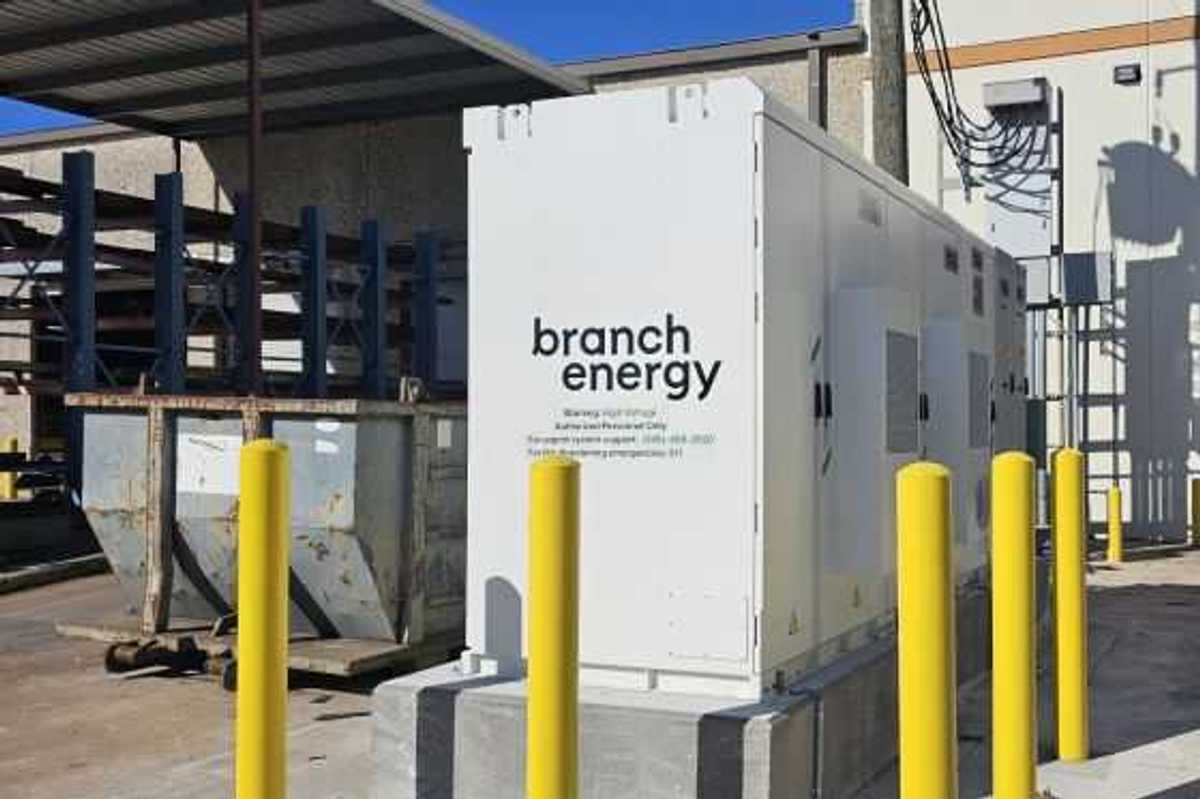
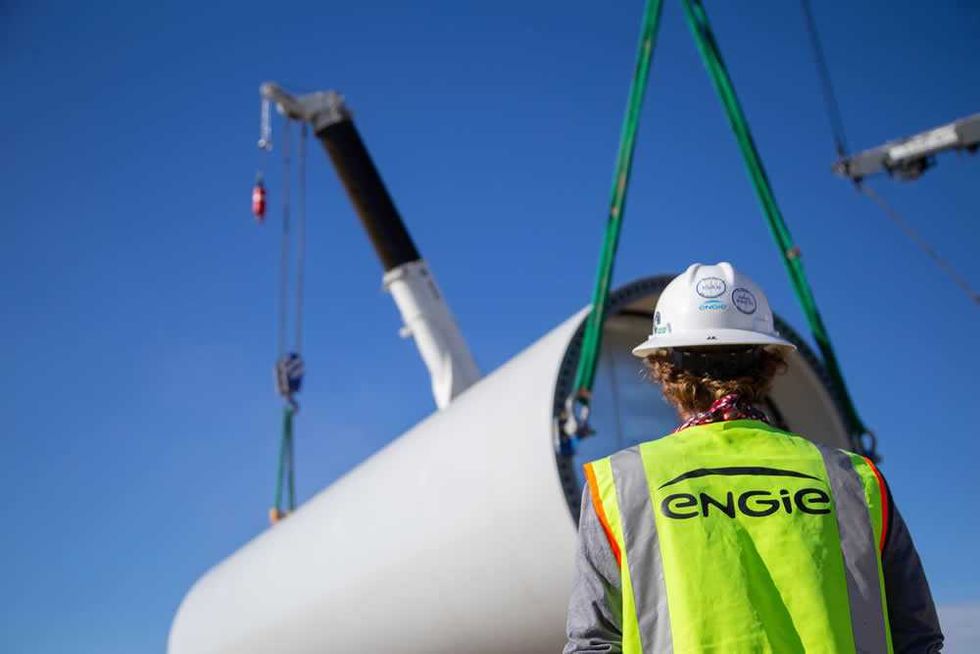
Utility Global’s H2Gen technology aims to decarbonize the heavy industrial sector. Photo courtesy of Utility Global

Houston-based Utility Global has raised $100 million in an ongoing Series D round to globally deploy its decarbonization technology at an industrial scale.

The round was led by Ara Partners and APG Asset, according to a news release. Utility plans to use the funding to expand manufacturing, grow its teams and support its commercial developments and partnerships.

“This financing marks a critical step in Utility’s transition from a proven technology to full-scale global commercial execution,” Parker Meeks, CEO and president of Utility Global, said in the release. “Industrial customers are no longer looking for pilots or promises; they need deployable solutions that work within existing assets and deliver true economic industrial decarbonization today that is operationally reliable and highly scalable. Utility’s technology produces both economic clean hydrogen and capture-ready CO2 streams, and this capital enables us to scale and deploy that impact globally with speed, discipline, and rigor.”

Utility Global's H2Gen technology produces low-cost, clean hydrogen from water and industrial off-gases without requiring electricity. It's designed to integrate into existing industrial infrastructure in hard-to-abate assets in the steel, refining, petrochemical, chemical, low-carbon fuels, and upstream oil and gas sectors.

“Utility is tackling one of the most difficult challenges in the energy transition: decarbonizing hard‑to‑abate industrial sectors,” Cory Steffek, partner at Ara Partners and Utility Global board chair, said in the release. “What sets Utility apart is its ability to compete head‑to‑head with conventional fossil‑based solutions on cost and reliability, even as it materially reduces emissions. With this new funding, Utility is well-positioned for its next chapter of commercial growth while maintaining the technical excellence and capital discipline that have defined its development to date.”

Utility Global reached several major milestones in 2025. After closing a $53 million Series C, the company agreed to develop at least one decarbonization facility at an ArcelorMittal steel plant in Brazil. It also signed a strategic partnership with California-based Kyocera International Inc. to scale global manufacturing of its H2Gen electrochemical cells.

The company also partnered with Maas Energy Works, another California company, to develop a commercial project integrating Maas’ dairy biogas systems with H2Gen to produce economical, clean hydrogen.

"These projects were never intended to stand alone. They anchor a deep and growing pipeline of commercial projects now in development globally across steel, refining, chemicals, biogas and other hard-to-abate sectors worldwide, Meeks shared in a 2025 year-in-review note. He added that 2026 would be a year of "focused acceleration to scale."

Ad Placement 300x100
Ad Placement 300x600

CultureMap Emails are Awesome

Houston cleantech startup seeks $200M for superhot geothermal plant

seeing green

Houston-based Quaise Energy is looking to raise $200 million to support the development of a 50-megawatt superhot geothermal plant in Oregon.

The company is seeking $100 million in Series B funding, plus an additional $100 million from grants, debt and project-level finance, a representative from the company tells Energy Capital. Axios first reported the news late last month.

Quaise specializes in terawatt-scale geothermal power. It is known for its millimeter-wave drilling technology, which was developed at MIT.

The company's Project Obsidian development in central Oregon will combine conventional drilling with its millimeter-wave technology. Quaise says the project, targeted to come online in 2030, could be the first commercial plant to operate in superhot rock, a more efficient and abundant resource, but one that requires more advanced and durable drilling technology.

Quaise says Obsidian would initially generate 50 megawatts of "always-on" power and would be designed to add 200 megawatts as additional wells are developed. A power-purchase deal has already been signed for the initial 50 megawatts with an undisclosed customer.

A representative from the company says Quaise would also use the funding to continue advancing its millimeter-wave technology and prepare it for commercialization.

Last year, the company drilled to a depth of about 330 feet using its millimeter-wave technology at its field site in Central Texas.

“Our progress this year has exceeded all expectations,” Carlos Araque, CEO and president of Quaise Energy, said at the time. “We’re drilling faster and deeper at this point than anyone believed possible, proving that millimeter-wave technology is the only tool capable of reaching the superhot rock needed for next-generation geothermal power. We are opening up a path to a new energy frontier.”

Canary Media reports that Quaise plans to drill to nearly 3,300 feet later this year and to deploy its millimeter-wave technology at its power plant in 2027.

Quaise raised $21 million in a Series A1 financing round in 2024 and a $52 million Series A in 2022. Major investors include Prelude Ventures, Safar Partners, Mitsubishi Corporation, Nabors Industries, TechEnergy and others.

Quaise was one of eight Houston-area companies to appear on Time magazine and Statista’s list of America’s Top GreenTech Companies of 2025.

Houston positioned to lead in Carbon Capture Utilization (CCU), study shows

The View From HETI

With global demand for energy production while lowering emissions continues to grow, Houston and the Gulf Coast region are uniquely positioned to lead with carbon capture, utilization and sequestration (CCUS). A new study developed by the Houston Energy Transition Initiative (HETI) in collaboration with Deloitte Consulting explores how the region can transform captured CO₂ into valuable products while supporting continued economic growth and industrial competitiveness.

Key takeaways from the report include:

Houston and the Gulf Coast are uniquely advantaged to utilize and store carbon.As a global hub for chemicals and refining industries, Houston has access to world-class infrastructure, a skilled workforce, and access to global markets. The region also has one of the nation’s highest concentrations of industrial CO2 and creates the opportunity to capture waste material streams to deliver lower carbon intensity products that continue to deliver economic benefits to the region.

While carbon capture and sequestration (CCS) projects continue to advance, CCU requires coordinated action across policy, infrastructure, technology and market demand to scale successfully. Utilization and sequestration are complementary strategies that support and protect investment deployments. CCS acts as an early foundation while markets and infrastructure evolve toward broader CO₂ utilization, and CCU is essential to developing low-carbon-intensity value chains and products.

“Our collaboration with Deloitte highlights how Houston and the Gulf Coast continue to build on the strengths that have long made our region an energy leader. Houston’s infrastructure, workforce, and industrial ecosystem uniquely position the region to scale CCU,” said Jane Stricker, Senior Vice President, Energy Transition, and Executive Director of HETI. “With supportive policy, continued innovation, and strong industry partnerships, we can accelerate CCU deployment, create new low-carbon value chains, and ensure Houston remains at the forefront of the global energy transition.”

Download the full report here.

———

This article originally appeared on the Greater Houston Partnership's Houston Energy Transition Initiative blog. HETI exists to support Houston's future as an energy leader. For more information about the Houston Energy Transition Initiative, EnergyCapitalHTX's presenting sponsor, visit htxenergytransition.org.

Houston startup raises $6M to grow AI platform for solar, battery contractors

fresh funding

Houston tech startup Artemis has raised $6 million from 10 investors. The company offers an AI-supported platform that enables solar, battery storage and home improvement contractors to design, sell and finance energy projects.

Long Journey and Copec WIND Ventures co-led the round, with participation from angel investor Scott Banister, Coalition Operators, FJ Labs, Ludlow Ventures, Palm Tree Crew, Plug and Play Ventures, Shrug Capital and Tribeca Ventures.

To help propel growth, the company secured $10 million in financing last year (under its previous name, Monalee) from venture debt and growth credit provider Applied Real Intelligence. As Monalee, the company raised $16 million in venture capital.

The company was founded in 2022 as an installer of solar and battery storage projects. Five years later, the startup used in-house technology to establish its standalone software platform as it began pivoting away from installation. The company recently adopted the Artemis brand name.

Artemis says its platform saves time and money for installers of residential solar, battery storage, and energy projects. The platform combines an AI-powered design tool with embedded financing capabilities and compliance automation to create a single operating system.

The company says its customers report as much as a 72 percent reduction in software costs and up to 98 percent faster turnaround times. Thus far, more than 100 installers are using Artemis’ technology.

“Installers shouldn’t need six tools and a week of back-and-forth to sell a project," Walid Halty, co-founder and CEO of Artemis, said in a press release. “This funding gives us the fuel to scale our mission to compress design, financing, and compliance into a single flow so every installer can operate like a modern energy company. We’re not just speeding up deals, we're modernizing how distributed energy gets built.”

The Artemis platform, now available in the U.S. and soon to be launched in Latin America, caters to home improvement contractors, solar companies, lenders, and utilities.

“Artemis is transforming the complexity of distributed energy into elegant simplicity," added Arielle Zuckerberg, general partner at Long Journey.