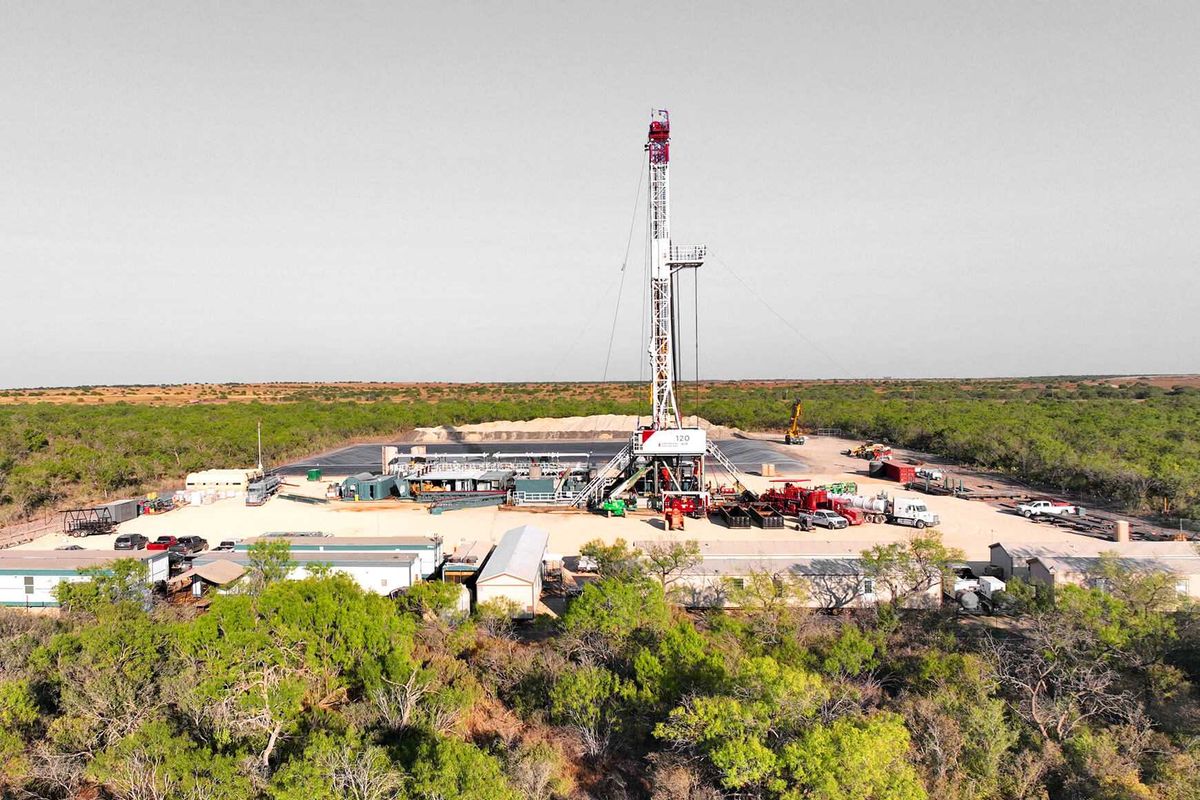
A new report predicts that Texas will be home to 30 percent of the U.S. data center market by 2028. Photo via Chevron.com

Data centers are proving to be a massive economic force in Texas.

For instance, a new report from clean energy company Bloom Energy predicts Texas will see a 142 percent increase in its market share for data centers from 2025 to 2028. That would be the highest increase of any state.

Bloom Energy expects Texas to exceed 40 gigawatts of data-center capacity by 2028, representing a nearly 30 percent share of the U.S. market. A typical AI data center consumes 1 to 2 gigawatts of energy.

“Data center and AI factory developers can’t afford delays,” Natalie Sunderland, Bloom Energy’s chief marketing officer, said in the report. “Our analysis and survey results show that they’re moving into power‑advantaged regions where capacity can be secured faster — and increasingly designing campuses to operate independently of the grid.”

“The surge in AI demand creates a clear opportunity for states that can adapt to support large-scale AI deployments at speed,” Sunderland adds.

Further evidence of the data center explosion in Texas comes from ConstructConnect, a provider of data and software for contractors and manufacturers. ConstructConnect reported that in the 12-month span through November 2025, data-center construction starts in Texas accounted for $11 billion in spending. At $12.5 billion, only Louisiana surpassed the Texas total.

Capital expenses for U.S. data centers were expected to surpass $425 billion last year, according to ratings agency S&P Global.

ConstructConnect also reports that Texas is among five states collectively grabbing 80 percent of potential data center construction starts. Currently, Texas hosts around 400 data centers, with close to 60 of them in the Houston market.

A large pool of data-center construction spending in Texas is flowing from Google, which announced in November that it would earmark $40 billion for new AI data centers in the state.

“Texas leads in AI and tech innovation,” Gov. Greg Abbott proclaimed when the Google investment was unveiled.

Other studies and reports lay out just how much data centers are influencing economic growth in the Lone Star State:

  • A study by Texas Royalty Brokers indicates Texas leads the U.S. with 17 clusters of AI data centers. The study measured the density of AI data centers by counting the number of graphics processing units (GPUs) installed in those clusters. GPUs are specialized chips built to run AI models and perform complex calculations.
  • Citing data from construction consulting company FMI, The Wall Street Journal reported that spending on construction of data centers is expected to rise 23 percent in 2026 compared with last year. Much of that construction spending will happen in Texas. In the 12 months through November 2025, the average data center cost $597 million, according to ConstructConnect.
  • Data published in 2025 by commercial real estate services company Cushman & Wakefield shows three Texas markets — Austin, Dallas and San Antonio — boast the lowest construction costs for data centers among the 19 U.S. markets that were analyzed. The mid-range of costs in that trio of markets is roughly $10.65 million per megawatt. Houston isn’t included in the data.

Although Houston isn’t cited in the Cushman & Wakefield data, it nonetheless is playing a major role in the data-center boom. Houston-area energy giants Chevron and ExxonMobil are chasing opportunities to supply natural gas as a power source for data centers, for example.

“As Houston rapidly evolves into a hub for AI, cloud computing, and data infrastructure, the city is experiencing a surge in data-center investments driven by its unique position at the intersection of energy, technology, and innovation,” says the Greater Houston Partnership.
Ad Placement 300x100
Ad Placement 300x600

CultureMap Emails are Awesome

Houston startup nets new funding to accelerate methane leak detection

fresh funding

Houston climatech startup Aquanta Vision has secured pre-seed funding to accelerate the commercialization of its methane leak detection software.

EIC Rose Rock participated in the round, joining investors like Marathon Petroleum Corporation, Chevron Technology Ventures, Ecosphere Ventures, and Odyssey Energy Advisors. The investment follows successful field trials for Aquanta Vision’s optical gas imaging (OGI) detection software, according to the company.

“This investment highlights our shared excitement as our patented novel technology improves detection levels for OGI camera operators,” Babur Ozden, Aquanta Vision’s CEO and founder, said in a news release. “The funding from EIC Rose Rock enables us to strategically accelerate this impact.”

Aquanta Vision’s OGI technology features an automated detection layer through an add-on app that improves methane detectability without requiring new hardware. It installs in minutes, runs locally and provides real-time, in-flight plume visualization for inspections with drone-mounted and handheld cameras.

“We are excited to partner with Aquanta Vision to scale and deploy this world-class technology that enables the energy industry to continue to deliver the secure, reliable and affordable energy that drives the American economy,” David Clouse, managing director of the EIC Rose Rock fund, added in the news release.

The company has partnered with Teledyne Flir and Sierra Olympia, makers of one of the world’s largest deployed fleet of handheld and drone-mounted optical gas imaging cameras used in industrial inspections. AquantaVision is now working with Teledyne Flir’s product team, as well as Sierra Olympia and its OEM partners.

Aquanta Vision has estimated that methane leaks cost the U.S. energy industry billions of dollars each year, with 60 percent of leaks going undetected, and methane leaks accounting for around 10 percent of natural gas's contribution to climate change, according to MIT’s climate portal.

Houston trio lands on Time’s list of 10 most influential energy companies

making an impact

Three companies with headquarters in Houston made Time magazine’s new list of the 10 most influential energy companies.

The unranked list includes:

  • Houston-based oil and gas giant Chevron
  • Houston-based Fervo Energy, a geothermal power provider that just went public in a $1.9 billion IPO
  • Saudi Aramco, the world’s largest oil company, whose U.S. headquarters is in Houston

In naming Chevron to the list, Time cites the company’s standing as the only major American oil company operating in Venezuela. Time says Chevron wields “extraordinary power” over Venezuela’s massive oil reserves.

Despite pressure from the White House on U.S. oil and gas producers to ramp up investments in Venezuela, “Chevron has pumped the brakes, pledging to boost output gradually and not chase price fluctuations,” Time says.

“Chevron has been in Venezuela for over a century,” CEO Mike Wirth told shareholders in January. “We remain committed to leveraging our deep expertise and long-standing partnerships for the benefit of our shareholders and the people of Venezuela.”

Time points out that Fervo sits “at the front of the pack” in generation of geothermal energy. The Houston-based company uses fracking techniques borrowed from the oil and gas industry to create underground hot-rock reservoirs that heat water to generate electricity.

Fervo’s Cape Station in Utah is scheduled to start delivering power to the grid this year. At full capacity of 500 megawatts, it will be the first large-scale commercial geothermal plant in the U.S. Time says another site in Utah, Project Blanford, is Fervo’s hottest well yet, highlighting the potential for harnessing geothermal heat for at-scale clean energy.

“It’s hard to find something that can [deliver] reliable 24/7 energy, that’s carbon-free, and can be constructed in a timely manner,” Fervo CEO Tim Latimer said. “It’s energy without a lot of the compromises.”

Government-owned Saudi Aramco, which last year earned $104.7 billion in profit, not only is a dominant player in the Mideast oil and gas sector, but Time says it holds “global clout in politics and business” that reaches far beyond oilfields. For example, the company finances big projects spearheaded by Crown Prince Mohammad Bin Salman, who chairs Saudi Arabia’s sovereign wealth fund. These include initiatives in global sports, tourism, and AI.

Baker Hughes teams up with Oklahoma co. to advance geothermal development

geothermal partnership

In recent months, Houston-based energy corporation Baker Hughes has launched multiple partnerships to expand geothermal energy extraction across the United States. The latest, a deal with Oklahoma-based Helmerich & Payne Inc. (H&P), was announced Wednesday.

As part of the deal, H&P will provide a geothermal-capable land drilling rig, while Baker Hughes will contribute technology and expertise. The rig is expected to be deployed later this year, according to a news release.

“Geothermal energy plays a critical role in meeting growing power demand by providing clean, reliable baseload generation,” Amerino Gatti, executive vice president of oilfield services & equipment for Baker Hughes, said in the release. “This collaboration reflects a deliberate step to move its development in the U.S. from concept to reality. By working together, Baker Hughes and Helmerich & Payne are helping customers advance these critical energy projects with greater confidence and deliver reliable, sustainable power.”

Investment in the geothermal energy sector is currently exploding in the U.S., having grown by at least 1,000 percent just in the last seven years, according to a recent report by Rocky Mountain Institute.

On one hand, only about 1 percent of the American energy grid currently uses geothermal, but on the other, the U.S. holds roughly 25 percent of the world’s geothermal capacity. Harnessing that power becomes even more attractive as conflicts in Russia and Iran continue to hamstring energy markets from those countries and revitalize interest in renewable energy.

Baker Hughes has been at the forefront of the geothermal boom. This new deal with H&P combines H&P’s drilling platform technology with Baker Hughes’s subsurface and energy extraction support technologies.

“This agreement underscores Helmerich & Payne’s commitment to supporting emerging energy opportunities through our drilling technologies and operational expertise,” H&P President and CEO Trey Adams added in the release. “We are pleased to collaborate with Baker Hughes to support the advancement of geothermal development in the United States.”

The deal with H&P is just one of several recent ones Baker Hughes has closed. In March, they announced support for XGS’s geothermal extraction projects in New Mexico, which are being used to meet the increasing demands of data centers in the state. Last May, Fervo Energy selected Baker Hughes to supply equipment for its flagship geothermal project in Utah.