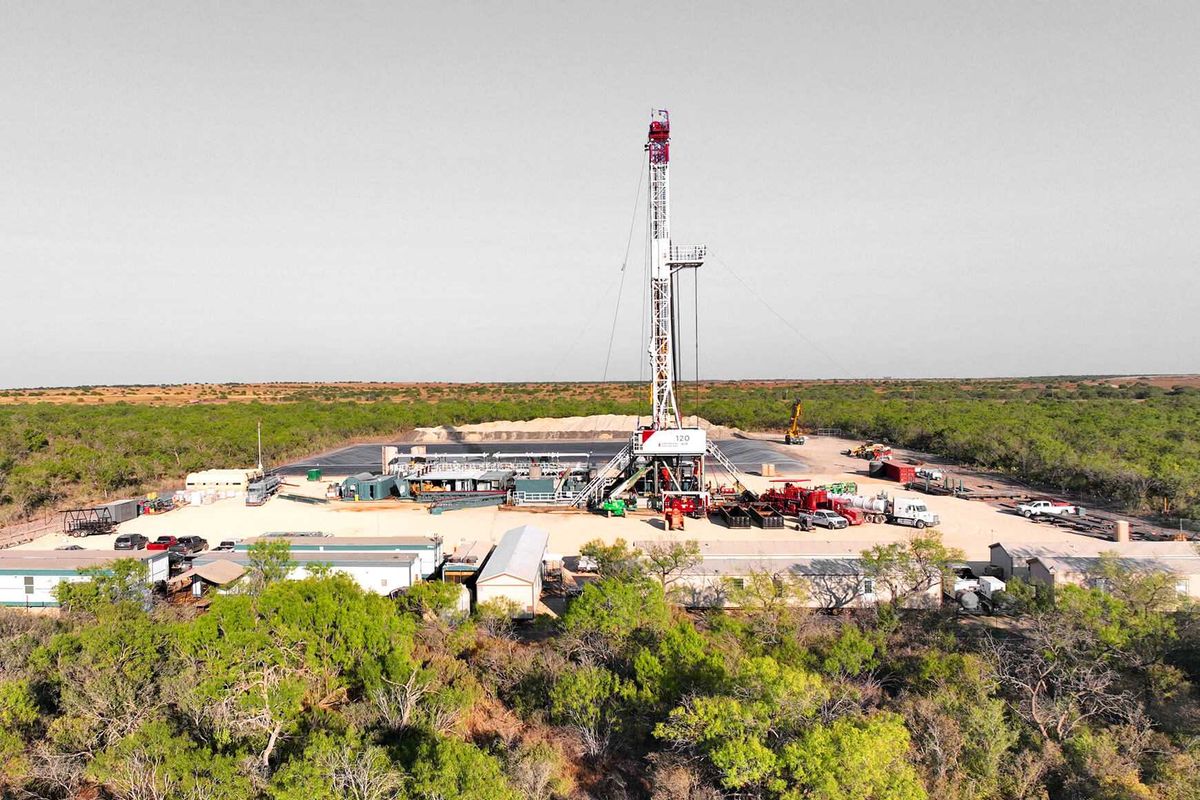
ABS and Seatrium signed a three-year Technology Collaboration Agreement at OTC. Photo courtesy of ABS

Two companies have teamed up on decarbonization efforts and made their relationship official at Houston's Offshore Technology Conference last week.

ABS and Seatrium signed a three-year Technology Collaboration Agreement at OTC, which expands on "their long running partnership on cutting-edge marine and technology projects," per a news release.

The agreement is entitled “Accelerating Decarbonization and Energy Transition,” and covers collaboration on technologies that fall under four broad themes: decarbonization, electrification, new energies and digital transformation.

“Together, ABS and Seatrium have a remarkable history of pioneering the technological frontiers in the marine and offshore industries,” says Christopher J. Wiernicki, ABS chairman and CEO, says in a release. "Our shared vision for the future, combined with our twin cultures of innovation and collaboration mean we are well placed to safely deliver the rapid technological advance our industry needs if we are to meet emissions targets and capitalize on the opportunities offered by decarbonization and digitalization."

The agreement is intended to support commercialization across the four identified themes.

“Seatrium is making significant strides in our visionary approach to engineering a sustainable, low-carbon energy future. This progress is achievable through pivotal industry collaborations with organizations like ABS," Chris Ong, CEO of Seatrium, adds. "We are more than just partners; we are natural allies united by a shared mission and driven by a powerful vision for a sustainable future.

"ABS and Seatrium have achieved great successes through our previous collaborations, and we are committed to harnessing our distinct strengths and capabilities to push the boundaries and transform the way we approach decarbonization, energy transition, and digital transformation,” he continues.

ABS, a 150-year-old marine and offshore energy innovation company, is headquartered in the Houston area. Seatrium, which is headquartered in Singapore, was recognized by ABS as the first shipyard group to deploy smart technologies in its operations.
Ad Placement 300x100
Ad Placement 300x600

CultureMap Emails are Awesome

Houston maritime startup raises $43M to electrify cargo vessels

A Houston-based maritime technology company that is working to reduce emissions in the cargo and shipping industry has raised VC funding and opened a new Houston headquarters.

Fleetzero announced that it closed a $43 million Series A financing round this month led by Obvious Ventures with participation from Maersk Growth, Breakthrough Energy Ventures, 8090 Industries, Y Combinator, Shorewind, Benson Capital and others. The funding will go toward expanding manufacturing of its Leviathan hybrid and electric marine propulsion system, according to a news release.

The technology is optimized for high-energy and zero-emission operation of large vessels. It uses EV technology but is built for maritime environments and can be used on new or existing ships with hybrid or all-electric functions, according to Fleetzero's website. The propulsion system was retrofitted and tested on Fleetzero’s test ship, the Pacific Joule, and has been deployed globally on commercial vessels.

Fleetzero is also developing unmanned cargo vessel technology.

"Fleetzero is making robotic ships a reality today. The team is moving us from dirty, dangerous, and expensive to clean, safe, and cost-effective. It's like watching the future today," Andrew Beebe, managing director at Obvious Ventures, said in the news release. "We backed the team because they are mariners and engineers, know the industry deeply, and are scaling with real ships and customers, not just renderings."

Fleetzero also announced that it has opened a new manufacturing and research and development facility, which will serve as the company's new headquarters. The facility features a marine robotics and autonomy lab, a marine propulsion R&D center and a production line with a capacity of 300 megawatt-hours per year. The company reports that it plans to increase production to three gigawatt-hours per year over the next five years.

"Houston has the people who know how to build and operate big hardware–ships, rigs, refineries and power systems," Mike Carter, co-founder and COO of Fleetzero, added in the release. "We're pairing that industrial DNA with modern batteries, autonomy, and software to bring back shipbuilding to the U.S."

Shell partners with UK-based co. for hydrogen electrolyzer pilot

ultra-efficient electrolyzer

Shell Global Solutions International, a subsidiary of Shell, which maintains its U.S. headquarters in Houston, has signed a collaboration agreement with London-based Supercritical Solutions to advance Supercritical’s ultra-efficient hydrogen electrolyzer technology toward a field pilot demonstration.

In the deal, the companies will collaborate on a paid technology feasibility study that will support the evaluation and planning of the pilot demonstration, according to a news release. Supercritical Solutions’ technology aims to deliver high-efficiency renewable hydrogen at a lower cost for the industrial hydrogen market.

"Signing this collaboration agreement with Shell is a major milestone for Supercritical Solutions and an important step on our commercialisation journey,” Luke Tan, co-founder of Supercritical, said in the news release. “We are directly addressing the cost and complexity barriers facing the renewable hydrogen market. We are excited to move forward with a company like Shell, whose global leadership has been proven to accelerate innovative technologies to market.”

Supercritical’s hydrogen electrolyser technology can operate at high temperatures and pressures of up to 220 bar without the need for an external hydrogen compressor, rare-earth materials or easily degradable membranes. The technology removes the typical compression step in the process while delivering hydrogen at industry standards. It requires significantly less energy than many traditional electrolyzers and is more cost-efficient.

This recent investment builds on an ongoing relationship between Shell and Supercritical. Supercritical was founded in 2020 and was runner-up in Shell’s New Energy Challenge, which helps startups and scaleups develop sustainable technologies, in 2021. Shell Ventures then invested in Supercritical’s Series A funding round in 2024 with Toyota Ventures.

3 Houston-area companies named to Global Cleantech 100

Energized

Three Houston-area companies—Amperon, Hertha Metals and Vaulted Deep—appear on this year’s Global Cleantech 100 list.

The unranked list, generated by market intelligence and advisory firm Cleantech Group, identifies the 100 privately held companies around the world that are most likely to make a significant impact in the cleantech market over the next five to 10 years.

For the 2026 list, Cleantech Group received more than 24,000 Global Cleantech 100 nominations from nearly 60 countries. Cleantech Group scored those companies and narrowed the contenders to 264. An expert panel reviewed those nominees, and the list was whittled down to the 100 winners.

Here’s a rundown of the three Houston-area honorees:

Amperon

Founded in 2018 by Sean Kelly and Abe Stanway, Houston-based Amperon offers an AI-enabled energy forecasting and analytics platform designed to help stabilize electric grids. Amperon received undisclosed amounts of venture capital from National Grid Partners and Tokyo Gas Co. Ltd. last year and announced a recent investment from Samsung Ventures earlier this month.

Hertha Metals

Founded in 2022 by Laureen Meroueh, Conroe-based Hertha Metals provides a single-step process for producing sustainable steel. Last year, the company emerged from stealth mode and raised more than $17 million in venture capital.

Vaulted Deep

Vaulted Deep’s technology injects excess organic waste underground to remove carbon dioxide from the atmosphere. Julia Reichelstein and Omar Abou-Sayed founded the Houston-based company in 2023. Last year, the startup raised $32.3 million in venture capital. Also in 2025, Vaulted Deep signed a 12-year deal with software giant Microsoft to remove up to 4.9 million metric tons of carbon dioxide from the environment.

Vaulted Deep also made the list last year, along with Houston-based Syzygy Plasmonics and Fervo Energy. Fervo was also named the 2025 North American Company of the Year by Cleantech Group.