







Houston artists have created unique carbon-absorbing art. "Future's Past" by Emily Ding in partnership with UXD tells the story of the Mellie Esperson building. Photo courtesy of Dario DeLeon

Anthony Rose, the CEO of creative agency United By Design, is on a mission to brighten Houston’s urban spaces and improve the city’s air quality one carbon-absorbing mural at a time.

Rose originally founded United By Design, or UXD, in 2019 to connect muralists like himself and commercial businesses seeking to beautify their spaces and form brand identities. After creating vibrant murals for Lockhart Elementary School, the Houston Astros, and Smoothie King, Rose expanded UXD’s vision to include environmental sustainability in their artistic collaborations in 2022.

“This city’s vibrant art scene and growing focus on sustainability makes it an ideal location for our projects,” Rose says. “We’re not just creating eco-friendly murals, we’re reimagining how art can actively contribute to environmental solutions.”

In search of ecologically-conscious paints, Rose formed a partnership with Spain-based, natural paint company Graphenstone. Rose says he was drawn to the company’s eponymous Graphenstone coating because of its nontoxic ingredients and exclusively uses the product for UXD’s carbon-absorbing murals.
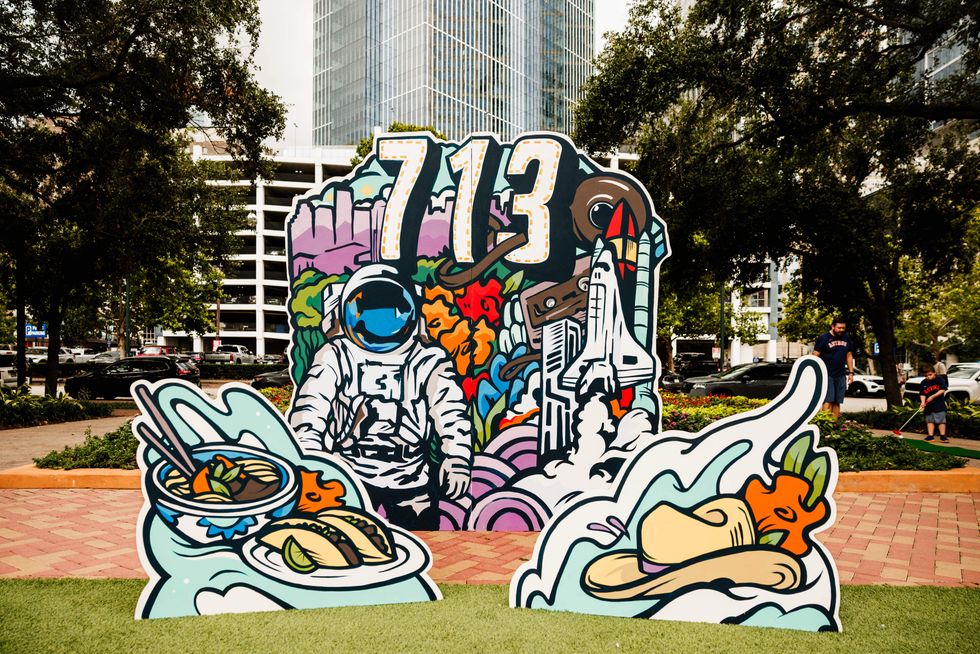
For 713 Day, UXD created carbon-absorbing mural "(HUE)STON HARMONY" in collaboration with Downtown Houston+ and local artist David Maldonado. Photo courtesy of Egidio Narvaez

The Graphenstone coating consists of a limestone base which goes through a process called photocatalysis, during which carbon dioxide from the atmosphere is absorbed into the surface, and is then sealed in with graphene, a thin layer of carbon atoms. The murals absorb carbon dioxide throughout the coat’s drying process which typically takes 30 days.

“Each of our murals absorbs about 1600 grams of CO2 during that curing process which is the equivalent daily absorption of about 33 growing trees,” Rose explains.

UXD’s largest carbon-absorbing mural to date is a floor-to-ceiling panorama in downtown Houston’s historic Mellie Esperson building, home to the company’s new creative hub. Painted by Houston-born artist Emily Ding, the mural is a tribute to the establishment’s namesake: an innovative, early 20th century entrepreneur who constructed the opulent building.

Rose says UXD plans to expand their carbon-absorbing murals project in collaboration with more local artists and establishments, while creating an artist-in-residency program themed around sustainability. Though Rose acknowledges in the grand scheme of carbon pollution these murals are not a silver bullet, he says the non-toxic paints are encouraging conversations about how artists can be conservation-minded.

“We’re trying to figure out how art as a messaging tool can help break down scientific data, a language not many people practice daily, can break down barriers and help bridge the gap to a more intuitive knowledge of sustainability,” Rose says. “We’re bringing the community together, helping them feel empowered, and giving them actionable information to help them live more sustainable lives.”

"Between Land and Sky" by artist David Maldonado was UXD's first carbon-absorbing painting. Photo courtesy of Dario DeLeon and Tommy Valdez

———

This article originally ran on InnovationMap.

Ad Placement 300x100
Ad Placement 300x600

CultureMap Emails are Awesome

Fervo Energy closes $462M series E

fresh funding

Houston-based geothermal energy company Fervo Energy has closed an oversubscribed $462 million series E funding round, led by new investor B Capital.

“Fervo is setting the pace for the next era of clean, affordable, and reliable power in the U.S.,” Jeff Johnson, general partner at B Capital, said in a news release. “With surging demand from AI and electrification, the grid urgently needs scalable, always-on solutions, and we believe enhanced geothermal energy is uniquely positioned to deliver. We’re proud to support a team with the technical leadership, commercial traction, and leading execution capabilities to bring the world’s largest next-generation geothermal project online and make 24/7 carbon-free power a reality.”

The financing reflects “strong market confidence in Fervo’s opportunity to make geothermal energy a cornerstone of the 24/7 carbon-free power future,” according to the company. The round also included participation from Google, a longtime Fervo Partner, and other new and returning investors like Devon Energy, Mitsui & Co., Ltd., Mitsubishi Heavy Industries and Centaurus Capital. Centaurus Capital also recently committed $75 million in preferred equity to support the construction of Cape Station Phase I, Fervo noted in the release.

The latest funding will support the continued buildout of Fervo’s Utah-based Cape Station development, which is slated to start delivering 100 MW of clean power to the grid beginning in 2026. Cape Station is expected to be the world's largest next-generation geothermal development, according to Fervo. The development of several other projects will also be included in the new round of funding.

“This funding sharpens our path from breakthrough technology to large-scale deployment at Cape Station and beyond,” Tim Latimer, CEO and co-founder of Fervo, added in the news release. “We’re building the clean, firm power fleet the next decade requires, and we’re doing it now.”

Fervo recently won Scaleup of the Year at the 2025 Houston Innovation Awards, and previously raised $205.6 million in capital to help finance the Cape Station earlier this year. The company fully contracted the project's capacity with the addition of a major power purchase agreement from Shell this spring. Fervo’s valuation has been estimated at $1.4 billion and includes investments and support from Bill Gates.

“This new investment makes one thing clear: the time for geothermal is now,” Latimer added in a LinkedIn post. “The world desperately needs new power sources, and with geothermal, that power is clean and reliable. We are ready to meet the moment, and thrilled to have so many great partners on board.”

Air Liquide and Hyundai ink partnership to scale hydrogen economy

green team

Air Liquide, which maintains its U.S. headquartered in Houston, and South Korea-based Hyundai Motor Group are expanding their strategic partnership to accelerate the growth of the global hydrogen ecosystem.

The renewal of the companies’ Memorandum of Understanding (MoU) was announced at the Hydrogen Council CEO Summit in Seoul last week. Together, the companies will work to scale hydrogen production, storage, transportation and utilization across Europe, Korea and the United States with a concentration on heavy-duty transport, logistics and public transportation.

Hyundai hopes Air Liquide's technical expertise will help contribute to more sustainable energy and carbon neutrality.

The companies plan to develop hydrogen refueling networks and storage capacity that can meet growing demands. They also plan to commercialize fuel cell electric vehicles (FCEVs) for diverse applications like public transportation, logistics fleets and ports.

"We are delighted to strengthen our partnership with Hyundai Motor Group,” Armelle Levieux, vice president of innovation, electronics and hydrogen at Air Liquide, said in a news release. “Collaborations like this between leaders across the value chain are essential to building the hydrogen economy.”

The partnership has already shown strong progress in South Korea, according to the companies, with Hyundai rolling out more than 2,000 hydrogen buses and 37,000 passenger fuel cell vehicles, with more expected by 2026. Additionally, Air Liquide has boosted supply capabilities in the region with the new state-of-the-art high-pressure hydrogen filling center, Lotte-Air Liquide Ener’Hy, in Daesan, an industrial hub near Seoul.

Air Liquide and Hyundai previously signed an MoU in 2018, along with other major South Korean players, agreeing to grow the hydrogen economy.

Hazardous waste company with Houston presence to make $3B acquisition

big deal

Veolia, a Boston-based company with major operations in Texas, is purchasing hazardous-waste company Clean Earth from Enviri as part of a $3 billion deal.

Veolia is a private water operator, technology provider and hazardous waste and pollution treatment company that operates a large hazardous waste treatment and incineration facility in Port Arthur. Hazardous waste treatment is a growing sector as the clean energy, semiconductor manufacturing, healthcare and pharmaceutical industries generate high levels of waste that need to be handled safely.

Acquiring Clean Earth’s 82 facilities, which include 19 EPA-permitted sites, will expand Veolia’s reach into 10 new states and will position the company as the second-largest hazardous waste operator in the U.S., according to a news release. The deal is Veolia’s sixth and largest North American acquisition of 2025.

“(The acquisition) allows us to unlock the full value potential of our U.S. hazardous waste activities and to double our size on this critical, fast-growing sector, creating a No. 2 player,” Estelle Brachlianoff, CEO of Veolia, said in a news release. “We reinforce our global capacities in hazardous waste and further increase our international footprint.”

Veolia’s Port Arthur facility specializes in servicing generators with large-volume waste treatment requirements.

The transaction is expected to close mid-2026. Veolia hopes the increased exposure into industries such as retail and healthcare will help to offer a full range of environmental services across the U.S.

“This continued transformation of our portfolio enhances the growth profile and strength of our group, uniquely positioned to tackle the sustained demand for environmental security,” Brachlianoff added in the release.