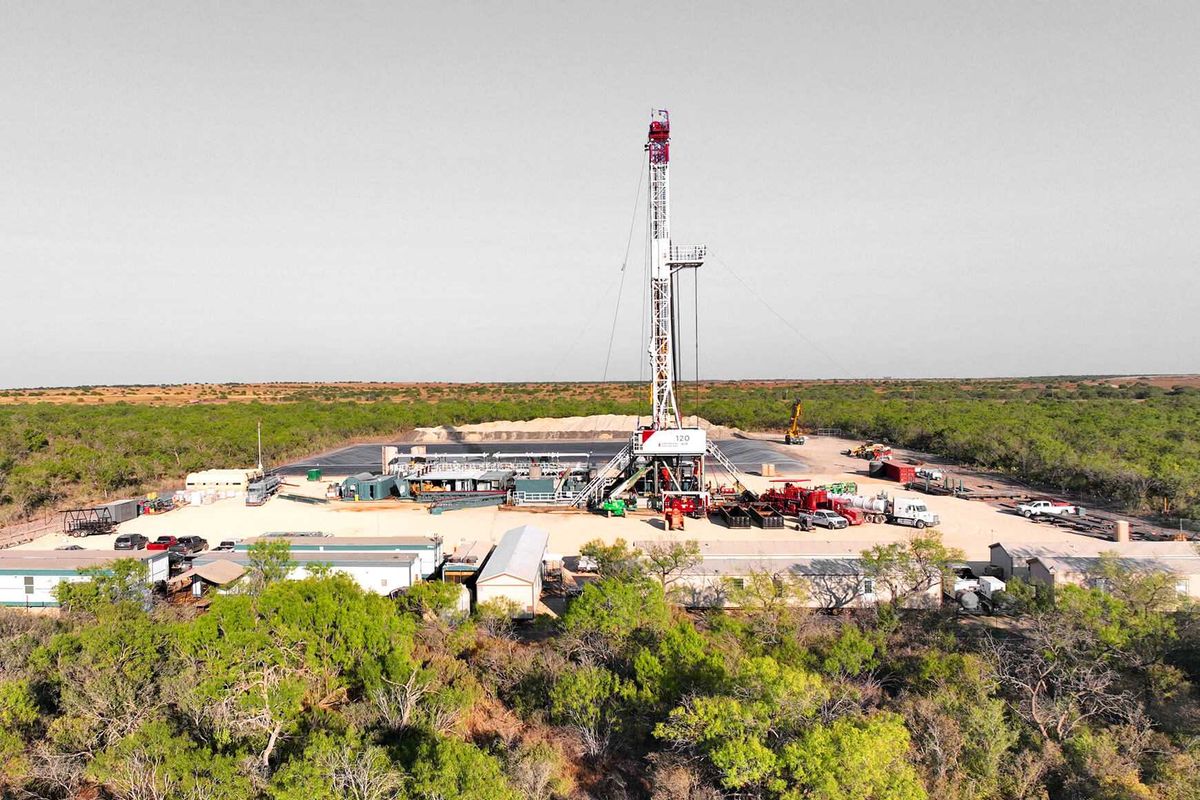
A forecast from Energy Innovation Policy & Technology shows that Texas is expected to see a decline in solar, wind and battery-powered storage by 2035 due to clean energy tax credit repeals in the 'One Big Beautiful Bill Act.' Photo via Getty Images.

Texas is expected to see a 77-gigawatt decrease in power generation capacity within the next 10 years under the federal "One Big Beautiful Bill Act," which President Trump recently signed into law, a new forecast shows.

Primarily due to the act’s repeal of some clean energy tax credits, a forecast, published by energy policy research organization Energy Innovation Policy & Technology, predicts that Texas is expected to experience a:

  • 54-gigawatt decline in capacity from solar power by 2035
  • 23-gigawatt decline in capacity from wind power by 2035
  • 3.1-gigawatt decline in capacity from battery-stored power by 2035
  • 2.5-gigawatt increase in capacity from natural gas by 2035

The legislation “will reduce additions of new, cost-effective electricity capacity in Texas, raising power prices for consumers and decreasing the state’s GDP and job growth in the coming years,” the forecast says.

The forecast also reports that the loss of sources of low-cost renewable energy and the resulting hike in natural gas prices could bump up electric bills in Texas. The forecast envisions a 23 percent to 54 percent hike in electric rates for residential, commercial and industrial customers in Texas.

Household energy bills are expected to increase by $220 per year by 2030 and by $480 per year by 2035, according to the forecast.

Energy Innovation Policy & Technology expects job growth and economic growth to also take a hit under the "Big Beautiful Bill."

The nonprofit organization foresees annual losses of $5.9 billion in Texas economic output (as measured by GDP) by 2030 and $10 billion by 2035. In tandem with the impact on GDP, Texas is projected to lose 42,000 jobs by 2030 and 94,000 jobs by 2035 due to the law’s provisions, according to the organization.

The White House believes the "Big Beautiful Bill" will promote, not harm, U.S. energy production. The law encourages the growth of traditional sources of power such as oil, natural gas, coal and hydropower.

“The One Big Beautiful Bill Act is a historic piece of legislation that will restore energy independence and make life more affordable for American families by reversing disastrous Biden-era policies that constricted domestic energy production,” Interior Secretary Doug Burgum said in a news release.

Promoters of renewable energy offer an opposing viewpoint.

“The bill makes steep cuts to solar energy and places new restrictions on energy tax credits that will slow the deployment of residential and utility-scale solar while undermining the growth of U.S. manufacturing,” says the Solar Energy Industries Association.

Jason Grumet, CEO of the American Clean Power Association, complained that the legislation limits energy production, boosts prices for U.S. businesses and families, and jeopardizes the reliability of the country’s power grid.

“Our economic and national security requires that we support all forms of American energy,” Grumet said in a statement. “It is time for the brawlers to get out of the way and let the builders get back to work.”

Ad Placement 300x100
Ad Placement 300x600

CultureMap Emails are Awesome

Houston startup advances methane tech, sets sights on growth capital

making milestones

Houston-based climatech startup Aquanta Vision achieved key milestones in 2025 for its enhanced methane-detection app and has its focus set on future funding.

Among the achievements was the completion of the National Science Foundation’s Advanced Sensing and Computation for Environmental Decision-making (ASCEND) Engine. The program, based in Colorado and Wyoming, awarded a total of $3 million in grants to support the commercialization of projects that tackle critical resilience challenges, such as water security, wildfire prediction and response, and methane emissions.

Aquanta Vision’s funding went toward commercializing its NETxTEN app, which automates leak detection to improve accuracy, speed and safety. The company estimates that methane leaks cost the U.S. energy industry billions of dollars each year, with 60 percent of leaks going undetected. Additionally, methane leaks account for around 10 percent of natural gas's contribution to climate change, according to MIT’s climate portal.

Throughout the months-long ASCEND program, Aquanta Vision moved from the final stages of testing into full commercial deployment of NETxTEN. The app can instantly identify leaks via its physics-based algorithms and raw video output of optical gas imaging cameras. It does not require companies to purchase new hardware, requires no human intervention and is universally compatible with all optical gas imaging (OGI) cameras. During over 12,000 test runs, 100 percent of leaks were detected by NETxTEN’s system, according to the company.

The app is geared toward end-users in the oil and gas industry who use OGI cameras to perform regular leak detection inspections and emissions monitoring. Aquanta Vision is in the process of acquiring new clients for the app and plans to scale commercialization between now and 2028, Babur Ozden, the company’s founder and CEO, tells Energy Capital.

“In the next 16 months, (our goal is to) gain a number of key customers as major accounts and OEM partners as distribution channels, establish benefits and stickiness of our product and generate growing, recurring revenues for ourselves and our partners,” he says.

The company also received an investment for an undisclosed amount from Marathon Petroleum Corp. late last year. The funding complemented follow-on investments from Ecosphere Ventures and Odyssey Energy Advisors.

Ozden says the funds will go toward the extension of its runway through the end of 2026. It will also help Aquanta Vision grow its team.

Ozden and Marcus Martinez, a product systems engineer, founded Aquanta Vision in 2023 and have been running it as a two-person operation. The company brought on four interns last year, but is looking to add more staff.

Ozden says the company also plans to raise a seed round in 2027 “to catapult us to a rapid growth phase in 2028-29.”

HETI discusses Houston’s energy leadership, from pathways to progress

The View From HETI

In 2024, RMI in collaboration with Mission Possible Partnership (MPP) and the Houston Energy Transition Initiative (HETI) mapped out ambitious scenarios for the region’s decarbonization journey. The report showed that with the right investments and technologies, Houston could achieve meaningful emissions reductions while continuing to power the world. That analysis painted a picture of what could be possible by 2030 and 2050.

Today, the latest HETI progress report shows Houston is not just planning anymore — the region is delivering.

Real results, right now

The numbers tell a compelling story. Since 2017, HETI’s member companies have invested more than $95 billion in low-carbon infrastructure, technologies, and R&D. That’s not a commitment for the future—that’s capital deployed, projects built, and operations transformed.

The results showed industry-wide reductions of 20% in total Scope 1 greenhouse gas emissions and a remarkable 55% decrease in methane emissions from global operations. These aren’t projections—they’re actual reductions happening across refineries, chemical plants, and production facilities throughout the Houston region.

How Houston is leading

What makes Houston’s approach work is its practical, technology-driven focus. Companies across the energy value chain are implementing solutions that work today:

  • Electrifying operations and integrating renewable power
  • Deploying advanced methane detection and elimination technologies
  • Upgrading equipment for greater efficiency
  • Capturing and storing carbon at commercial scale
  • Developing breakthrough technologies from geothermal to advanced nuclear

Take ExxonMobil’s Permian Basin electrification, Shell and Chevron’s lower-carbon Whale project, or BP’s massive Tangguh carbon capture project in Indonesia. These aren’t pilot programs—they’re multi-billion dollar investments demonstrating that decarbonization and energy production go hand in hand.

From scenarios to strategy

The RMI analysis identified three key pathways forward: enabling operational decarbonization, accelerating low-carbon technology scale-up, and creating carbon accounting mechanisms. Houston’s energy leaders have embraced all three.

The momentum is undeniable. Companies are setting ambitious 2030 and 2050 targets with clear roadmaps. New projects are reaching final investment decisions. Innovation ecosystems are flourishing. And critically, this progress is creating jobs and driving economic growth across the region.

Why this matters

Houston isn’t just managing the energy transition—it’s proving what’s possible when you combine world-class engineering expertise, integrated infrastructure, access to capital, and a commitment to both energy security and emissions reduction.

The dual challenge of delivering more energy with less emissions isn’t theoretical in Houston—it’s operational reality. Every ton of CO₂ reduced, every efficiency gain achieved, and every technology deployed demonstrates that we can meet growing global energy demand while making measurable progress on climate goals.

The path forward

The journey from last year’s scenarios to this year’s results shows something crucial: when industry, policymakers, and communities align around practical solutions, transformation accelerates.

Houston’s energy leadership isn’t about choosing between reliable energy and environmental progress, it’s about delivering both. And based on the progress we’re seeing, the momentum is only building.

———

Read the full analysis here. This article originally appeared on the Greater Houston Partnership's Houston Energy Transition Initiative blog. HETI exists to support Houston's future as an energy leader. For more information about the Houston Energy Transition Initiative, EnergyCapitalHTX's presenting sponsor, visit htxenergytransition.org.

TotalEnergies to supply solar power to new Google data centers in Texas

power deal

French energy company TotalEnergies, whose U.S. headquarters are in Houston, has signed power purchase agreements to supply 1 gigawatt of solar power for Google data centers in Texas over a 15-year span.

The power will be generated by TotalEnergies’ two solar farms that are being developed in Texas. Construction on the company’s Wichita site (805 megawatt-peak, or MWp) and Mustang Creek site (195 MWp) is scheduled to start in the second quarter of this year.

Marc-Antoine Pignon, U.S. vice president for renewables at TotalEnergies, said in a press release that the 1-gigawatt deal “highlights TotalEnergies’ strategy to deliver tailored renewable energy solutions that support the decarbonization goals of digital players, particularly data centers.”

The deal comes after California-based Clearway, in which TotalEnergies holds a 50 percent stake, secured an agreement to supply 1.2 gigawatts of solar power to Google data centers in Texas and other states.

“Supporting a strong, stable, affordable grid is a top priority as we expand our infrastructure,” said Will Conkling, director of clean energy and power at Google. “Our agreement with TotalEnergies adds necessary new generation to the local system, boosting the amount of affordable and reliable power supply available to serve the entire region.”

TotalEnergies maintains a 10-gigawatt-capacity portfolio of onshore solar, wind and battery storage assets in the U.S., including 5 gigawatts in the territory served by the Electric Reliability Council of Texas (ERCOT).

Other clean energy customers of TotalEnergies include Airbus, Air Liquide, Amazon, LyondellBasell, Merck and Microsoft.