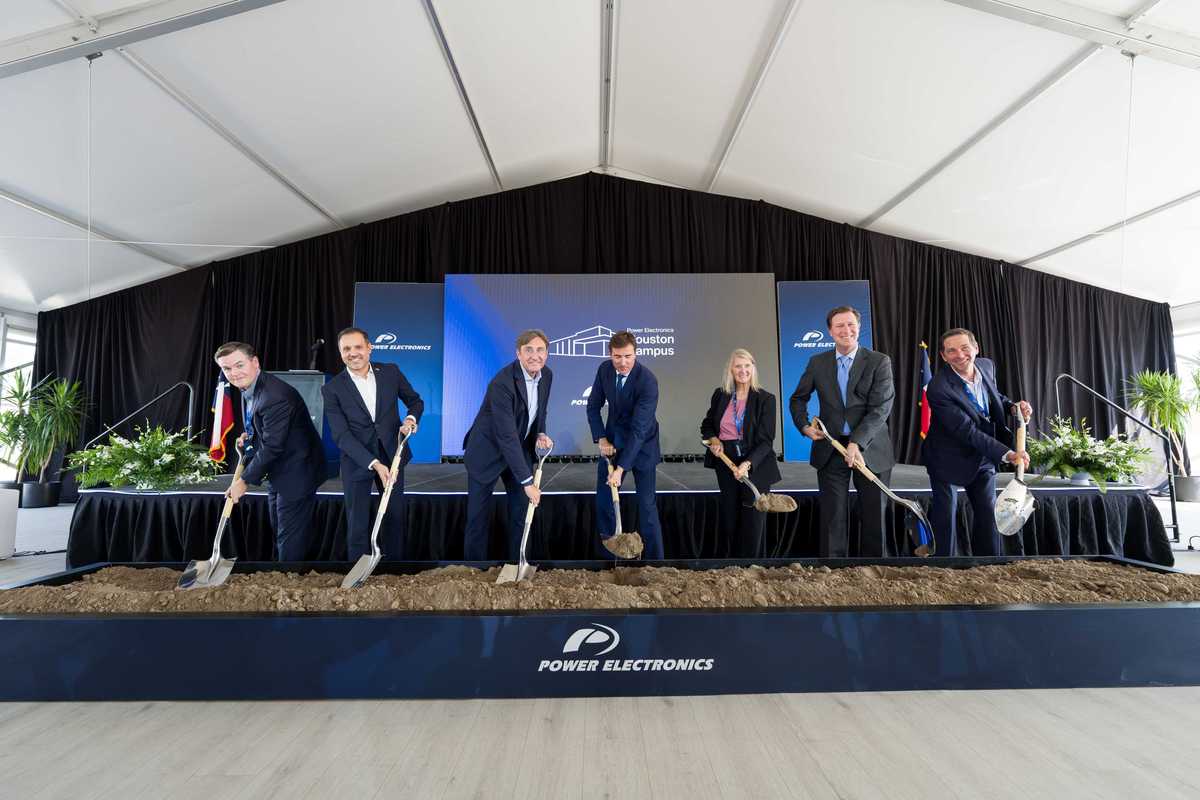
Quantum Power Systems took home the top TEX-E prize at this year's Energy Venture Day pitch competition during CERAWeek. Photo via LinkedIn

Twelve teams from around the country, including several from Houston, took home top honors at this year's Energy Venture Day and Pitch Competition at CERAWeek.

The fast-paced event, held March 25, put on by Rice Alliance, Houston Energy Transition Initiative and TEX-E, invited 36 industry startups and five Texas-based student teams focused on driving efficiency and advancements in the energy transition to present 3.5-minute pitches before investors and industry partners during CERAWeek's Agora program.

The competition is a qualifying event for the Startup World Cup, where teams compete for a $1 million investment prize.

PolyJoule won in the Track C competition and was named the overall winner of the pitch event. The Boston-based company will go on to compete in the Startup World Cup held this fall in San Francisco.

PolyJoule was spun out of MIT and is developing conductive polymer battery technology for energy storage.

Rice University's Resonant Thermal Systems won the second-place prize and $15,000 in the student track, known as TEX-E. The team's STREED solution converts high-salinity water into fresh water while recovering valuable minerals.

Teams from the University of Texas won first and second place in the TEX-E competition, bringing home $25,000 and $10,000, respectively. The student winners were:

Companies that pitched in the three industry tracts competed for non-monetary awards. Here are the companies named "most-promising" by the judges:

Track A | Industrial Efficiency & Decarbonization

Track B | Advanced Manufacturing, Materials, & Other Advanced Technologies

  • First: Licube, based in Houston
  • Second: ZettaJoule, based in Houston and Maryland
  • Third: Oleo

Track C | Innovations for Traditional Energy, Electricity, & the Grid

The teams at this year's Energy Venture Day have collectively raised $707 million in funding, according to Rice. They represent six countries and 12 states. See the full list of companies and investor groups that participated here.

Houston-based HEXASpec took home the top TEX-E prize and $25,000 at last year's Energy Venture Day and Pitch Competition. Photo courtesy TEX-E.

40+ teams to pitch at annual CERAWeek clean energy competition

energy venture day

The Rice Alliance for Technology and Entrepreneurship, the Houston Energy Transition Initiative (HETI), the Texas Entrepreneurship Exchange for Energy (TEX-E) and the Ion have named the 30-plus energy ventures and teams that will pitch at the 2026 Energy Venture Day and Pitch Competition during CERAWeek this month.

The selected ventures are "driving efficiency and advancements toward the energy transition," according to the Rice Alliance. Each will each present a 3.5-minute pitch before a network of investors and industry partners during CERAWeek's Agora program on Wednesday, March 25, from noon-5:30 p.m.

The competition is divided up into the TEX-E university track, in which Texas student-led energy startups compete for $50,000 in cash prizes, and the industry ventures track.

Teams competing in the TEX-E Prize track include:

  • GOES
  • Quantum Power System
  • Quas
  • Resonant Thermal Systems
  • Srijan

The industry track is subdivided into three additional tracks, spanning materials to clean energy and will feature 37 companies. A group of expert judges will name the top three companies from each industry track. The winner of the CERAWeek competition will also have the chance to advance and compete for the $1 million investment prize at the Startup World Cup in November 2026.

Teams come from around the world, including several Houston-based ventures, such as Agellus Tank Robotics, Capwell Services and Corrolytics.

The full list of companies pitching at CERAWeek includes:

  • Agellus Tank Robotics
  • Airovation Technologies
  • Anax Power
  • Armeta
  • ATS Energy
  • Capwell Services
  • CarbonLume
  • Cogniprise
  • Corrolytics
  • Daphne Technology
  • Gemini Energy
  • Grid8
  • H Quest Vanguard
  • intcom
  • Ionada Canada
  • Junipix
  • Kunin Technologies
  • LAVA Power
  • Licube
  • LNK Energies
  • Maverick X
  • Membravo
  • Mirico
  • Mocean Energy
  • Monitorai
  • OCOchem
  • Oleo
  • Pix Force
  • PolyJoule
  • Power to Hydrogen
  • Sotaog
  • Spotlight
  • Tierra Climate
  • Verdagy
  • Via Separations
  • Vycarb
  • ZettaJoule

Those not attending CERAWeek can catch these companies and more than a dozen others at a pitch preview at the Ion. The free Pitch Preview will be held Tuesday, March 24, from 9 a.m.-2:30 p.m. Click here to register.

Additional companies pitching during the free preview include:

  • Ammobia
  • Arolytics
  • Ayrton Energy
  • ChainWeave
  • Cybereum
  • Energytech
  • ENP Technologies
  • KP Labs
  • Mcatalysis
  • Mitico
  • Mote
  • Nanos
  • New Horizon Oil and Gas
  • Predyct
  • Salem Robotics
  • Toluai

Two Rice University student teams took home top prizes during last year's TEX-E competition, while ventures from New Jersey, Wyoming and Virgina won in their respective industry tracks. See the full list of last year's winners here.

Ad Placement 300x100
Ad Placement 300x600

CultureMap Emails are Awesome

Tesla's EV Robotaxis officially launch in Texas' largest metros

On The Road

Tesla’s Robotaxi service has taken to the streets of Houston. In a brief statement Saturday, April 18 on its X social media account, Tesla Robotaxi says the autonomous rideshare service just launched in Texas’ two biggest metro areas — Houston and Dallas.

“Try Tesla Robotaxi in Dallas & Houston!” Tesla CEO Elon Musk says in a reposting on X of the Robotaxi announcement.

One of Robotaxi’s competitors, Alphabet-owned Waymo, beat the Tesla service to the Dallas, Houston, and Austin markets. Another competitor, Amazon-owned Zoox, has Dallas flagged for its autonomous rideshare service.

Robotaxi previously kicked off in Austin, where Tesla is based and manufactures electric vehicles, and the San Francisco Bay Area. Nearly 50 Robotaxis operate in Austin, where the service’s inaugural rides happened last year, and more than 500 in the San Francisco area.

Of the three rides logged in a 31-square-mile area in Dallas as of Monday morning, the average fare was $7.96 and the average trip was 3.5 miles, according to an online tracker of autonomous rideshare services. The tracker showed only one Robotaxi was on the roads in Dallas.

As of Monday morning, a 25-square-mile area in Houston had two Robotaxis on the road, according to the online tracker. The average fare for five recorded rides was $11.34 and the average trip was six miles.

“We want Robotaxi pricing to be simple and easy for you to understand,” according to the Robotaxi website. “Initially, as part of our introductory program, we will charge a simple, affordable rate plus applicable taxes and fees for all rides within the available service area.”

The tracker shows the Robotaxi in Dallas did not have a human aboard to monitor each trip, and only one of Houston’s two Robotaxis did not have a human monitor in the driver’s seat.

For now, all passengers ride in Tesla Model Y cars. Robotaxi operates from 6 am-2 am daily.

To use the service, you first must download the Robotaxi app, which works only on iPhones.

Robotaxi lets you stream music and adjust climate settings and seat positioning from the Robotaxi app or the vehicle’s touchscreen. Climate and media settings are stored in your Robotaxi profile and automatically transfer from one vehicle to another. If you own a Tesla, certain profile settings and media preferences are available in your own car as well as in a Robotaxi.

In January at the World Economic Forum in Davos, Switzerland, Musk said a “widespread” network of driverless rideshare vehicles would be operating in the U.S. by the end of this year, CNBC reported.

---

This article originally appeared on CultureMap.com.

Major Texas energy port wrestles with water crisis due to years of drought

Resource Report

In parched southern Texas, a yearslong drought has depleted Corpus Christi's water reserves so gravely that the city is scrambling to prevent a shortage that could force painful cutbacks for residents and hobble the refineries and petrochemical plants in a major energy port.

Experts said the city didn't expect such a bad drought, and new sources of reliable water didn't arrive as expected. Those problems arose as the city increased its water sales to big industrial customers.

“We just have not kept up with water supply and water infrastructure like we should have. And it's decades in the making,” said Peter Zanoni, the city manager since 2019.

Corpus Christi, a city of about 317,000 people that also supplies water to nearby counties, is closely tied to its oil and gas industry. The region makes everyday essentials like fuel and steel and ships them to the world.

Zanoni said it is highly unlikely the city will run out of water, but without significant rainfall or new sources, residents may face forced cutbacks and industry may have to do with less. At a time when the Iran war is already raising gas prices, the shortage is hitting an area that produces 5% of the U.S. gasoline supply.

Droughts are common, but this one has dragged on for most of the past seven years. Key reservoirs are at their lowest point ever. The quickest fix is different weather.

“We are actively praying for a hurricane,” former city council member David Loeb said, half in jest. Loeb doesn't want anyone injured, but after wrestling with previous droughts in his time on the council, he feels the lack of rain acutely.

The drought isn't expected to lift by summer, leaving officials scrambling to tap more groundwater to avoid an emergency.

Lessons from last time

After the last drought in the early 2010s, the city approved a pipeline extension to bring in more water from the Colorado River and promoted conservation. In the years that followed, water use actually fell. The city, seeing opportunity, added a petrochemical plant and steel mill to its long list of industrial customers.

City officials had allowed for drought in their calculations — just not this kind of drought, Zanoni said. It has hit especially hard because reservoirs never fully recharged after the last one.

And it's come at a bad time.

After many years, the pipeline extension finally delivered its full capacity only last year. Meanwhile, discussion of building a desalination plant that would remove salt from seawater — a potentially drought-proof solution recommended in 2016 — bogged down over concerns about costs as high as $1.3 billion and environmental impact.

“If the then-city council had followed through on that, we would have had that plant up and running by now,” Zanoni said.

It's an industry town

Corpus Christi has followed its long-established plan for reducing water use. Stage 1 seeks voluntary actions from citizens like taking shorter showers and limiting how often they can water. Currently, the city is in Stage 3, which means pauses on many outdoor water uses.

Many residents are angry that they can’t water their lawns, that their bills are set to rise sharply and that they may face fines, said Isabel Araiza, co-founder of a grassroots group active on water issues. Some don’t feel industry will be asked to share in the pain, she said.

The city's drought plan allows for charging residents and businesses extra if they use lots of water. But big industry, which Zanoni says consumes as much as 60% of the city's water, can opt to pay a permanent surcharge to avoid the possibility of having a much larger fee added in times of drought.

Araiza calls it a bad system. Once industry pays the surcharge, she said, they have no incentive to conserve water.

The city has defended the system, saying in a statement that industry does not “get a pass on water conservation” or forced curtailment. The statement said the business surcharges have raised $6 million a year.

It is wrong to suggest industry isn’t helping, said Bob Paulison, executive director of the Coastal Bend Industry Association. Companies have stopped landscaping, they recycle water for essential cooling needs and they are looking for alternative water sources, he said.

The city hasn't imposed extra costs on anyone yet.

But Zanoni said water rates may eventually double as the city invests roughly $1 billion on infrastructure — costs that some argue will disproportionately benefit industry and make life for residents more expensive.

What's the way out?

The city is in a water emergency when it has 180 days before water supply can't keep up with demand. Officials have run through different scenarios for getting new water and the drought easing, and have said an emergency could come as early as May, as late as October, or not at all.

The city has tapped into millions of gallons of new groundwater, and it hopes to get even more.

The biggest unknown is the Evangeline Groundwater Project, which involves a pipeline and about two dozen wells that could add enough water to head off an emergency. It still needs state approval but the city hopes water could be flowing as soon as November. New sources come with drawbacks – some have raised water quality concerns, and there are worries too much pumping could deplete groundwater.

If the city has to declare a water emergency, it would be able to more aggressively curtail water use – mandatory reductions that would apply evenly to all industry and residents. That is a sensitive decision and is likely to be a “knock-down drag-out bloodbath,” Loeb said.

Because residents on average have already reduced their water use, future mandatory cuts are likely to fall heavier on industry.

“It’ll be an unbelievable disaster,” said Don Roach, former assistant general manager of the San Patricio Municipal Water District that has lots of industrial customers in the area. “When you cut the cooling water off to most of these industries, they just have to shut down. There’s no other way around it.”

Paulison said companies that produce fuel, polymers, iron and steel “have the least amount of flexibility in just cutting water usage.” He added, however, that companies remain optimistic they can reduce usage, adapt and continue operations.

Zanoni said the city's plans should buy time to avert the worst.

“We are hoping we don’t get there, but we don’t work on hope,” he said.

Fervo Energy officially files for initial public offering

going public

Fervo Energy has officially filed for IPO.

The Houston-based geothermal unicorn filed a registration statement on Form S-1 with the U.S. Securities and Exchange Commission on April 17 to list its Class A common stock on the Nasdaq exchange. Fervo intends to be listed under the ticker symbol "FRVO."

The number and price of the shares have not yet been determined, according to a news release from Fervo. J.P. Morgan, BofA Securities, RBC Capital Markets and Barclays are leading the offering.

The highly anticipated filing comes as Fervo readies its flagship Cape Station geothermal project to deliver its first power later this year

"Today, miles-long lines for gasoline have been replaced by lines for electricity. Tech companies compete for megawatts to claim AI market share. Manufacturers jockey for power to strengthen American industry. Utilities demand clean, firm electricity to stabilize the grid," Fervo CEO Tim Latimer shared in the filing. "Fervo is prepared to serve all of these customers. Not with complex, idiosyncratic projects but with a simplified, standardized product capable of delivering around-the-clock, carbon-free power using proven oil and gas technology."

Fervo has been preparing to file for IPO for months. Axios Pro first reported that the company "quietly" filed for an IPO in January and estimated it would be valued between $2 billion and $3 billion.

Fervo also closed $421 million in non-recourse debt financing for the first phase of Cape Station last month and raised a $462 million Series E in December. The company also announced the addition of four heavyweights to its board of directors last week, including Meg Whitman, former CEO of eBay, Hewlett-Packard, and Spring-based HPE.

Fervo reported a net loss of $70.5 million for the 2025 fiscal year in the S-1 filing and a loss of $41.1 million in 2024.

Tracxn.com estimates that Fervo has raised $1.12 billion over 12 funding rounds. The company was founded in 2017 by Latimer and CTO Jack Norbeck.