







taking notes

Fortune 500 Houston energy cos. named, events not to miss, and more things to know this week

Fortune 500 companies named, a really big deal to know about, and more. Photo via Getty Images

Editor's note: Dive headfirst into the new week with three quick things to catch up on in Houston's energy transition.

Events not to miss

Put these Houston-area energy-related events on your calendar.

  • The 5th Texas Energy Forum 2024, organized by U.S. Energy Stream, will take place on August 21 and 22 at the Petroleum Club of Houston. Register now.
  • Hart Energy's New Energies Summit is taking place on August 27 to 28 at the Hilton Americas - Houston. Register now.
  • The inaugural Houston Energy and Climate Startup Week will take place September 9 to 13. Learn more.
  • The inaugural Houston Energy and Climate Week will take place September 9 to 13. Learn more.
  • Rice Alliance's Energy Tech Venture Forum is September 12. Register now.
  • Gastech will be hosted in Houston this year. The event is September 17 to 20 at the George R Brown Convention Center. Register now.

Companies to know: Houston energy companies score big on annual Fortune 500 ranking

Houston-based energy companies have again held a sizable presence on the Fortune 500 ranking. Photo via Getty Images

Fourteen businesses with global or regional headquarters in the Houston area appear on Fortune’s new list of the world’s 500 biggest companies.

Click here for the rundown of Fortune Global 500 companies with global or regional headquarters in the Houston area.

Big deal: Woodside to acquire clean ammonia project outside of Houston for $2.4B
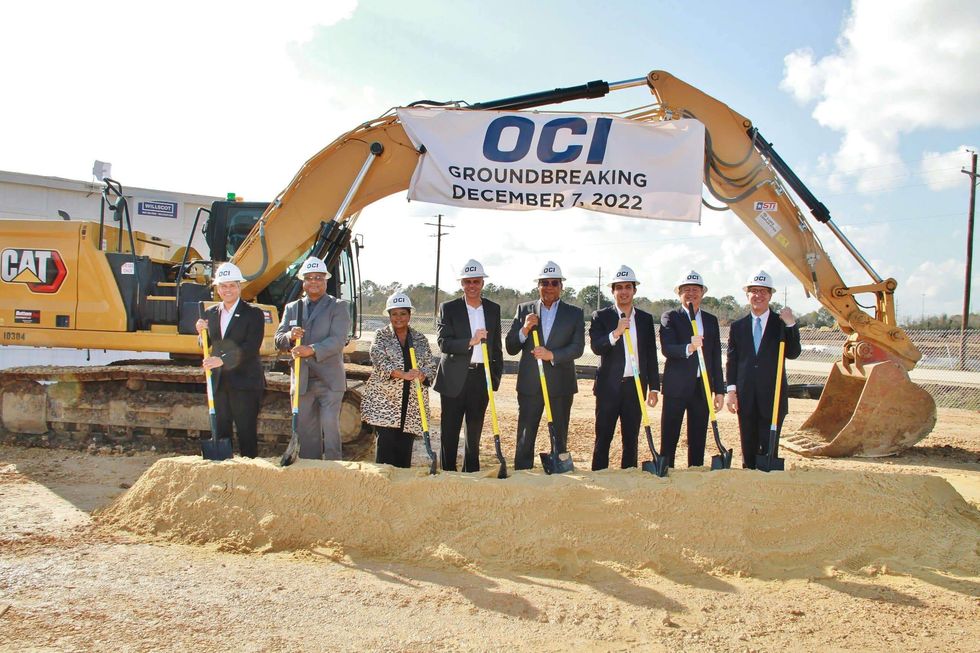
OCI broke ground on the project in 2022. Photo via oci-global.com

Woodside Energy has announced its acquiring a Beaumont, Texas, clean ammonia project that's slated to deliver its first ammonia by 2025 and lower carbon ammonia by 2026.

The agreement is for Woodside to acquire 100 percent of OCI Clean Ammonia Holding and its lower carbon ammonia project in Beaumont in an all-cash deal of approximately $2.35 billion. According to Woodside CEO Meg O’Neill, the acquisition positions Woodside as an early mover in clean ammonia within the energy transition.

“This transaction positions Woodside in the growing lower carbon ammonia market," O’Neill says in a news release. "The potential applications for lower carbon ammonia are in power generation, marine fuels and as an industrial feedstock, as it displaces higher-emitting fuels." Read more.

Trending News

A View From HETI

A new JLL report predicts that power will become the primary factor in selecting future data center sites, with renewables playing a major role. Photo courtesy JLL.

Renewable energy is evolving as the primary energy source for large data centers, according to a new report.

The 2026 Global Data Center Outlook from commercial real estate services giant JLL points out that the pivot toward big data centers being powered by renewable energy stems from rising electricity costs and tightening carbon reduction requirements. In the data center sector, renewable energy, such as solar and wind power, is expected to outcompete fossil fuels on cost, the report says.

The JLL forecast carries implications for the Houston area’s tech and renewable energy sectors.

As of December, Texas was home to 413 data centers, second only to Virginia at 665, according to Visual Capitalist. Dozens more data centers are in the pipeline, with many of the new facilities slated for the Houston, Austin, Dallas-Fort Worth and San Antonio areas.

Amid Texas’ data center boom, several Houston companies are making inroads in the renewable energy market for data centers. For example, Houston-based low-carbon energy supplier ENGIE North America agreed last May to supply up to 300 megawatts of wind power for a Cipher Mining data center in West Texas.

The JLL report says power, not location or cost, will become the primary factor in selecting sites for data centers due to multi-year waits for grid connections.

“Energy infrastructure has emerged as the critical bottleneck constraining expansion [of data centers],” the report says. “Grid limitations now threaten to curtail growth trajectories, making behind-the-meter generation and integrated battery storage solutions essential pathways for sustainable scaling.”

Behind-the-meter generation refers to onsite energy systems such as microgrids, solar panels and solar battery storage. The report predicts global solar capacity will expand by roughly 100 gigawatts between 2026 and 2030 to more than 10,000 gigawatts.

“Solar will account for nearly half of global renewable energy capacity in 2026, and despite its intermittent properties, solar will remain a key source of sustainable energy for the data center sector for years to come,” the report says.

Thanks to cost and sustainability benefits, solar-plus-storage will become a key element of energy strategies for data centers by 2030, according to the report.

“While some of this energy harvesting will be colocated with data center facilities, much of the energy infrastructure will be installed offsite,” the report says.

Other findings of the report include:

  • AI could represent half of data center workloads by 2030, up from a quarter in 2025.
  • The current five-year “supercycle” of data center infrastructure development may result in global investments of up to $3 trillion by 2030.
  • Nearly 100 gigawatts worth of new data centers will be added between 2026 and 2030, doubling global capacity.

“We’re witnessing the most significant transformation in data center infrastructure since the original cloud migration,” says Matt Landek, who leads JLL’s data center division. “The sheer scale of demand is extraordinary.”

Hyperscalers, which operate massive data centers, are allocating $1 trillion for data center spending between 2024 and 2026, Landek notes, “while supply constraints and four-year grid connection delays are creating a perfect storm that’s fundamentally reshaping how we approach development, energy sourcing, and market strategy.”

Trending News