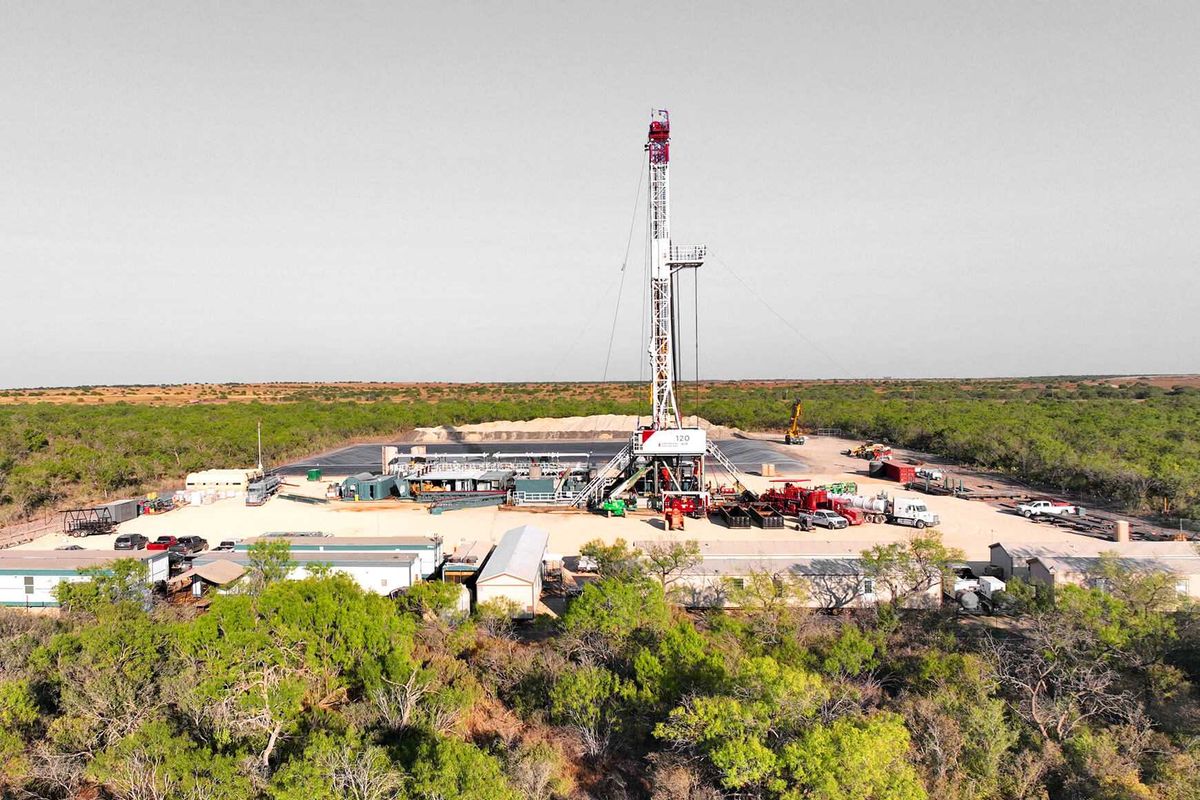
Fervo Energy has claimed the No. 1 spot on Time magazine’s and Statista’s 2026 list of America’s Top GreenTech Companies. Photo via fervoenergy.com

The accolades keep coming for Houston-based geothermal energy company Fervo Energy.

Fervo sits atop Time magazine’s and Statista’s 2026 list of America’s Top GreenTech Companies. Fervo ranked No. 6 on the list last year.

The ranking honors 250 companies in the U.S. based on their environmental impact, innovation and financial strength. Fervo joins five other Houston-area companies on the list.

  • No. 49 Quaise Energy, an MIT Energy Initiative spinout that’s developing a drilling system designed to convert existing power stations for geothermal power production
  • No. 71 Plus Power, which develops, owns and operates battery energy storage systems
  • No. 98 Utility Global, whose technology enables industrial decarbonization
  • No. 199 Solugen, whose technology converts plant-based feedstocks into carbon-negative chemicals
  • No. 215 Noodoe, which specializes in EV charging stations and software

Fervo says its approach to enhanced geothermal systems (EGS)—including horizontal drilling, AI-enabled drilling and exploration, advanced reservoir engineering, and fiber-optic sensing—demonstrates how validated technology can help deliver reliable zero-emission power.

“By applying drilling technology from the oil and gas industry, we have proven that we can produce 24/7 carbon-free energy resources in new geographies across the world,” Fervo co-founder and CEO Tim Latimer said last year.

Other recent recognitions for Fervo includes:

  • The 2025 Houston Innovation Awards named it Scaleup of the Year
  • MIT Technology Review put Fervo on its 2025 list of the 10 global climatech companies to watch
  • Time named Fervo one of the 100 Most Influential Companies of 2025
  • Fervo was hailed as the Global Cleantech Group 100 North American Company of the Year
  • Fervo was among Congruent Ventures’ and Silicon Valley Bank’s 50 by 2050 companies, all of which are poised to advance global decarbonization over a 25-year span
Just last month, Fervo secured $421 million in debt financing for the construction of its 500-megawatt Cape Station geothermal project in Utah. And in December, the company landed an oversubscribed $462 million Series E round of funding, pushing its valuation to an estimated $1.4 billion. Fervo filed for an IPO earlier this year.
CenterPoint is one of 13 Houston companies on Time's list. Photo via centerpoint.com

7 Houston energy-focused businesses among Time's best midsize companies 2025

new report

Seven Houston-based businesses focused on the energy industry appear on Time magazine and Statista’s new ranking of the country’s best midsize companies.

Time and Statista ranked companies based on employee satisfaction, revenue growth, and transparency about sustainability. All 500 companies on the list have annual revenue from $100 million to $10 billion.

The Houston energy-focused companies on the list are:

  • No. 141 MRC Global. Score: 85.84
  • No. 176 National Oilwell Varco. Score: 84.50
  • No. 266 Nabor Industries. Score: 81.59
  • No. 296 Archrock. Score: 80.17
  • No. 327 Superior Energy Services. Score: 79.38
  • No. 359 CenterPoint Energy. Score: 78.02
  • No. 461 Oceaneering. Score: 73.87
In total, 13 Houston-based businesses appear, with Houston engineering firm KBR topping the Texas businesses that made the list. KBR earned the No. 30 spot, earning a score of 91.53 out of 100. It is joined by these other Houston companies:
  • No. 168 Comfort Systems USA. Score: 84.72
  • No. 175 Crown Castle. Score: 84.51
  • No. 234 Kirby. Score: 82.48
  • No. 332 Insperity. Score: 79.15
  • No. 485 Skyward Specialty Insurance. Score: 73.15

Additional Texas companies on the list include:

  • No. 95 Austin-based Natera. Score: 87.26
  • No. 199 Plano-based Tyler Technologies. Score: 86.49
  • No. 139 McKinney-based Globe Life. Score: 85.88
  • No. 140 Dallas-based Trinity Industries. Score: 85.87
  • No. 149 Southlake-based Sabre. Score: 85.58
  • No. 223 Dallas-based Brinker International. Score: 82.87
  • No. 226 Irving-based Darling Ingredients. Score: 82.86
  • No. 256 Dallas-based Copart. Score: 81.78
  • No. 276 Coppell-based Brink’s. Score: 80.90
  • No. 279 Dallas-based Topgolf. Score: 80.79
  • No. 294 Richardson-based Lennox. Score: 80.22
  • No. 308 Dallas-based Primoris Services. Score: 79.96
  • No. 322 Dallas-based Wingstop Restaurants. Score: 79.49
  • No. 335 Fort Worth-based Omnicell. Score: 78.95
  • No. 337 Plano-based Cinemark. Score: 78.91
  • No. 345 Dallas-based Dave & Buster’s. Score: 78.64
  • No. 349 Dallas-based ATI. Score: 78.44
  • No. 385 Frisco-based Addus HomeCare. Score: 76.86
  • No. 414 New Braunfels-based Rush Enterprises. Score: 75.75
  • No. 431 Dallas-based Comerica Bank. Score: 75.20
  • No. 439 Austin-based Q2 Software. Score: 74.85
  • No. 458 San Antonio-based Frost Bank. Score: 73.94
  • No. 475 Fort Worth-based FirstCash. Score: 73.39
  • No. 498 Irving-based Nexstar Broadcasting Group. Score: 72.71
---
This article originally appeared on our sister site, InnovationMap.
Ad Placement 300x100
Ad Placement 300x600

CultureMap Emails are Awesome

Fervo promotes strategy leader to COO as flagship geothermal project nears launch

new leader

Houston geothermal unicorn Fervo Energy has named Sarah Jewett as its new COO.

Jewett steps into the role as the company prepares for its flagship Cape Station geothermal project to deliver its first power later this year.

Jewett joined Fervo in 2020 as director of strategy and most recently served as the company's senior vice president of strategy. She spoke with HETI on the potential of geothermal energy in 2024.

Before Fervo, Jewett served as senior director of corporate development for Houston-based Select Energy Services. She ran hydraulic fracturing crews for Schlumberger in the Permian Basin and Alaska's North Slope early in her career.

In the COO role, Jewett is tasked with creating "the centralized infrastructure required to execute on what the company believes is the most significant commercial opportunity for clean, firm power in history," according to a company release.

“What Sarah has built over the last six years has been foundational to the company’s success. From the time she joined, she has brought an unwavering people-first mindset and outstanding dedication to building things that last,” Tim Latimer, CEO and co-founder of Fervo, added in the release. “As we move into the next phase of our growth, there is no better person to lead the operating core of this company.”

Jewett holds an MBA from Harvard Business School and a bachelor's degree in mechanical engineering from Dartmouth College.

Fervo announced the addition of four heavyweights to its board of directors this spring, including Meg Whitman, former CEO of eBay, Hewlett-Packard, and Spring-based HPE. Shortly after, the company filed for its highly anticipated $1 billion-plus IPO. Read more here.

UH study finds Gulf Coast best positioned for emerging carbon removal technology

coastal impact

The Gulf Coast is an ideal spot for deploying a new ocean-based carbon removal technology that uses seawater to capture and store carbon dioxide, according to a new study from the University of Houston.

The study was led by UH Cullen College of Engineering Professor Mim Rahimi and published in Nature’s Communications Sustainability journal. Abdelrahman Refaie, a PhD student at UH, authored the paper. It aimed to develop a plan for implementing an electrochemical marine carbon dioxide removal (e-mCDR) technology that treats seawater to increase the ocean’s ability to absorb and store carbon dioxide from the air.

Currently, oceans absorb about 30 percent of human-produced carbon dioxide emissions each year, according to UH, making it a great natural resource for carbon removal.

The team at UH scouted and analyzed 38 coastal facilities across the U.S.—including power plants, desalination plants, and liquefied natural gas (LNG) terminals—before determining the Gulf Coast as an attractive option. The South Hub, or the Gulf Coast along Texas and Louisiana, ranked the top-performing area for the technology due to the industrial infrastructure, affordable electricity, hydrogen transportation and storage networks.

Other regions like California and the Northeast also scored well due to their clean energy mix and carbon removal potential, according to UH.

“The South hub has one of the highest diversity factors between power plants, desalination and LNG,” Refaie said in a news release. “That means if, logistically, down the road LNG is not open for this implementation, then we have another option in the area. It reduces the risk factor.”

UH says the findings show how companies could commercialize the technology, which could boost coastal economies.

“The question we had wasn’t technical, rather, it was logistical in regard to implementation down the road,” Rahimi said. “This would be a roadmap if a company or the government wants to utilize this technology.”

Rahimi aims to increase awareness about e-mCDR technology and its potential impact. He recently discussed the ocean-centric carbon removal work with members of Congress in March at the Carbon to Sea’s 2026 Hill Day.

“I think faculty at the University of Houston can do more of this kind of work,” Rahimi said in a separate release. “Meeting with Members of Congress gives us a chance to help policymakers better understand the science and engineering happening at our university. That kind of engagement is an important part of moving new technologies forward. It also shows how the work we do on campus can have a real impact on communities beyond the university.”