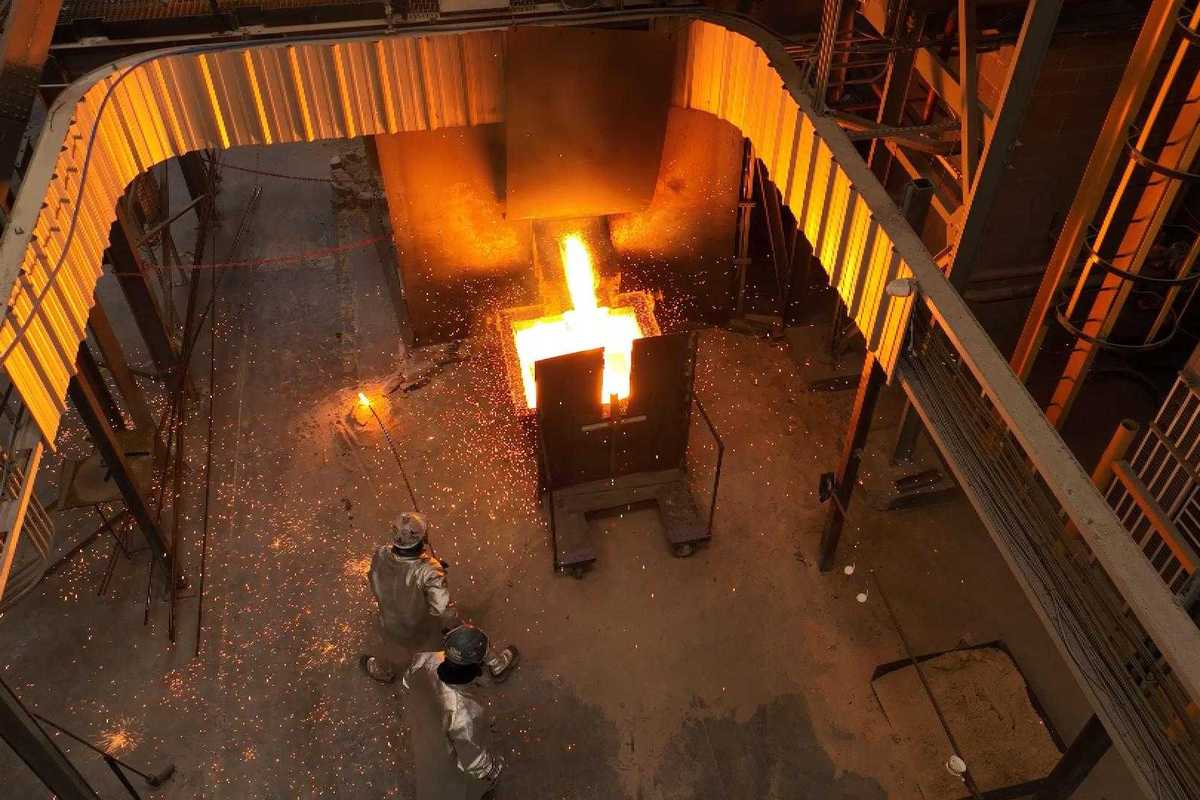
Locksley Resources will provide antimony-rich feedstocks from a project in the Mojave Desert as part of a new partnership with Rice University that aims to develop scalable methods for extracting and utilizing antimony. Photo via locksleyresources.com.au.

Rice University and Australian mineral exploration company Locksley Resources have joined together in a research partnership to accelerate the development of antimony processing in the U.S. Antimony is a critical mineral used for defense systems, electronics and battery storage.

Rice and Locksley will work together to develop scalable methods for extracting and utilizing antimony. Currently, the U.S. relies on imports for nearly all refined antimony, according to Rice.

Locksley will fund the research and provide antimony-rich feedstocks and rare earth elements from a project in the Mojave Desert. The research will explore less invasive hydrometallurgical techniques for antimony extraction and explore antimony-based materials for use in batteries and other energy storage applications.

“This strategic collaboration with Rice marks a pivotal step in executing Locksley’s U.S. strategy,” Nathan Lude, chairman of Locksley Resources, said in a news release. “By fast-tracking our research program, we are helping rebuild downstream capacity through materials innovation that the country urgently requires.”

Pulickel Ajayan, the Benjamin M. and Mary Greenwood Anderson Professor of Materials Science and Nanoengineering at Rice, is the principal investigator of the project.

“Developing scalable, domestic pathways for antimony processing is not only a scientific and engineering challenge but also a national strategic priority,” Ajayan said in the news release. “By combining Rice’s expertise in advanced materials with Locksley’s resources, we can address a critical supply chain gap and build collaborations that strengthen U.S. energy resilience.”

The Rice Advanced Materials Institute (RAMI) will play a major role in supporting the advancement of technology and energy-storage applications.

“This partnership aligns with our mission to lead in materials innovations that address national priorities,” Lane Martin, director of RAMI, said in a news release. “By working with Locksley, we are helping to build a robust domestic supply chain for critical materials and support the advancement of next-generation energy technologies.”

Ad Placement 300x100
Ad Placement 300x600

CultureMap Emails are Awesome

UH lands $1.5M for endowed professorship and energy workforce initiative

funding the future

The University of Houston announced two major funding awards last month focused on energy transition initiatives and leadership.

Longtime UH supporters Peggy and Chris Seaver made a $1 million gift to the university to establish the Peggy and Chris Seaver Endowed Aspire Professorship, a faculty position “designed to strengthen UH Energy and expand the university’s leadership in addressing the most pressing global energy challenges,” according to a news release.

The new role is the third professorship appointed to UH Energy. The professorship can qualify for a dollar-for-dollar match through the Aspire Fund Challenge, a $50 million matching initiative launched by an anonymous donor.

“This gift will be key to cementing UH’s role as The Energy University,” Ramanan Krishnamoorti, vice president for energy and innovation at UH, said in the release. “By recruiting a highly respected faculty member with international experience, we are further elevating UH Energy’s global profile while deepening our impact here in the energy capital of the world.”

Also in January, the university shared that it would be joining the Urban Enrichment Institute (UEI) and the City of Houston to help train the next generation of energy workers, thanks to a $560,000 grant.

The Gulf Research Program of the National Academies of Sciences, Engineering and Medicine awarded the funding to the UEI, a nonprofit that supports at-risk youth. It will allow the UEI to work with UH’s Energy Transition Institute and the Houston Health Department to launch “Spark Energy Futures: Equipping Youth and Communities for the Energy Transition.”

The new initiative is designed for Houstonians ages 16-25 and will provide hands-on experience, four months of STEM-based training, and industry-aligned certifications without a four-year degree. Participants can also earn credentials and job placement support.

“Our energy systems are going through unprecedented changes to address the growing energy demands in the United States, Gulf Coast and Texas,” Debalina Sengupta, assistant vice president and Chief Operating Officer of ETI at UH, said in a news release.“To meet growing demands, the energy supply, transmission, distribution and markets associated with an ever-increasing energy mix needs a workforce skilled in multidimensional aspects of energy, as well as the flexibility to switch as needed to provide affordable, reliable and sustainable energy to our population.”

Keith Cornelius, executive director of UEI, added that he expects about 50 students to participate in the program’s inaugural year and that the program is looking to attract those interested in entering the energy workforce without a college degree.

“We’re looking to have tremendous success with the Energy Transition Institute,” Cornelius said. “This program is a testament to what can be done between a community-based organization, a major university and the city.”

The award was part of a $2.7 million grant that will fund four projects in the Gulf region, including two others in Texas. The Gulf Research Program Awards also granted $748,175 to launch the “Building the South Texas Energy Workforce” initiative in in Kingsville, Texas and $728,000 for “Texas Green Careers Academy: Activating a New Generation of Energy Professionals” in Austin.

Solar power and storage help save Texans millions on electric bills, CEO tells Senate

price stability

Solar power and battery storage are saving Texans hundreds of millions of dollars on their electric bills, the president and CEO of the Solar Energy Industries Association recently told a congressional committee.

Abigail Ross Hopper, the association’s president and CEO, said in testimony given to the U.S. Senate Environment and Public Works Committee that states like Texas that are adding significant capacity for solar power and battery storage are enjoying lower, more stable prices for electricity.

“Unsubsidized solar is now the cheapest source of electricity in history in much of the country,” Hopper said. “With no fuel costs, solar provides a hedge against natural gas price volatility that continues to cause electricity price spikes.”

“The only way to put downward pressure on prices is by bringing more power online, not less,” she added.

To illustrate the value of solar power and battery storage, Hopper compared two hot summer days in Texas—one in July 2022 and the other in July 2025.

Hopper explained that the Electric Reliability Council of Texas (ERCOT) had begun installing solar on its grid in 2022 but had very little battery storage. ERCOT manages 90 percent of the state’s electrical load.

When ERCOT grid conditions buckled under high demand on the highlighted day in 2022, the price of electricity spiked to nearly $1,500 per megawatt-hour, Hopper said.

“Three years later, the amount of solar had increased substantially and was complemented by energy storage,” she said.

On the specified day in 2025, under even greater demand than three years earlier, sizable amounts of solar power, battery storage and wind power kept ERCOT’s midday price of electricity low and stable—around $50 per megawatt-hour. That dollar amount represented a nearly 100 percent decrease compared with the highlighted day in 2022.

Solar and wind supplied nearly 40 percent of Texas’ power during the first nine months of 2025, according to the U.S. Energy Information Administration (EIA).

Despite the state’s expansion of solar power and battery storage capacity, residential electricity prices in ERCOT’s territory rose 30 percent from 2020 to 2025 and are expected to climb another 29 percent from 2025 to 2030, according to a forecast from the Texas Energy Poverty Research Institute.

The increase in electric bills is tied to factors such as:

  • Higher natural gas prices
  • Greater demand from AI data centers and cryptomining facilities
  • Extreme weather
  • Population growth
  • Development of new transmission and distribution lines

The strain on ERCOT’s grid is only getting worse. An EIA forecast predicts demand for ERCOT electricity will jump 9.6 percent in 2026, and ERCOT expects a 50 percent jump in demand by 2029.

Spring-based private equity firm acquires West Texas wind farm

power deal

Spring-based private equity firm Arroyo Investors has teamed up with ONCEnergy, a Portland, Oregon-based developer of clean energy projects, to buy a 60-megawatt wind farm southeast of Amarillo.

Skyline Renewables, which acquired the site, known as the Whirlwind Energy Center, in 2018, was the seller. The purchase price wasn’t disclosed.

Whirlwind Energy Center, located in Floyd County, West Texas, comprises 26 utility-scale wind turbines. The wind farm, built in 2007, supplies power to Austin Energy.

“The acquisition reflects our focus on value-driven investments with strong counterparties, a solid operating track record, and clear relevance to markets with growing capacity needs,” Brandon Wax, a partner at Arroyo, said in a press release. “Partnering with ONCEnergy allows us to leverage deep operational expertise while expanding our investment footprint in the market.”

Arroyo focuses on energy infrastructure investments in the Americas. Its portfolio includes Spring-based Seaside LNG, which produces liquefied natural gas and LNG transportation services.

Last year, Arroyo closed an investment fund with more than $1 billion in total equity commitments.

Since its launch in 2003, Arroyo has “remained committed to investing in high-quality assets, creating value and positioning assets for exit within our expected hold period,” founding partner Chuck Jordan said in 2022.