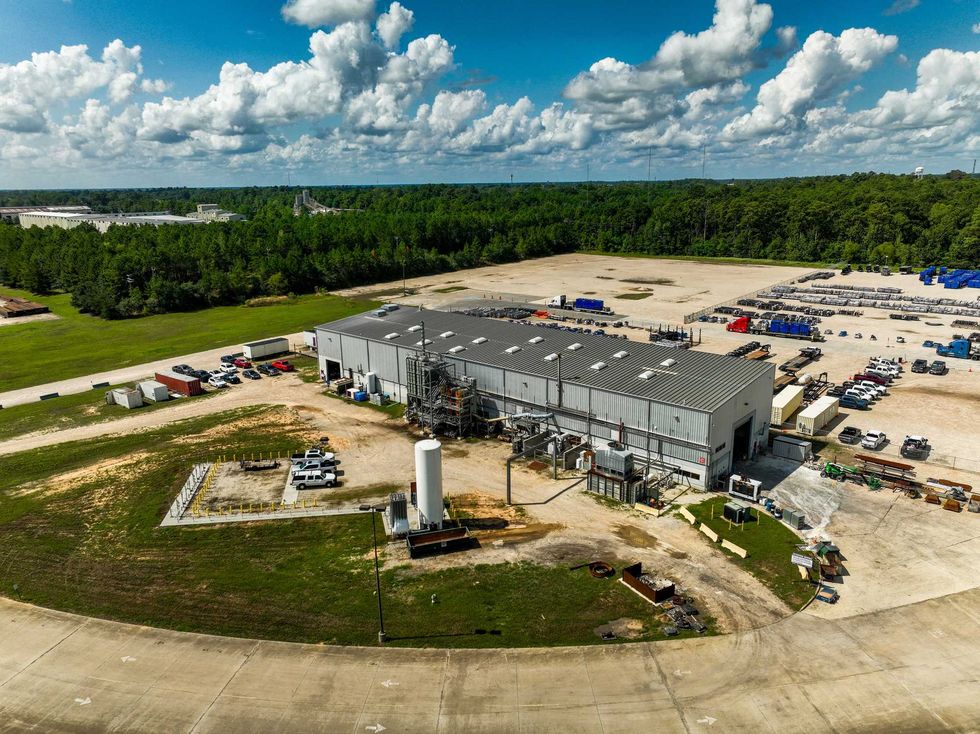
A new study from the University of Texas at Austin shows that new hydrogen production facilities could account for 2 percent to nearly 7 percent of the state's water demand by 2050. Photo via Getty Images.

Just as the data center industry thrives on electricity, the hydrogen industry thrives on water.

A new study from researchers at the University of Texas at Austin found that by 2050, new hydrogen production facilities could account for 2 percent to nearly 7 percent of water demand in the state. The impact could be especially dramatic along the Gulf Coast, where most of the state’s hydrogen production facilities are already built or are being planned.

The research was published in the journal Sustainability.

The study reported that "most existing and proposed hydrogen production infrastructures are within projected water-strained cities and counties, such as Houston in Harris County and Corpus Christi in Nueces County."

Compared with municipal water supplies or irrigation systems, the hydrogen industry’s demand for water is comparatively small, the study’s lead author, Ning Lin, an energy economist at UT’s Bureau of Economic Geology, said in a news release. But hydrogen-fueled demand could strain communities that already are grappling with current and future water shortages.

“Where you put a project can make a huge difference locally,” Lin says. “With multiple hydrogen facilities planned in water-stressed Gulf Coast counties, this study highlights the urgent need for integrated water and energy planning and provides a solid foundation to help policymakers, industry, and communities make informed decisions about hydrogen and water management.”

To forecast water demand, Lin and her colleagues crunched data from a 2024 National Petroleum Council study that estimated the regional hydrogen demand from 2030 to 2050 based on two energy policy scenarios.

As part of the study, researchers reviewed water use and water quality for various hydrogen production methods that affect whether water remaining from production can be recycled.

“In order to plan for water needs, somebody has to figure out what those future demands might look like, and this paper puts some numbers to (it) that, I think, will be very helpful,” Robert Mace, executive director of the Meadows Center for Water and the Environment at Texas State University, who was not part of the study, added in the release.

Ad Placement 300x100
Ad Placement 300x600

CultureMap Emails are Awesome

Houston robotics company partners with Marathon Petroleum to scale fleet

robot alliance

Houston- and Boston-based Square Robot Inc. has announced a partnership with downstream and midstream energy giant Marathon Petroleum Corp. (NYSE: MPC).

The partnership comes with an undisclosed amount of funding from Marathon, which Square Robot says will help "shape the design and development" of its submersible robotics platform and scale its fleet for nationwide tank inspections.

“Marathon’s partnership marks a major milestone in our mission to transform industrial tank inspection,” David Lamont, CEO of Square Robot, said in a news release. “They recognize the proven value of our robotic inspections—eliminating confined space entry, reducing the environmental impact, and delivering major cost efficiencies all while keeping tanks on-line and working. We’re excited to work together with such a great company to expand inspection capabilities and accelerate innovation across the industry.”

The company closed a $13 million series B last year. At the time of closing, Square Robot said it would put the funding toward international expansion in Europe and the Middle East.

Square Robot develops autonomous, submersible robots that are used for storage tank inspections and eliminate the need for humans to enter dangerous and toxic environments. Its newest tank inspection robot, known as the SR-3HT, became commercially available and certified to operate at a broader temperature range than previous models in the company's portfolio this fall.

The company was first founded in the Boston area in 2016 and launched its Houston office in 2019.

Eclipse Energy lands Weatherford investment to scale clean hydrogen tech

clean energy collab

Oil and gas giant Weatherford International (NASDAQ: WFRD) has made a capital investment for an undisclosed amount in Eclipse Energy as part of a collaborative partnership aimed at scaling and commercializing Eclipse's clean fuel technology.

According to a release, joint projects from the two Houston-based companies are expected to launch as soon as January 2026. The partnership aims to leverage Weatherford's global operations with Eclipse Energy's pioneering subsurface biotechnology that converts end-of-life oil fields into low-cost, sustainable hydrogen sources.

“We strongly believe the subsurface is the most overlooked climate asset,” Prabhdeep Singh Sekhon, CEO of Eclipse Energy, said in the release. “This partnership demonstrates how traditional oilfield expertise and frontier biotechnology can come together to transform the energy transition. Weatherford’s global reach and deep technical knowledge will accelerate our ability to scale our low-carbon technology rapidly and cost-effectively.”

Eclipse Energy, previously known as Gold H2, completed its first field trial this summer, demonstrating subsurface bio-stimulated hydrogen production. According to the company, its technology could yield up to 250 billion kilograms of low-carbon hydrogen, and it could also extend "beyond hydrogen, laying the foundation for the next generation of subsurface clean energy fuels."

Last month, Eclipse Energy won in the Energy Transition Business category at the 2025 Houston Innovation Awards. The company closed an $8 million series A this year and has plans to raise another round in 2026.