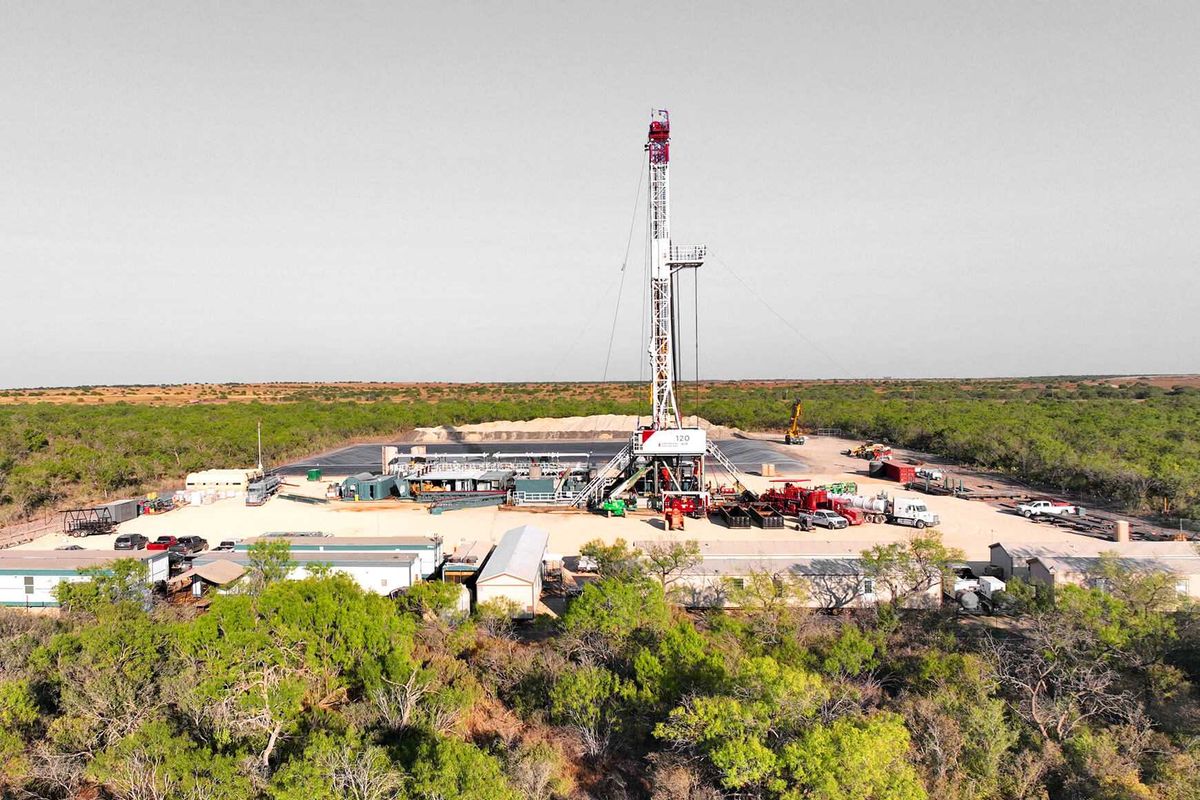
Fervo Energy is targeting a listing on the Nasdaq exchange. Photo courtesy Fervo Energy

Fervo Energy has officially filed for IPO.

The Houston-based geothermal unicorn filed a registration statement on Form S-1 with the U.S. Securities and Exchange Commission on April 17 to list its Class A common stock on the Nasdaq exchange. Fervo intends to be listed under the ticker symbol "FRVO."

The number and price of the shares have not yet been determined, according to a news release from Fervo. J.P. Morgan, BofA Securities, RBC Capital Markets and Barclays are leading the offering.

The highly anticipated filing comes as Fervo readies its flagship Cape Station geothermal project to deliver its first power later this year

"Today, miles-long lines for gasoline have been replaced by lines for electricity. Tech companies compete for megawatts to claim AI market share. Manufacturers jockey for power to strengthen American industry. Utilities demand clean, firm electricity to stabilize the grid," Fervo CEO Tim Latimer shared in the filing. "Fervo is prepared to serve all of these customers. Not with complex, idiosyncratic projects but with a simplified, standardized product capable of delivering around-the-clock, carbon-free power using proven oil and gas technology."

Fervo has been preparing to file for IPO for months. Axios Pro first reported that the company "quietly" filed for an IPO in January and estimated it would be valued between $2 billion and $3 billion.

Fervo also closed $421 million in non-recourse debt financing for the first phase of Cape Station last month and raised a $462 million Series E in December. The company also announced the addition of four heavyweights to its board of directors last week, including Meg Whitman, former CEO of eBay, Hewlett-Packard, and Spring-based HPE.

Fervo reported a net loss of $70.5 million for the 2025 fiscal year in the S-1 filing and a loss of $41.1 million in 2024.

Tracxn.com estimates that Fervo has raised $1.12 billion over 12 funding rounds. The company was founded in 2017 by Latimer and CTO Jack Norbeck.

Meg Whitman, former CEO of eBay, Hewlett-Packard and HPE, has joined the Fervo board as lead independent director. Photo courtesy of U.S. State Department

Fervo Energy adds former eBay CEO Meg Whitman, other leaders to board

power players

As it prepares for a highly anticipated IPO, Houston-based geothermal power provider Fervo Energy has added four heavyweights to its board of directors.

The most notable new board member is Meg Whitman, former CEO of eBay, Hewlett-Packard, and Spring-based HPE, and former U.S. ambassador to Kenya. She joined the Fervo board as lead independent director.

One of the other high-profile new board members at Fervo is Jessica Uhl. She was chief financial officer of Shell from 2017 to 2022 and spent a little over a year as president of GE Vernova, a GE energy spinoff. She is a former board member of GE, Goldman Sachs and Shell. Today, Uhl advises investment firms on energy matters.

Another energy industry veteran, Trey Lowe, also joined the Fervo board. Lowe is senior vice president and chief technology officer at oil and gas producer Devon Energy, a Fervo investor that’s moving its headquarters from Oklahoma City to Houston. Before Devon, Lowe worked in the U.S. and Norway for Houston-based energy technology company SLB.

The fourth new director at Fervo is Robert Keehan, who spent 37 years at professional services firm PwC. He most recently was PwC’s chief global auditor and earlier was a partner in the firm’s energy practice.

Keehan and Uhl will serve as independent directors, which are non-executive governance and oversight roles, while Lowe is a non-independent director, which is a more hands-on role.

With the four new directors, Fervo has seven board members.

The arrival of the four new board members comes at a monumental time for Fervo, a provider of utility-scale geothermal energy:

“Energy markets are demanding dependable, carbon-free power at an unprecedented scale, and Fervo is uniquely positioned to supply it,” Tim Latimer, co-founder and CEO of Fervo, said in December.
Ad Placement 300x100
Ad Placement 300x600

CultureMap Emails are Awesome

New survey reveals concerns over AI data center growth in Houston

data findings

A new report out of the University of Houston shows that area residents remain wary of the long-term effects of operating data centers.

The recent survey from the University of Houston’s latest SPACE City Panel, conducted by the Center for Public Policy at the Hobby School of Public Affairs, shows that while 85 percent of Houston-area residents use AI, nearly 63 percent oppose the construction of AI data centers within 1 mile of their homes.

Respondents’ concerns centered around data centers’ high energy demand and the area’s power grid reliability. According to the survey, 32 percent of residents who oppose local data center projects would be more likely to support the centers if they relied on renewable energy over fossil fuels.

“Respondents understand that AI can bring economic and educational benefits, but they are also concerned about the physical infrastructure needed to fuel AI, especially data centers,” Soran Mohtadi, post-doctoral fellow at the Hobby School and a researcher on the report, said in a news release. “This physical infrastructure demands more electricity and water, leading to environmental impacts.”

Experts estimate that 6.5 gigawatts of data center capacity will be added to the Texas grid by 2030. And Houston’s data center capacity is predicted to more than double by 2028.

The Electric Reliability Council of Texas also projects electricity demand could reach 218 gigawatts by 2031, which would be more than double the record peak set in August 2023. Data centers are expected to account for 86 gigawatts of that new demand.

Survey respondents also said they are concerned about the state's future water supply, given the large amounts of water that data centers need to stay cool.

In terms of who’s responsible for that issue, 57.6 percent of respondents said they put the onus on Texas lawmakers, while 31.5 percent say tech companies should be responsible.

Additionally, more than 75 percent of respondents believed that data center developers and technology companies—not residents—should bear the cost of infrastructure upgrades to support data centers.

“Every decision legislators make has implications on residents’ everyday lives and local infrastructure now and in the future,” Maria P. Perez Arguelles, lead researcher on the report and research assistant professor at the Hobby School, added in the news release. “This issue is going to become more important in years to come, so this is just the beginning.”

Read the full report here.

---

This article originally appeared on our sister site, EnergyCapitalHTX.com.

American Airlines and Google ink record-breaking deal for cleaner jet fuel

SAF DEAL

Fort Worth-based American Airlines has sealed a record-breaking deal with tech giant Google to bolster the use of cleaner jet fuel.

The deal involves Google’s purchase of sustainable aviation fuel certificates tied to fuel that American will use at Chicago O’Hare International Airport, one of the airline’s hubs. These certificates enable companies like Google to pay for the environmental benefits of sustainable jet fuel without actually using the fuel.

American and Google say this is the largest publicly announced certificate deal between an airline and a corporate customer.

Google says environmental gains from the certificates will help it cut emissions from employees’ business travel.

The agreement covers 35 million gallons of sustainable aviation fuel over three years, resulting in a nearly 300,000 metric tons of carbon dioxide equivalent emissions. American has agreed to buy the fuel from San Antonio-based Valero.

“Our industry-leading agreement with Google is a critical step forward in reducing emissions from our operations,” Jill Blickstein, American’s chief sustainability officer, said in a news release. “By working with leaders like Google who share our commitment to innovation, we’re helping to grow demand for [cleaner jet fuel] and support the development of a stronger, more resilient market.”

Sustainable aviation fuel can reduce emissions by up to 80 percent compared with traditional jet fuel. It is made from feedstocks, like waste oil and fats, or it can be produced synthetically using captured carbon dioxide and renewable electricity.

The aviation industry accounts for about 2.5 percent of carbon dioxide emissions around the world, according to the International Energy Agency.

CenterPoint reports grid resilience updates as hurricane season begins

hurricane readiness

As hurricane season descends upon the region, CenterPoint Energy has shared the latest update on its Greater Houston Resiliency Initiative (GHRI) that’s been working to make grid upgrades and introduce weather-related tech since 2024.

As of April 2026, CenterPoint had:

  • Replaced more than 65,000 poles with stronger storm-resistant infrastructure
  • Trimmed or cleared more than 10,000 miles of vegetation
  • Undergrounded more than 500 miles of power lines
  • Installed more than 600 automation devices
  • Installed more than 150 weather stations

In May, CenterPoint announced its new Community Progress Tracker, which helps residents track electronic infrastructure improvements. In terms of other technology, CenterPoint has announced its partnership with weather, wildfire and flood modeling software Technosylva. The software is expected to help CenterPoint track weather conditions in advance to better prepare crews.

CenterPoint has also added 150 weather stations to improve weather monitoring, conducted a full-scale hurricane response exercise involving more than 400 employees and completed more than 25,000 hours of FEMA training across more than 800 employees. The company opened a new year-round Emergency Operations Center to help coordinate with emergency response partners, local and state officials, and media during major weather events.

“We are proud of the progress made in 2025, which helped deliver more than 100 million fewer outage minutes when compared to 2024, and we are determined to make even more progress in 2026 as we work toward our defining goal: building the nation's most resilient coastal grid,” Nathan Brownell, CenterPoint's vice president of resilience and capital delivery, previously said in a news release.

According to the company, the GHRI aims to improve overall grid resiliency and reliability and to reduce outages for customers. CenterPoint projects its efforts can reduce customer outages by 150 million by the end of 2026.