







Square Robot's Houston office has the ability to showcase the technology to its potential customers. Photo courtesy of Square Robot

The robots are coming. Although the rise of Chat GPT has frightened plenty of professionals, we’re not on the precipice of the singularity just yet. And some of Houston’s coolest robots are contained in above-ground tanks, simply doing jobs that are too expensive and difficult for humans. The mechanical helpers in question come courtesy of Square Robot.

Square Robot co-founder and chief technology officer Jerome Vaganay started the company in 2016 in Boston. The company opened its Houston office in August of 2019.

“A lot of our partners and client base is out of here,” says director of operations, Matt Crist.

Karishma Prasad, director of technical operations, who joined the team in Houston earlier this year, adds “It’s a great centralized place for us. Houston is a great hub both nationally and internationally. There is so much energy transition innovation happening here.”

Square Robot is indeed a robotics company, but it trades in a very specific type of robot. The SR-1 is an innovative tank inspector.

“Since the ‘60s there’s been a traditional way of going into a tank. People would go inside and clean it with a variety of products," Crist explains. "Once it was clean, they would come in and inspect it repair it and that could take months.”

In fact, it could often cause a 15 or 16-week outage, he says.

Square Robot’s brainstorm was to take the human element out of the process. In other words, robots can do the job more safely, efficiently and quickly than a human ever could by collecting 18,000 data points per square foot, while allowing the product — most often diesel — to stay in the tank.

Square Robot saves those vast weeks of time, but perhaps even more importantly, says Prasad, “We’re avoiding emissions being released into the atmosphere.”

With its key location in Houston, Square Robot has worked with most of the major names in the energy world, including ExxonMobil, Chevron, BP, and Crist’s former employer, Phillips 66.

The latest robot is the SR-3, which is currently being tested in Houston. Curious webwatchers can see its progress on Square Robot’s website. Unlike the flagship SR-1, the new robot boasts a side launcher that allows it to be completely immersed in a tank before being launched.

But perhaps the most exciting thing about Square Robot’s 15-human Houston office is its test tank. There, potential partners can see exactly what the company’s ingenious creation can do. Square Robot will participate in ILTA, the International Operating Conference & Trade Show, which takes place from May 21-24. On the 24th, the company will host an open house from noon to 3 p.m. to allow potential users to see the SR-3 in action in the 42-foot-long test tank.

Square Robot will complete its hundredth tank inspection in May. It is also growing beyond the oil and gas world to include work with the power industry and was recently selected as a finalist in the Incubatenergy Lab Start Up program. This is one robot that we will happily allow to take over formerly all-too-human responsibilities.
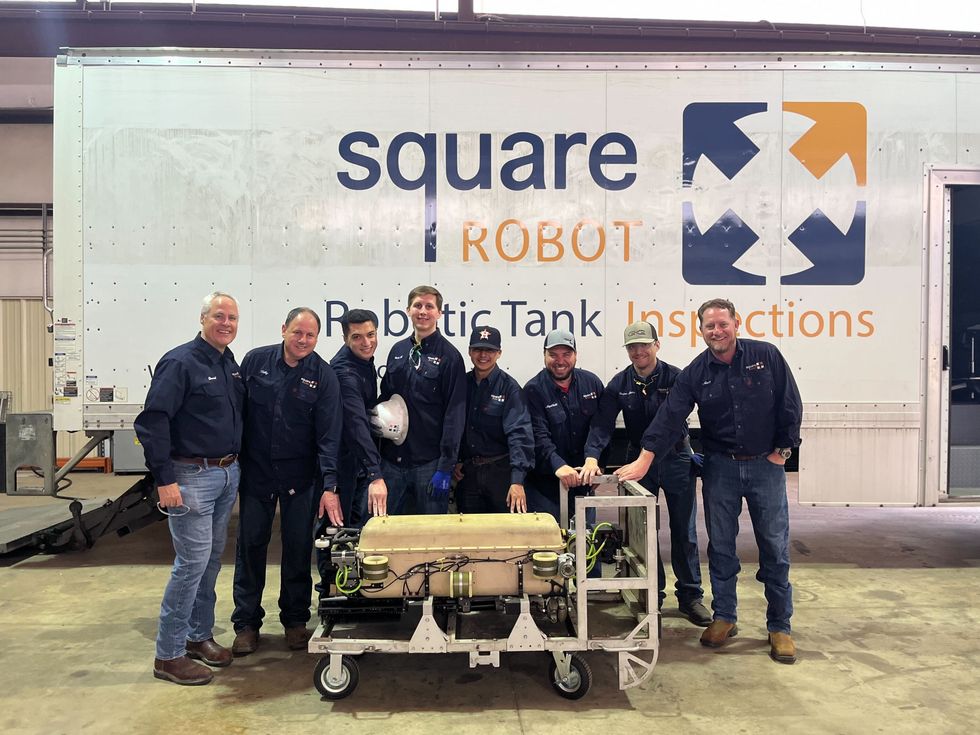
Square Robot has a team of 15 in Houston. Photo courtesy of Square Robot

---

This article originally ran on InnovationMap.


Ad Placement 300x100
Ad Placement 300x600

CultureMap Emails are Awesome

Reliant partners to expand Texas virtual power plant and home battery use

energy incentives

Houston’s Reliant and San Francisco tech company GoodLeap are teaming up to bolster residential battery participation and accelerate the growth of NRG’s virtual power plant (VPP) network in Texas.

Through the new partnership, eligible Reliant customers can either lease a battery or enter into a power purchase agreement with GoodLeap through its GoodGrid program, which incentivises users by offering monthly performance-based rewards for contributing stored power to the grid. Through the Reliant GoodLeap VPP Battery Program, customers will start earning $40 per month in rewards from GoodLeap.

“These incentives highlight our commitment to making homeowner battery adoption more accessible, effectively offsetting the cost of the battery and making the upgrade a no-cost addition to their homes,” Dan Lotano, COO at GoodLeap, said in a news release.“We’re proud to work with NRG to unlock the next frontier in distributed energy in Texas. This marks an important step in GoodLeap reaching our nationwide goal of 1.5 GW of managed distributed energy over the next five years.”

Other features of the program include power outage plans, with battery reserves set aside for outage events. The plan also intelligently manages the battery without homeowner interaction.

The partnership comes as Reliant’s parent company, NRG, continues to scale its VPP program. Last year, NRG partnered with California-based Renew Home to distribute hundreds of thousands of VPP-enabled smart thermostats by 2035 in an effort to help households manage and lower their energy costs.

“We started building our VPP with smart thermostats across Texas, and now this partnership with GoodLeap brings home battery storage into our platform,” Mark Parsons, senior vice president and head of Texas energy at NRG, said in a the release. “Each time we add new devices, we’re enabling Texans to unlock new value from their homes, earn rewards and help build a more resilient grid for everyone. This is about giving customers the opportunity to actively participate in the energy transition and receive tangible benefits for themselves and their communities.

How Corrolytics is tackling industrial corrosion and cutting emissions

now streaming

Corrosion is not something most people think about, but for Houston's industrial backbone pipelines, refineries, chemical plants, and water infrastructure, it is a silent and costly threat. Replacing damaged steel and overusing chemicals adds hundreds of millions of tons of carbon emissions every year. Despite the scale of the problem, corrosion detection has barely changed in decades.

In a recent episode of the Energy Tech Startups Podcast, Anwar Sadek, founder and CEO of Corrolytics, explained why the traditional approach is not working and how his team is delivering real-time visibility into one of the most overlooked challenges in the energy transition.

From Lab Insight to Industrial Breakthrough

Anwar began as a researcher studying how metals degrade and how microbes accelerate corrosion. He quickly noticed a major gap. Companies could detect the presence of microorganisms, but they could not tell whether those microbes were actually causing corrosion or how quickly the damage was happening. Most tests required shipping samples to a lab and waiting months for results, long after conditions inside the asset had changed.

That gap inspired Corrolytics' breakthrough. The company developed a portable, real-time electrochemical test that measures microbial corrosion activity directly from fluid samples. No invasive probes. No complex lab work. Just the immediate data operators can act on.

“It is like switching from film to digital photography,” Anwar says. “What used to take months now takes a couple of hours.”

Why Corrosion Matters in Houston's Energy Transition

Houston's energy transition is a blend of innovation and practicality. While the world builds new low-carbon systems, the region still depends on existing industrial infrastructure. Keeping those assets safe, efficient, and emission-conscious is essential.

This is where Corrolytics fits in. Every leak prevented, every pipeline protected, and every unnecessary gallon of biocide avoided reduces emissions and improves operational safety. The company is already seeing interest across oil and gas, petrochemicals, water and wastewater treatment, HVAC, industrial cooling, and biofuels. If fluids move through metal, microbial corrosion can occur, and Corrolytics can detect it.

Because microbes evolve quickly, slow testing methods simply cannot keep up. “By the time a company gets lab results, the environment has changed completely,” Anwar explains. “You cannot manage what you cannot measure.”

A Scientist Steps Into the CEO Role

Anwar did not plan to become a CEO. But through the National Science Foundation's ICorps program, he interviewed more than 300 industry stakeholders. Over 95 percent cited microbial corrosion as a major issue with no effective tool to address it. That validation pushed him to transform his research into a product.

Since then, Corrolytics has moved from prototype to real-world pilots in Brazil and Houston, with early partners already using the technology and some preparing to invest. Along the way, Anwar learned to lead teams, speak the language of industry, and guide the company through challenges. “When things go wrong, and they do, it is the CEO's job to steady the team,” he says.

Why Houston

Relocating to Houston accelerated everything. Customers, partners, advisors, and manufacturing talent are all here. For industrial and energy tech startups, Houston offers an ecosystem built for scale.

What's Next

Corrolytics is preparing for broader pilots, commercial partnerships, and team growth as it continues its fundraising efforts. For anyone focused on asset integrity, emissions reduction, or industrial innovation, this is a company to watch.

Listen to the full conversation with Anwar Sadek on the Energy Tech Startups Podcast to learn more:

---

Energy Tech Startups Podcast is hosted by Jason Ethier and Nada Ahmed. It delves into Houston's pivotal role in the energy transition, spotlighting entrepreneurs and industry leaders shaping a low-carbon future.


Investors close partial acquisition of Phillips 66 subsidiary with growing EV network

M&A activity

Energy Equation Partners, a London-based investment firm focused on clean energy companies, and New York-based Stonepeak have completed the acquisition of a 65 percent interest in JET Tankstellen Deutschland GmbH, a subsidiary of Houston oil and gas giant Phillips 66.

JET is one of the largest and most popular fuel retailers in Germany and Austria with a rapidly growing EV charging network, according to a news release. It also operates approximately 970 service stations, convenience stores and car washes.

“We are delighted to complete this acquisition and to partner with Stonepeak and Phillips 66 to take JET to the next level,” Javed Ahmed, managing partner of Energy Equation Partners, said in a news release. “This investment reflects EEP’s commitment to investing in established players in the energy sector who have the potential to make a meaningful impact on the energy transition, and we are excited to work alongside the entire JET team, including its dedicated service station operators, to realize this vision.”

The deal values JET at approximately $2.8 billion. Phillips 66 will retain a 35 percent non-operated interest in JET and received about $1.6 billion in pre-tax proceeds.

“Under Phillips 66’s ownership, JET has grown into one of the largest fuel retailers in Germany and Austria," Anthony Borreca, senior managing director and co-head of energy at Stonepeak, added in a news release. "We are excited to join forces with them, as well as Javed and the EEP team, who have long-standing experience investing in and operating retail fuel distribution and logistics globally, to support the next phase of JET’s growth.”