INPEX Corp. and Green Hydrogen International have agreed to a Joint Study Agreement to advance a South Texas hydrogen production facility called "Hydrogen City." Photo via Getty Images

An oil and gas exploration and production company has signed on to collaborate on a green hydrogen project in Texas to keep up with growing global market demand.

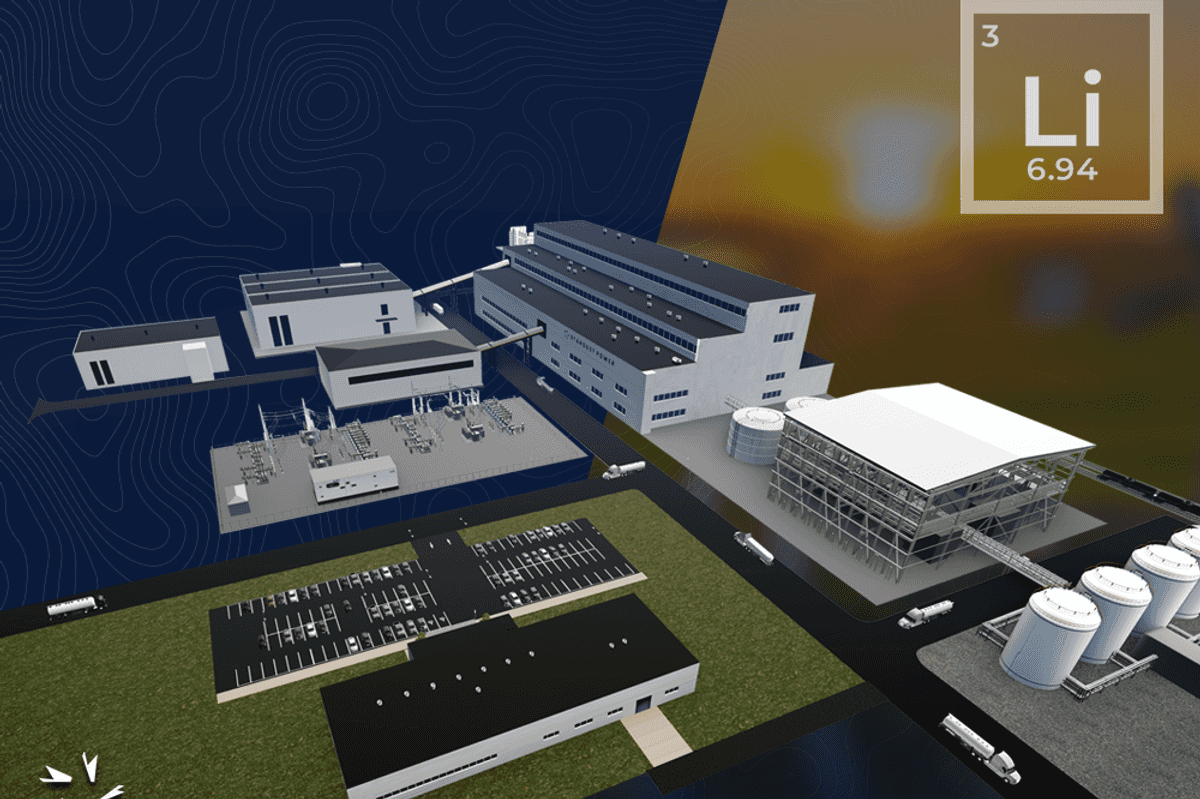
INPEX Corp. and Green Hydrogen International have agreed to a Joint Study Agreement to advance a South Texas hydrogen production facility called "Hydrogen City." The project's first phase will produce 280,000 tons per year of green hydrogen and 1 million tons per year of green ammonia. Construction is slated to begin in 2026 with commercial operation expected in 2029.

INPEX's "unparalleled expertise in large energy project development combined with a world-class marketing organization will provide enormous advantages to the Hydrogen City project and our goal of producing the world's lowest-cost green hydrogen by 2029," Brian Maxwell, CEO of GHI, says in a news release.

The partnership brings together both entities' expertise, with INPEX's experience developing large scale energy projects and marketing LNG to international customers. Meanwhile, GHI uses salt cavern storage and behind-the-meter renewable power to produce low-cost green hydrogen.

"I am excited to announce this green hydrogen project in Texas, which exemplifies our unwavering commitment to environmental leadership and innovation," INPEX Representative Director, President, and CEO Takayuki Ueda says in the release. "INPEX's dedication to a brighter, greener future remains steadfast, and this endeavor in Texas marks a pivotal step in our vision for a more sustainable tomorrow."

INPEX is also a part of a large-scale, low-carbon ammonia production and export project on the Houston Ship Channel that was anounced ealier this month.

Hydrogen City, located in South Texas atop the Peidras Pintas Salt Dome, was originally announced in March 2022. There will be a 75 mile pipeline from Hydrogen City to Corpus Christi, supplying a 1 Million Tonne Per Annum (MTPA) ammonia production facility and local off-takers.
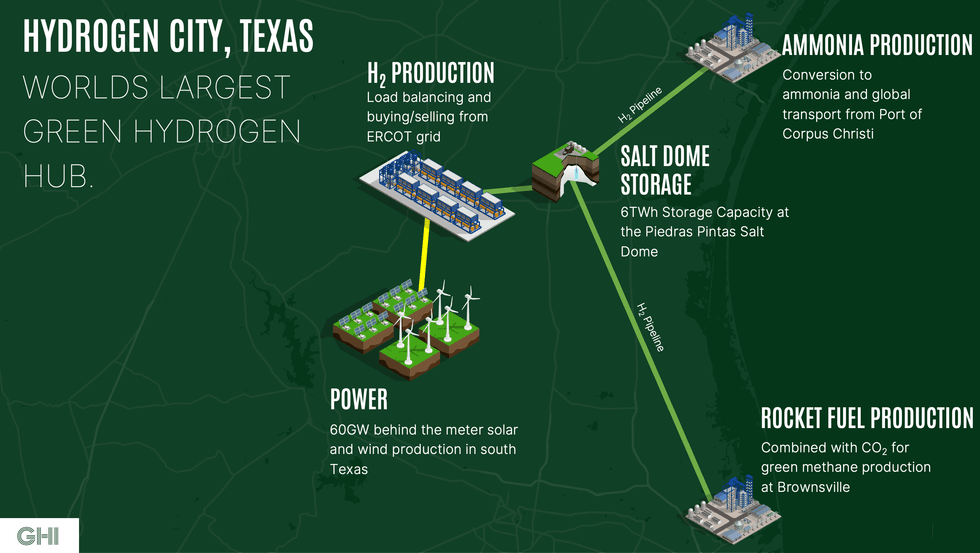
Image via ghi-corp.com

Ad Placement 300x100
Ad Placement 300x600

CultureMap Emails are Awesome

Air Liquide and Hyundai ink partnership to scale hydrogen economy

green team

Air Liquide, which maintains its U.S. headquartered in Houston, and South Korea-based Hyundai Motor Group are expanding their strategic partnership to accelerate the growth of the global hydrogen ecosystem.

The renewal of the companies’ Memorandum of Understanding (MoU) was announced at the Hydrogen Council CEO Summit in Seoul last week. Together, the companies will work to scale hydrogen production, storage, transportation and utilization across Europe, Korea and the United States with a concentration on heavy-duty transport, logistics and public transportation.

Hyundai hopes Air Liquide's technical expertise will help contribute to more sustainable energy and carbon neutrality.

The companies plan to develop hydrogen refueling networks and storage capacity that can meet growing demands. They also plan to commercialize fuel cell electric vehicles (FCEVs) for diverse applications like public transportation, logistics fleets and ports.

"We are delighted to strengthen our partnership with Hyundai Motor Group,” Armelle Levieux, vice president of innovation, electronics and hydrogen at Air Liquide, said in a news release. “Collaborations like this between leaders across the value chain are essential to building the hydrogen economy.”

The partnership has already shown strong progress in South Korea, according to the companies, with Hyundai rolling out more than 2,000 hydrogen buses and 37,000 passenger fuel cell vehicles, with more expected by 2026. Additionally, Air Liquide has boosted supply capabilities in the region with the new state-of-the-art high-pressure hydrogen filling center, Lotte-Air Liquide Ener’Hy, in Daesan, an industrial hub near Seoul.

Air Liquide and Hyundai previously signed an MoU in 2018, along with other major South Korean players, agreeing to grow the hydrogen economy.

Hazardous waste company with Houston presence to make $3B acquisition

big deal

Veolia, a Boston-based company with major operations in Texas, is purchasing hazardous-waste company Clean Earth from Enviri as part of a $3 billion deal.

Veolia is a private water operator, technology provider and hazardous waste and pollution treatment company that operates a large hazardous waste treatment and incineration facility in Port Arthur. Hazardous waste treatment is a growing sector as the clean energy, semiconductor manufacturing, healthcare and pharmaceutical industries generate high levels of waste that need to be handled safely.

Acquiring Clean Earth’s 82 facilities, which include 19 EPA-permitted sites, will expand Veolia’s reach into 10 new states and will position the company as the second-largest hazardous waste operator in the U.S., according to a news release. The deal is Veolia’s sixth and largest North American acquisition of 2025.

“(The acquisition) allows us to unlock the full value potential of our U.S. hazardous waste activities and to double our size on this critical, fast-growing sector, creating a No. 2 player,” Estelle Brachlianoff, CEO of Veolia, said in a news release. “We reinforce our global capacities in hazardous waste and further increase our international footprint.”

Veolia’s Port Arthur facility specializes in servicing generators with large-volume waste treatment requirements.

The transaction is expected to close mid-2026. Veolia hopes the increased exposure into industries such as retail and healthcare will help to offer a full range of environmental services across the U.S.

“This continued transformation of our portfolio enhances the growth profile and strength of our group, uniquely positioned to tackle the sustained demand for environmental security,” Brachlianoff added in the release.

Reliant partners to expand Texas virtual power plant and home battery use

energy incentives

Houston’s Reliant and San Francisco tech company GoodLeap are teaming up to bolster residential battery participation and accelerate the growth of NRG’s virtual power plant (VPP) network in Texas.

Through the new partnership, eligible Reliant customers can either lease a battery or enter into a power purchase agreement with GoodLeap through its GoodGrid program, which incentivises users by offering monthly performance-based rewards for contributing stored power to the grid. Through the Reliant GoodLeap VPP Battery Program, customers will start earning $40 per month in rewards from GoodLeap.

“These incentives highlight our commitment to making homeowner battery adoption more accessible, effectively offsetting the cost of the battery and making the upgrade a no-cost addition to their homes,” Dan Lotano, COO at GoodLeap, said in a news release.“We’re proud to work with NRG to unlock the next frontier in distributed energy in Texas. This marks an important step in GoodLeap reaching our nationwide goal of 1.5 GW of managed distributed energy over the next five years.”

Other features of the program include power outage plans, with battery reserves set aside for outage events. The plan also intelligently manages the battery without homeowner interaction.

The partnership comes as Reliant’s parent company, NRG, continues to scale its VPP program. Last year, NRG partnered with California-based Renew Home to distribute hundreds of thousands of VPP-enabled smart thermostats by 2035 in an effort to help households manage and lower their energy costs.

“We started building our VPP with smart thermostats across Texas, and now this partnership with GoodLeap brings home battery storage into our platform,” Mark Parsons, senior vice president and head of Texas energy at NRG, said in a the release. “Each time we add new devices, we’re enabling Texans to unlock new value from their homes, earn rewards and help build a more resilient grid for everyone. This is about giving customers the opportunity to actively participate in the energy transition and receive tangible benefits for themselves and their communities.