energy flow
Houston quantum simulator research reveals clues for solar energy conversion
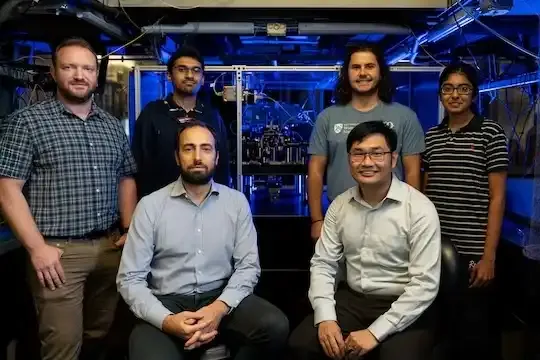
Rice University scientists have used a programmable quantum simulator to mimic how energy moves through a vibrating molecule.
The research, which was published in Nature Communications last month, lets the researchers watch and control the flow of energy in real time and sheds light on processes like photosynthesis and solar energy conversion, according to a news release from the university.
The team, led by Rice assistant professor of physics and astronomy Guido Pagano, modeled a two-site molecule with one part supplying energy (the donor) and the other receiving it (the acceptor).
Unlike in previous experiments, the Rice researchers were able to smoothly tune the system to model multiple types of vibrations and manipulate the energy states in a controlled setting. This allowed the team to explore different types of energy transfer within the same platform.
“By adjusting the interactions between the donor and acceptor, coupling to two types of vibrations and the character of those vibrations, we could see how each factor influenced the flow of energy,” Pagano said in the release.
The research showed that more vibrations sped up energy transfer and opened new paths for energy to move, sometimes making transfer more efficient even with energy loss. Additionally, when vibrations differed, efficient transfer happened over a wider range of donor–acceptor energy differences.
“The results show that vibrations and their environment are not simply background noise but can actively steer energy flow in unexpected ways,” Pagano added.
The team believes the findings could help with the design of organic solar cells, molecular wires and other devices that depend on efficient energy or charge transfer. They could also have an environmental impact by improving energy harvesting to reduce energy losses in electronics.
“These are the kinds of phenomena that physical chemists have theorized exist but could not easily isolate experimentally, especially in a programmable manner, until now,” Visal So, a Rice doctoral student and first author of the study, added in the release.
The study was supported by The Welch Foundation,the Office of Naval Research, the National Science Foundation CAREER Award, the Army Research Office and the Department of Energy.