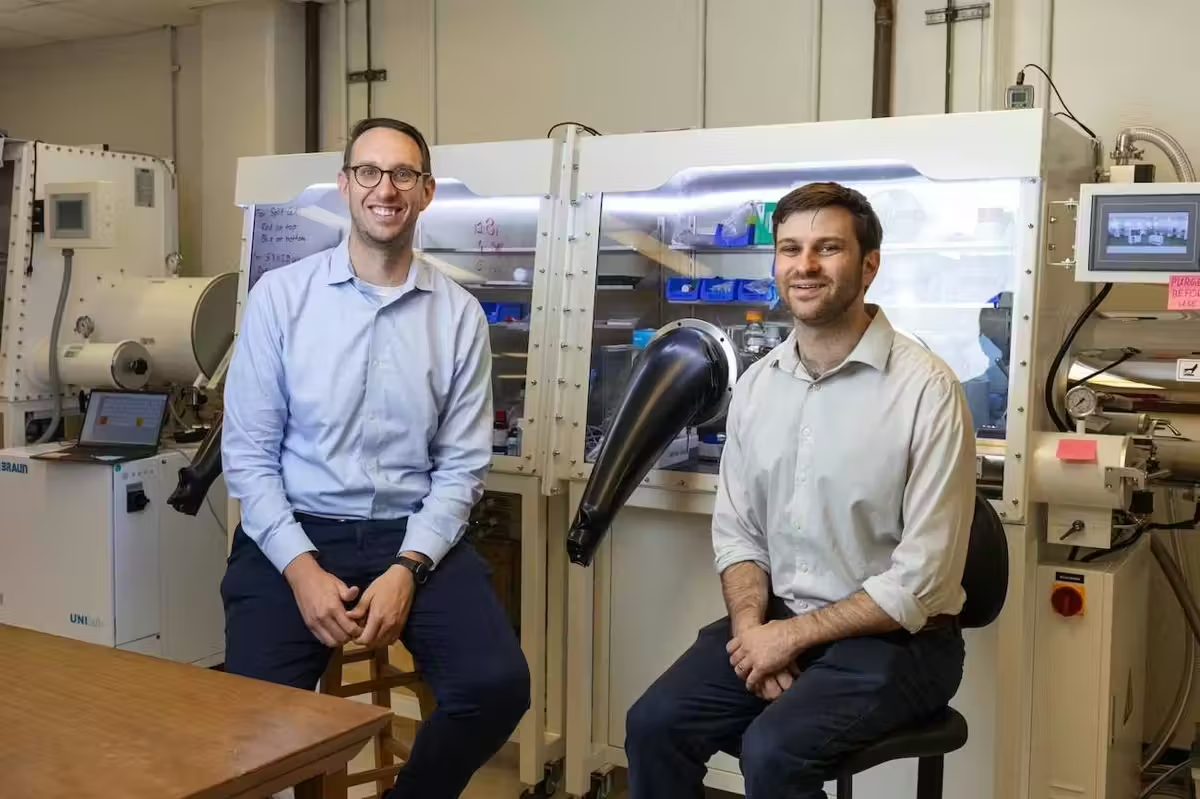
Base Power, founded by Justin Lopas and Zach Dell, has closed one of the largest venture capital deals of the year. Photo courtesy Base Power.

Austin-based startup Base Power, which offers battery-supported energy in the Houston area and other regions, has raised $1 billion in series C funding—making it one of the largest venture capital deals this year in the U.S.

VC firm Addition led the $1 billion round. All of Base Power’s existing major investors also participated, including Trust Ventures, Valor Equity Partners, Thrive Capital, Lightspeed Venture Partners, Andreessen Horowitz (a16z), Altimeter, StepStone Group, 137 Ventures, Terrain, Waybury Capital, and entrepreneur Elad Gil. New investors include Ribbit Capital, Google-backed CapitalG, Spark Capital, Bond, Lowercarbon Capital, Avenir Growth Capital, Glade Brook Capital Partners, Positive Sum and 1789 Capital Management.

Coupled with the new $1 billion round, Base Power has hauled in more than $1.27 billion in funding since it was founded in 2023.

Base Power supplies power to homeowners and the electric grid through a distributed storage network.

“The chance to reinvent our power system comes once in a generation,” Zach Dell, co-founder and CEO of Base Power, said in a news release. “The challenge ahead requires the best engineers and operators to solve it, and we’re scaling the team to make our abundant energy future a reality.”

Zach Dell is the son of Austin billionaire and Houston native Michael Dell, chairman and CEO of Round Rock-based Dell Technologies.

In less than two years, Base Power has developed more than 100 megawatt-hours of battery-enabled storage capacity. One megawatt-hour represents one hour of energy use at a rate of one million watts.

Base Power recently expanded its service to the city of Houston. It already was delivering energy to several other communities in the Houston area. To serve the Houston region, the startup has opened an office in Katy.

The startup also serves the Dallas-Fort Worth and Austin markets. At some point, Base Power plans to launch a nationwide expansion.

To meet current and future demand, Base Power is building its first energy storage and power electronics factory at the former downtown Austin site of the Austin American-Statesman’s printing presses.

“We’re building domestic manufacturing capacity for fixing the grid,” Justin Lopas, co-founder and chief operating officer of Base Power, added in the release. “The only way to add capacity to the grid is [by] physically deploying hardware, and we need to make that here in the U.S. ... This factory in Austin is our first, and we’re already planning for our second.”

Ad Placement 300x100
Ad Placement 300x600

CultureMap Emails are Awesome

Japanese company plans $357M solar manufacturing plant in Houston area

coming soon

Japanese solar manufacturing company TOYO Co. Ltd. plans to invest $357 million to bring a 1.5-gigwatt solar cell manufacturing facility to the Houston area.

TOYO’s latest state-of-the-art facility will be co-located at its existing solar module site in Humble, according to a news release from the company. It will produce heterojunction (HJT) solar cells, which are known to be more durable and efficient with a higher heat threshold.

TOYO reports that the new facility will create 400 full-time manufacturing jobs. The project is expected to be completed in 20 months, which includes an initial pilot production.

"Expanding into domestic cell manufacturing is the natural next step in our commitment to creating an integrated onshore solar supply chain from polysilicon to panels," Takahiko Onozuka, chairman and CEO of TOYO, said in the news release. "Co-locating 1.5 GW of HJT cell capacity at our Houston module site significantly optimizes our capital allocation and infrastructure spend.”

TOYO entered the Houston market in 2024 through its acquisition of a majority stake in Solar Plus Technology Texas LLC.

Earlier this year, it began producing solar modules at its 567,140-square-foot plant in Lovett Industrial’s Nexus North Logistics Park. At the time, the company said it planned to expand manufacturing capacity to 6.5 gigawatts.

"The new cell plant reflects TOYO's long-term strategy to build a fully FEOC-compliant domestic manufacturing platform focused on serving the needs of the U.S. utility-scale solar market," Rhone Resch, TOYO's chief strategy officer, added in the release. "By producing premium solar products in the United States, we will be well positioned to meet the market's evolving domestic content requirements while strengthening supply chain security and reliability. Looking ahead, we believe HJT is the optimal technology platform for integrating next-generation perovskite solar cells, which we expect will drive the next major advancement in solar conversion efficiency and support TOYO's long-term technology roadmap.”

New survey reveals concerns over AI data center growth in Houston

data findings

A new report out of the University of Houston shows that area residents remain wary of the long-term effects of operating data centers.

The recent survey from the University of Houston’s latest SPACE City Panel, conducted by the Center for Public Policy at the Hobby School of Public Affairs, shows that while 85 percent of Houston-area residents use AI, nearly 63 percent oppose the construction of AI data centers within 1 mile of their homes.

Respondents’ concerns centered around data centers’ high energy demand and the area’s power grid reliability. According to the survey, 32 percent of residents who oppose local data center projects would be more likely to support the centers if they relied on renewable energy over fossil fuels.

“Respondents understand that AI can bring economic and educational benefits, but they are also concerned about the physical infrastructure needed to fuel AI, especially data centers,” Soran Mohtadi, post-doctoral fellow at the Hobby School and a researcher on the report, said in a news release. “This physical infrastructure demands more electricity and water, leading to environmental impacts.”

Experts estimate that 6.5 gigawatts of data center capacity will be added to the Texas grid by 2030. And Houston’s data center capacity is predicted to more than double by 2028.

The Electric Reliability Council of Texas also projects electricity demand could reach 218 gigawatts by 2031, which would be more than double the record peak set in August 2023. Data centers are expected to account for 86 gigawatts of that new demand.

Survey respondents also said they are concerned about the state's future water supply, given the large amounts of water that data centers need to stay cool.

In terms of who’s responsible for that issue, 57.6 percent of respondents said they put the onus on Texas lawmakers, while 31.5 percent say tech companies should be responsible.

Additionally, more than 75 percent of respondents believed that data center developers and technology companies—not residents—should bear the cost of infrastructure upgrades to support data centers.

“Every decision legislators make has implications on residents’ everyday lives and local infrastructure now and in the future,” Maria P. Perez Arguelles, lead researcher on the report and research assistant professor at the Hobby School, added in the news release. “This issue is going to become more important in years to come, so this is just the beginning.”

Read the full report here.

---

This article originally appeared on our sister site, EnergyCapitalHTX.com.

American Airlines and Google ink record-breaking deal for cleaner jet fuel

SAF DEAL

Fort Worth-based American Airlines has sealed a record-breaking deal with tech giant Google to bolster the use of cleaner jet fuel.

The deal involves Google’s purchase of sustainable aviation fuel certificates tied to fuel that American will use at Chicago O’Hare International Airport, one of the airline’s hubs. These certificates enable companies like Google to pay for the environmental benefits of sustainable jet fuel without actually using the fuel.

American and Google say this is the largest publicly announced certificate deal between an airline and a corporate customer.

Google says environmental gains from the certificates will help it cut emissions from employees’ business travel.

The agreement covers 35 million gallons of sustainable aviation fuel over three years, resulting in a nearly 300,000 metric tons of carbon dioxide equivalent emissions. American has agreed to buy the fuel from San Antonio-based Valero.

“Our industry-leading agreement with Google is a critical step forward in reducing emissions from our operations,” Jill Blickstein, American’s chief sustainability officer, said in a news release. “By working with leaders like Google who share our commitment to innovation, we’re helping to grow demand for [cleaner jet fuel] and support the development of a stronger, more resilient market.”

Sustainable aviation fuel can reduce emissions by up to 80 percent compared with traditional jet fuel. It is made from feedstocks, like waste oil and fats, or it can be produced synthetically using captured carbon dioxide and renewable electricity.

The aviation industry accounts for about 2.5 percent of carbon dioxide emissions around the world, according to the International Energy Agency.