







The new show is based on a podcast produced by Texas Monthly. Photo courtesy of Paramount+

A new television show that's slated to premiere this fall will put Texas' oil boom on center stage.

Taylor Sheridan's buzzy new Texas-based series Landman will premiere Sunday, November 17, on Paramount+, the network revealed. That's just one week after the November 10 debut of the final episodes of Sheridan's Yellowstone on Paramount.

Landman will launch with two episodes, with subsequent ones dropping weekly on Sundays, a news release says. In total, the first season will be 10 episodes long. The series is based on Texas Monthly's acclaimed podcast Boomtown by West Texas-raised journalist Christian Wallace, which aired from late 2019 to early 2020. Wallace is serving as a consultant and writer on the series.

"Set in the proverbial boomtowns of West Texas, Landman is a modern-day tale of fortune seeking in the world of oil rigs," the show's release says. "Based on the notable 11-part podcast Boomtown, the series is an upstairs/downstairs story of roughnecks and wildcat billionaires fueling a boom so big, it’s reshaping our climate, our economy and our geopolitics."
Landman, Paramount+'Landman' stars Billy Bob Thornton. Photo courtesy of Paramount+

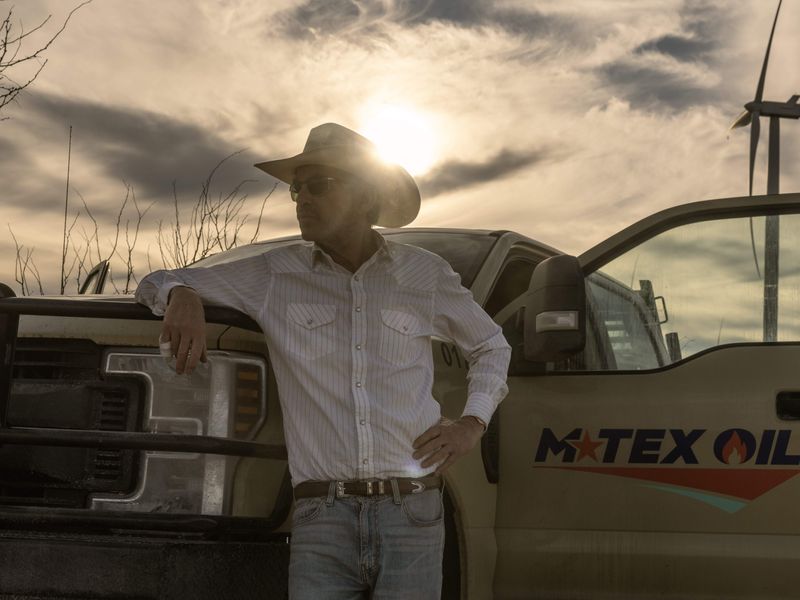
The series stars Billy Bob Thornton as the titular "land man" Tommy Norris, a crisis manager for an oil company.

He leads an all-star cast that includes Demi Moore as Cami Miller and Jon Hamm in a recurring guest role as her husband, Texas oil titan Monty Miller. Ali Larter plays Thornton's wife, Angela Norris; their two kids are portrayed by Michelle Randolph (1923) and Jacob Lofland (Joker 2).

Landman, Jon Hamm, Demi MooreJon Hamm stars as Texas oil titan Monty Miller, and Demi Moore plays his wife, Cami.Photo courtesy of Paramount+

Other stars include James Jordan (Yellowstone), Kayla Wallace (When Calls the Heart), Mark Collie (Nashville), and Paulina Chávez (The Expanding Universe of Ashley Garcia); Andy Garcia (Expendables franchise) and Michael Peña (End of Watch)will make guest appearances.

Sheridan is creator and executive co-producer, and the show is produced by MTV Entertainment Studios, 101 Studios, and Sheridan’s Bosque Ranch Productions. Its release comes sooner than expected; even the show's IMDB page says "2025."

Although it's set in West Texas,Landman has been filming around Dallas-Fort Worth since early 2024, with the show's stars frequenting restaurants and shops around town. Fans have been making a sport of posting local star sightings on social media.

Some lucky residents even got to be extras in sports scenes shot at TCU.

Unlike 1883, which was filmed in and around North Texas in 2021, Landman is not considered a Yellowstone spinoff.

Filming around Dallas-Fort Worth is convenient for Sheridan, who lives on a ranch near Weatherford with his wife, Nicole. He also filmed parts of his series Lawmen: Bass Reeves in North Texas in 2023.

A Texas cowboy through and through, Sheridan is the creator of the award-winning series Yellowstone, its prequels 1883 and 1923, and a forthcoming one reportedly called 1944, starring fellow Texan Matthew McConaughey.

The only question left is: Will Texas get to host the big Landman red-carpet premiere, as Fort Worth did for the Yellowstone Season 5 premiere in November 2022? Stay tuned.

———

This article originally ran on CultureMap.

Ad Placement 300x100
Ad Placement 300x600

CultureMap Emails are Awesome

Mars Materials makes breakthrough in clean carbon fiber production

Future of Fiber

Houston-based Mars Materials has made a breakthrough in turning stored carbon dioxide into everyday products.

In partnership with the Textile Innovation Engine of North Carolina and North Carolina State University, Mars Materials turned its CO2-derived product into a high-quality raw material for producing carbon fiber, according to a news release. According to the company, the product works "exactly like" the traditional chemical used to create carbon fiber that is derived from oil and coal.

Testing showed the end product met the high standards required for high-performance carbon fiber. Carbon fiber finds its way into aircraft, missile components, drones, racecars, golf clubs, snowboards, bridges, X-ray equipment, prosthetics, wind turbine blades and more.

The successful test “keeps a promise we made to our investors and the industry,” Aaron Fitzgerald, co-founder and CEO of Mars Materials, said in the release. “We proved we can make carbon fiber from the air without losing any quality.”

“Just as we did with our water-soluble polymers, getting it right on the first try allows us to move faster,” Fitzgerald adds. “We can now focus on scaling up production to accelerate bringing manufacturing of this critical material back to the U.S.”

Mars Materials, founded in 2019, converts captured carbon into resources, such as carbon fiber and wastewater treatment chemicals. Investors include Untapped Capital, Prithvi Ventures, Climate Capital Collective, Overlap Holdings, BlackTech Capital, Jonathan Azoff, Nate Salpeter and Brian Andrés Helmick.

Tesla no longer world's biggest EV maker as sales drop for second year

EV Update

Tesla lost its crown as the world’s bestselling electric vehicle maker as a customer revolt over Elon Musk’s right-wing politics, expiring U.S. tax breaks for buyers and stiff overseas competition pushed sales down for a second year in a row.

Tesla said that it delivered 1.64 million vehicles in 2025, down 9% from a year earlier.

Chinese rival BYD, which sold 2.26 million vehicles last year, is now the biggest EV maker.

It's a stunning reversal for a car company whose rise once seemed unstoppable as it overtook traditional automakers with far more resources and helped make Musk the world's richest man. The sales drop came despite President Donald Trump's marketing effort early last year when he called a press conference to praise Musk as a “patriot” in front of Teslas lined up on the White House driveway, then announced he would be buying one, bucking presidential precedent to not endorse private company products.

For the fourth quarter, Tesla sales totaled 418,227, falling short of even the much reduced 440,000 target that analysts recently polled by FactSet had expected. Sales were hit hard by the expiration of a $7,500 tax credit for electric vehicle purchases that was phased out by the Trump administration at the end of September.

Tesla stock fell 2.6% to $438.07 on Friday.

Even with multiple issues buffeting the company, investors are betting that Tesla CEO Musk can deliver on his ambitions to make Tesla a leader in robotaxi services and get consumers to embrace humanoid robots that can perform basic tasks in homes and offices. Reflecting that optimism, the stock finished 2025 with a gain of approximately 11%.

The latest quarter was the first with sales of stripped-down versions of the Model Y and Model 3 that Musk unveiled in early October as part of an effort to revive sales. The new Model Y costs just under $40,000 while customers can buy the cheaper Model 3 for under $37,000. Those versions are expected to help Tesla compete with Chinese models in Europe and Asia.

For fourth-quarter earnings coming out in late January, analysts are expecting the company to post a 3% drop in sales and a nearly 40% drop in earnings per share, according to FactSet. Analysts expect the downward trend in sales and profits to eventually reverse itself as 2026 rolls along.

Musk said earlier last year that a “major rebound” in sales was underway, but investors were unruffled when that didn't pan out, choosing instead to focus on Musk's pivot to different parts of business. He has has been saying the future of the company lies with its driverless robotaxis service, its energy storage business and building robots for the home and factory — and much less with car sales.

Tesla started rolling out its robotaxi service in Austin in June, first with safety monitors in the cars to take over in case of trouble, then testing without them. The company hopes to roll out the service in several cities this year.

To do that successfully, it needs to take on rival Waymo, which has been operating autonomous taxis for years and has far more customers. It also will also have to contend with regulatory challenges. The company is under several federal safety investigations and other probes. In California, Tesla is at risk of temporarily losing its license to sell cars in the state after a judge there ruled it had misled customers about their safety.

“Regulatory is going to be a big issue,” said Wedbush Securities analyst Dan Ives, a well-known bull on the stock. “We're dealing with people's lives.”

Still, Ives said he expects Tesla's autonomous offerings will soon overcome any setbacks.

Musk has said he hopes software updates to his cars will enable hundreds of thousands of Tesla vehicles to operate autonomously with zero human intervention by the end of this year. The company is also planning to begin production of its AI-powered Cybercab with no steering wheel or pedals in 2026.

To keep Musk focused on the company, Tesla’s directors awarded Musk a potentially enormous new pay package that shareholders backed at the annual meeting in November.

Musk scored another huge windfall two weeks ago when the Delaware Supreme Court reversed a decision that deprived him of a $55 billion pay package that Tesla doled out in 2018.

Musk could become the world's first trillionaire later this year when he sells shares of his rocket company SpaceX to the public for the first time in what analysts expect would be a blockbuster initial public offering.

Renewables to play greater role in powering data centers, JLL says

Data analysis

Renewable energy is evolving as the primary energy source for large data centers, according to a new report.

The 2026 Global Data Center Outlook from commercial real estate services giant JLL points out that the pivot toward big data centers being powered by renewable energy stems from rising electricity costs and tightening carbon reduction requirements. In the data center sector, renewable energy, such as solar and wind power, is expected to outcompete fossil fuels on cost, the report says.

The JLL forecast carries implications for the Houston area’s tech and renewable energy sectors.

As of December, Texas was home to 413 data centers, second only to Virginia at 665, according to Visual Capitalist. Dozens more data centers are in the pipeline, with many of the new facilities slated for the Houston, Austin, Dallas-Fort Worth and San Antonio areas.

Amid Texas’ data center boom, several Houston companies are making inroads in the renewable energy market for data centers. For example, Houston-based low-carbon energy supplier ENGIE North America agreed last May to supply up to 300 megawatts of wind power for a Cipher Mining data center in West Texas.

The JLL report says power, not location or cost, will become the primary factor in selecting sites for data centers due to multi-year waits for grid connections.

“Energy infrastructure has emerged as the critical bottleneck constraining expansion [of data centers],” the report says. “Grid limitations now threaten to curtail growth trajectories, making behind-the-meter generation and integrated battery storage solutions essential pathways for sustainable scaling.”

Behind-the-meter generation refers to onsite energy systems such as microgrids, solar panels and solar battery storage. The report predicts global solar capacity will expand by roughly 100 gigawatts between 2026 and 2030 to more than 10,000 gigawatts.

“Solar will account for nearly half of global renewable energy capacity in 2026, and despite its intermittent properties, solar will remain a key source of sustainable energy for the data center sector for years to come,” the report says.

Thanks to cost and sustainability benefits, solar-plus-storage will become a key element of energy strategies for data centers by 2030, according to the report.

“While some of this energy harvesting will be colocated with data center facilities, much of the energy infrastructure will be installed offsite,” the report says.

Other findings of the report include:

  • AI could represent half of data center workloads by 2030, up from a quarter in 2025.
  • The current five-year “supercycle” of data center infrastructure development may result in global investments of up to $3 trillion by 2030.
  • Nearly 100 gigawatts worth of new data centers will be added between 2026 and 2030, doubling global capacity.

“We’re witnessing the most significant transformation in data center infrastructure since the original cloud migration,” says Matt Landek, who leads JLL’s data center division. “The sheer scale of demand is extraordinary.”

Hyperscalers, which operate massive data centers, are allocating $1 trillion for data center spending between 2024 and 2026, Landek notes, “while supply constraints and four-year grid connection delays are creating a perfect storm that’s fundamentally reshaping how we approach development, energy sourcing, and market strategy.”