




Oregon-based nuclear technology company NuScale Power is moving into CityCentre. Photo courtesy of Midway

The nuclear energy renaissance continues in Texas with an announcement by NuScale Power. The Oregon-based provider of proprietary and innovative advanced small modular reactor (SMR) nuclear technology announced in April it would be opening office space in Houston’s CityCentre.

“Opening this space in Houston underscores our commitment to meeting rising energy demand with safe, scalable nuclear technology,” John Hopkins, NuScale president and CEO, said in a news release. “This move expands our presence in a key market for partners, prospective customers, and stakeholders in addition to positioning us for the future as we focus on the near-term deployment of our industry-leading technology. Texas is leading the way in embracing advanced nuclear for grid resilience and industrial decarbonization, and we’re proud to expand our footprint and capabilities in this important region.”

Interest in nuclear power has been growing in recent years thanks to tensions with oil-rich nations, concerns about man-made climate change from fossil fuels, and the rapidly increasing power needs of data centers. Both Dow and Texas A&M University have announced expanded nuclear power projects in the last year, with an eye of changing the face of Texas’s energy industry through smaller, safer fission reactors.

Enter NuScale, founded in 2007 from technology developed at the University of Oregon. Their modular SMR technology generates 77 megawatts and is one of the only small modular reactors (SMR) to receive design approval from the U.S. Nuclear Regulatory Commission (NRC). These advances have led to runaway success for NuScale, whose stock has risen by more than 1,670 percent since the start of 2024.

The new operations campus in CityCentre is expected to facilitate the movement, installation and coordination of NuScale technology into the various energy systems. Typically, SMRs are used for off-grid installations, desalination operations, mining facilities and similar areas that lack infrastructure. However, the modularity means that they can be easily deployed to a variety of areas.

It comes none too soon. ERCOT projects that Texas data centers alone will require 77,965 megawatts by 2030.
Ad Placement 300x100
Ad Placement 300x600

CultureMap Emails are Awesome

TotalEnergies expands solar joint venture with $1.2B portfolio in Texas, Ohio

solar expansion

TotalEnergies, a French company whose U.S. headquarters is in Houston, announced this month that it is expanding its renewable energy joint venture with New York-based investment firm KKR by adding 700 megawatts of utility-scale solar projects.

The deal will add three utility-scale solar assets in Texas and Ohio, which are expected to reach commercial operation by Q1 2027, according to a news release from the company. The portfolio is valued at $1.2 billion.

The 50/50 joint venture between TotalEnergies and KKR currently holds 1.4 gigawatts of renewable energy and will grow to 2.1 gigawatts.

The new deal is expected to close this year. Once completed, TotalEnergies will operate the assets. The electricity generated from the solar projects will be sold to third parties, the company reports.

The companies originally formed the joint venture about a year ago when TotalEnergies sold KKR a 50 percent stake in a North American solar portfolio valued at $1.25 billion. The deal originally included six utility-scale solar assets, primarily located in the U.S.

“TotalEnergies is a renewable energy industry leader globally, and we are thrilled to establish this joint venture with the TotalEnergies team to support their renewables business," Cecilio Velasco, managing director KKR, said in a release last year. “We have long been investors in renewables through our infrastructure platform, having committed more than $23 billion to date in energy transition investments. TotalEnergies’ North American solar portfolio is a great fit for us, representing high-quality renewable energy assets with long term contracts.”

TotalEnergies reports that by June 2026 it held more than 37 gigawatts of gross renewable power generation capacity. It aims to achieve over 100 terawatt-hours of net electricity production by 2030.

The company signed a major power purchase agreement with Google earlier this year. Through the deal, TotalEnergies will supply the tech giant with 1 gigawatt of solar power for its data centers in Texas over a 15-year span.

However, the company also recently redirected nearly $1 billion in capital away from wind energy projects and "decided to renounce offshore wind development in the United States." Read more here.

Houston researchers develop compact carbon capture tech for data centers

AI emissions

Two scientists from the University of Houston have been experimenting with new carbon capture systems that fit inside a standard shipping container, which have the potential to make eliminating carbon output from industrial sites much easier.

The capture of industrial carbon is an important complement to the fight against climate change, as well as winning tax credits for businesses that use carbon capture technology.

The problem is that such systems are often measured in acres, making them expensive to build and extremely power-hungry to actually use. UH Engineering Professor Mim Rahimi and former UH Ph.D. student Ahmad Hassan (now a postdoctoral associate at Harvard) have managed to fit their new system, the Small Modular Electrochemical Container (SMECs), inside a standard 40-foot shipping crate, making them compact and modular enough to be installed almost anywhere for operations of all sizes. Their research was recently published in the journal Environmental Science & Technology.

“With a conventional system, you’re building a 130-foot-tall structure designed for a specific power plant. With our technology, we can adjust the capacity by simply turning containers on or off,” Rahimi said in a news release. “That flexibility is particularly important for data centers, where electricity can come from a combination of natural gas and renewable sources.”

Rahimi and Hassan used simulated gas models to show that under optimal conditions, the SMEC used electrochemically mediated amine regeneration (EMAR) cells developed in Rahimi’s lab to capture 90 percent of carbon under optimal conditions through 300 cycles over 50 hours.

Encouraged, the team then modeled a 360-megawatt natural gas power plant associated with OpenAI’s Stargate AI data center project in Abilene, Texas. In addition to the savings on infrastructure costs, 20 of the researchers’ shipping container systems were able to capture 98 percent of carbon from Stargate’s 875-acre campus based on the model.

The looming energy costs and subsequent carbon emissions from data centers are a real concern. Estimates from the U.S. Department of Energy hypothesize that 12 percent of America’s energy needs could be gobbled up by the centers as soon as 2028. That is a massive new source of carbon. The flexibility of the SMEC means they can be deployed wherever the centers spring up.

“We’re taking a technology that traditionally requires enormous infrastructure and finding a way to fit it inside a shipping container,” Rahimi added in the release. “That opens up entirely new possibilities for how and where carbon capture systems can be used.”

In the future, the researchers say they plan to look at ways to adapt the technology to capture carbon dioxide directly from the atmosphere.

Hertha Metals breaks ground on $100M high-purity iron factory in Conroe

coming soon

Shortly after announcing a $133.65 Series A funding round, Conroe-based Hertha Metals broke ground Oct. 8 on a $100 million factory that will produce steel-grade and magnet-grade high-purity iron.

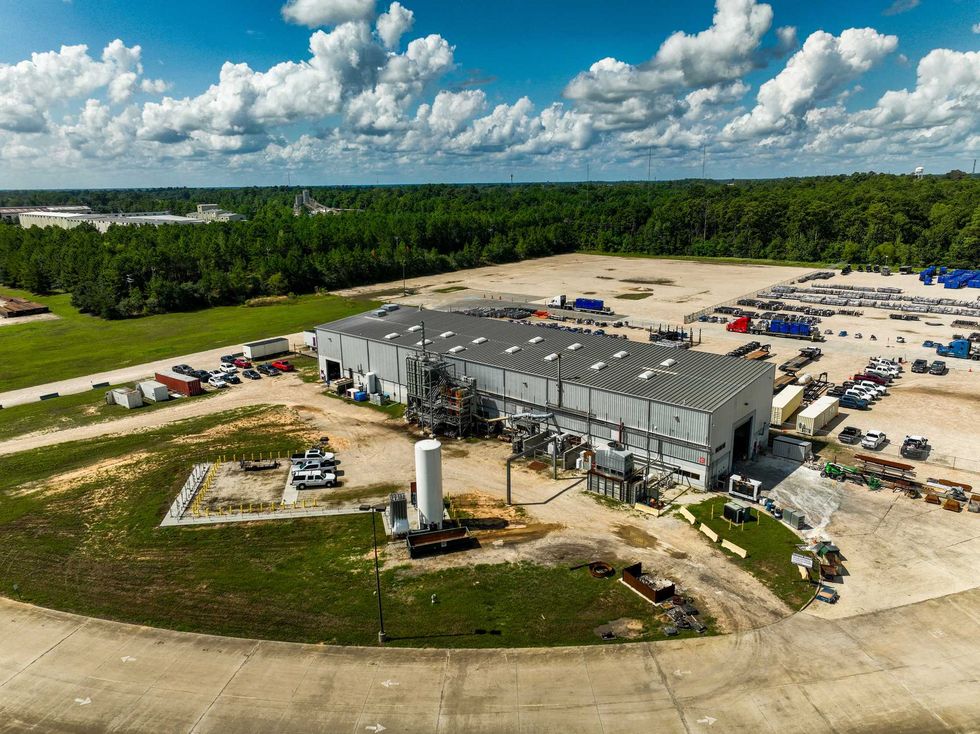
Hertha’s Chalyx plant, located in Conroe, will manufacture a total of about 10,000 metric tons per year of magnet-grade and steel-grade high-purity iron. The factory will use Hertha’s single-step process to generate high-purity iron for rare-earth-magnet and steel manufacturers in the U.S.

Hertha says Chalyx will be the first U.S. commercial plant for production of magnet-grade high-purity iron.

Chalyx is being built next to Hertha’s headquarters and its Pi100 pilot plant, which will remain in operation. Chalyx and Pi100 will form the first modern-day iron and steel “innovation complex” in the U.S., the company says.

“I founded Hertha Metals because I believed we could significantly improve how the world makes iron and steel from ore, and that an industry so fundamental to our future still had enormous room for invention,” Laureen Meroueh, founder and CEO of Hertha, said in a press release.

The 4-year-old startup says the Chalyx complex will lay the foundation for its first 500,000-ton-per-year steel mill.

Chalyx’s first priority is making high-purity iron for U.S. manufacturers of rare-earth magnets, Hertha says. These magnets are critical components for electric vehicles, data centers, wind turbines and defense systems.

China produces an estimated 94 percent of high-purity iron for rare-earth magnets, according to Hertha.

Aside from iron for rare-earth magnets, Chalyx will make iron and steel for pilot projects in the steel industry.

The plant is expected to come online in late 2027, with production of magnet-grade high-purity iron starting in early 2028.

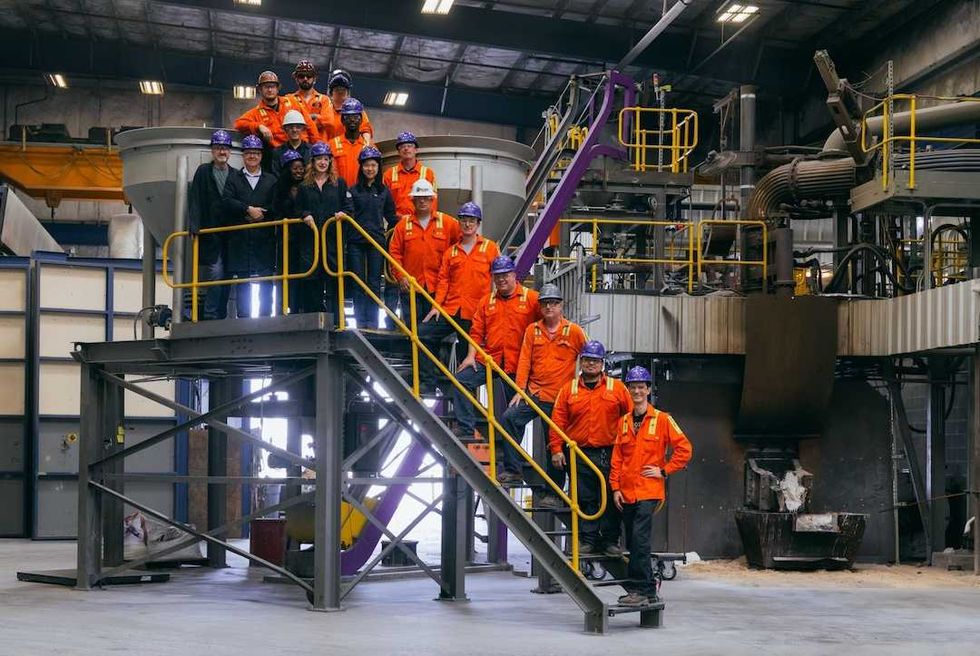
Today, Hertha employs 32 people, the company says. Once it’s fully operating, the Chalyx plant will employ about 50 people.

Just ahead of the groundbreaking, Hertha announced the $133.65 million Series A round, co-led by Khosla Ventures and Doerr Capital. The round included a $65 million equity investment from the Pentagon.

“Iron and steel have shaped human progress for thousands of years. And I believe there is still an enormous amount left to invent,” Meroueh said at the groundbreaking ceremony.