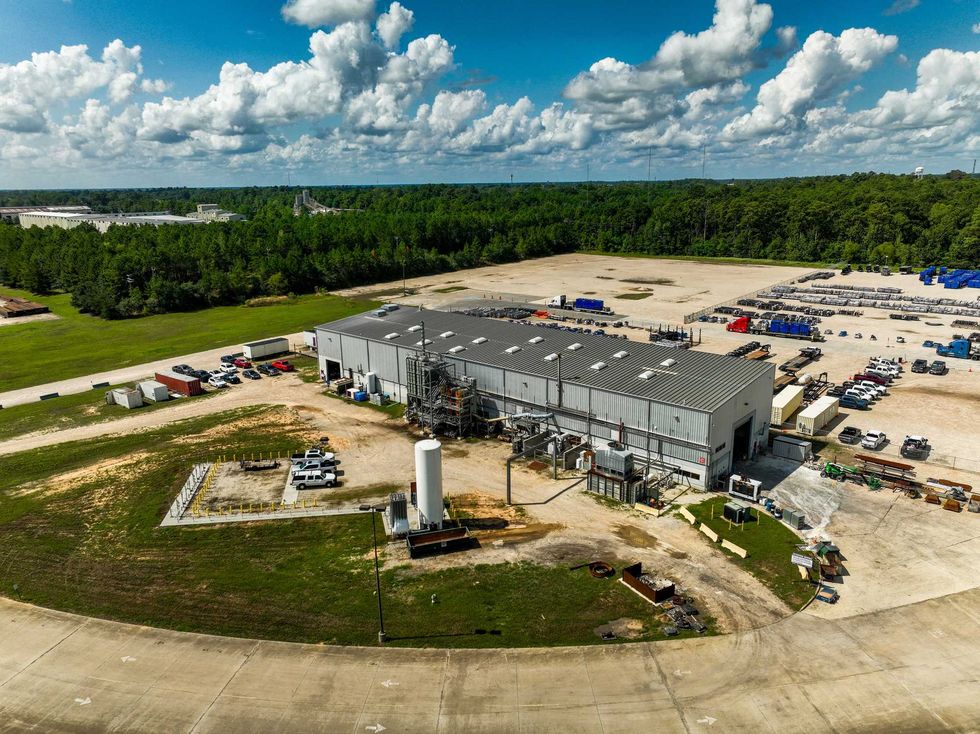
TotalEnergies will supply power to Google data centers from two Texas solar farms under development. Photo via totalenergies.us

French energy company TotalEnergies, whose U.S. headquarters are in Houston, has signed power purchase agreements to supply 1 gigawatt of solar power for Google data centers in Texas over a 15-year span.

The power will be generated by TotalEnergies’ two solar farms that are being developed in Texas. Construction on the company’s Wichita site (805 megawatt-peak, or MWp) and Mustang Creek site (195 MWp) is scheduled to start in the second quarter of this year.

Marc-Antoine Pignon, U.S. vice president for renewables at TotalEnergies, said in a press release that the 1-gigawatt deal “highlights TotalEnergies’ strategy to deliver tailored renewable energy solutions that support the decarbonization goals of digital players, particularly data centers.”

The deal comes after California-based Clearway, in which TotalEnergies holds a 50 percent stake, secured an agreement to supply 1.2 gigawatts of solar power to Google data centers in Texas and other states.

“Supporting a strong, stable, affordable grid is a top priority as we expand our infrastructure,” said Will Conkling, director of clean energy and power at Google. “Our agreement with TotalEnergies adds necessary new generation to the local system, boosting the amount of affordable and reliable power supply available to serve the entire region.”

TotalEnergies maintains a 10-gigawatt-capacity portfolio of onshore solar, wind and battery storage assets in the U.S., including 5 gigawatts in the territory served by the Electric Reliability Council of Texas (ERCOT).

Other clean energy customers of TotalEnergies include Airbus, Air Liquide, Amazon, LyondellBasell, Merck and Microsoft.

Ad Placement 300x100
Ad Placement 300x600

CultureMap Emails are Awesome

HETI discusses Houston’s energy leadership, from pathways to progress

The View From HETI

In 2024, RMI in collaboration with Mission Possible Partnership (MPP) and the Houston Energy Transition Initiative (HETI) mapped out ambitious scenarios for the region’s decarbonization journey. The report showed that with the right investments and technologies, Houston could achieve meaningful emissions reductions while continuing to power the world. That analysis painted a picture of what could be possible by 2030 and 2050.

Today, the latest HETI progress report shows Houston is not just planning anymore — the region is delivering.

Real results, right now

The numbers tell a compelling story. Since 2017, HETI’s member companies have invested more than $95 billion in low-carbon infrastructure, technologies, and R&D. That’s not a commitment for the future—that’s capital deployed, projects built, and operations transformed.

The results showed industry-wide reductions of 20% in total Scope 1 greenhouse gas emissions and a remarkable 55% decrease in methane emissions from global operations. These aren’t projections—they’re actual reductions happening across refineries, chemical plants, and production facilities throughout the Houston region.

How Houston is leading

What makes Houston’s approach work is its practical, technology-driven focus. Companies across the energy value chain are implementing solutions that work today:

  • Electrifying operations and integrating renewable power
  • Deploying advanced methane detection and elimination technologies
  • Upgrading equipment for greater efficiency
  • Capturing and storing carbon at commercial scale
  • Developing breakthrough technologies from geothermal to advanced nuclear

Take ExxonMobil’s Permian Basin electrification, Shell and Chevron’s lower-carbon Whale project, or BP’s massive Tangguh carbon capture project in Indonesia. These aren’t pilot programs—they’re multi-billion dollar investments demonstrating that decarbonization and energy production go hand in hand.

From scenarios to strategy

The RMI analysis identified three key pathways forward: enabling operational decarbonization, accelerating low-carbon technology scale-up, and creating carbon accounting mechanisms. Houston’s energy leaders have embraced all three.

The momentum is undeniable. Companies are setting ambitious 2030 and 2050 targets with clear roadmaps. New projects are reaching final investment decisions. Innovation ecosystems are flourishing. And critically, this progress is creating jobs and driving economic growth across the region.

Why this matters

Houston isn’t just managing the energy transition—it’s proving what’s possible when you combine world-class engineering expertise, integrated infrastructure, access to capital, and a commitment to both energy security and emissions reduction.

The dual challenge of delivering more energy with less emissions isn’t theoretical in Houston—it’s operational reality. Every ton of CO₂ reduced, every efficiency gain achieved, and every technology deployed demonstrates that we can meet growing global energy demand while making measurable progress on climate goals.

The path forward

The journey from last year’s scenarios to this year’s results shows something crucial: when industry, policymakers, and communities align around practical solutions, transformation accelerates.

Houston’s energy leadership isn’t about choosing between reliable energy and environmental progress, it’s about delivering both. And based on the progress we’re seeing, the momentum is only building.

———

Read the full analysis here. This article originally appeared on the Greater Houston Partnership's Houston Energy Transition Initiative blog. HETI exists to support Houston's future as an energy leader. For more information about the Houston Energy Transition Initiative, EnergyCapitalHTX's presenting sponsor, visit htxenergytransition.org.

UH lands $1.5M for endowed professorship and energy workforce initiative

funding the future

The University of Houston announced two major funding awards last month focused on energy transition initiatives and leadership.

Longtime UH supporters Peggy and Chris Seaver made a $1 million gift to the university to establish the Peggy and Chris Seaver Endowed Aspire Professorship, a faculty position “designed to strengthen UH Energy and expand the university’s leadership in addressing the most pressing global energy challenges,” according to a news release.

The new role is the third professorship appointed to UH Energy. The professorship can qualify for a dollar-for-dollar match through the Aspire Fund Challenge, a $50 million matching initiative launched by an anonymous donor.

“This gift will be key to cementing UH’s role as The Energy University,” Ramanan Krishnamoorti, vice president for energy and innovation at UH, said in the release. “By recruiting a highly respected faculty member with international experience, we are further elevating UH Energy’s global profile while deepening our impact here in the energy capital of the world.”

Also in January, the university shared that it would be joining the Urban Enrichment Institute (UEI) and the City of Houston to help train the next generation of energy workers, thanks to a $560,000 grant.

The Gulf Research Program of the National Academies of Sciences, Engineering and Medicine awarded the funding to the UEI, a nonprofit that supports at-risk youth. It will allow the UEI to work with UH’s Energy Transition Institute and the Houston Health Department to launch “Spark Energy Futures: Equipping Youth and Communities for the Energy Transition.”

The new initiative is designed for Houstonians ages 16-25 and will provide hands-on experience, four months of STEM-based training, and industry-aligned certifications without a four-year degree. Participants can also earn credentials and job placement support.

“Our energy systems are going through unprecedented changes to address the growing energy demands in the United States, Gulf Coast and Texas,” Debalina Sengupta, assistant vice president and Chief Operating Officer of ETI at UH, said in a news release.“To meet growing demands, the energy supply, transmission, distribution and markets associated with an ever-increasing energy mix needs a workforce skilled in multidimensional aspects of energy, as well as the flexibility to switch as needed to provide affordable, reliable and sustainable energy to our population.”

Keith Cornelius, executive director of UEI, added that he expects about 50 students to participate in the program’s inaugural year and that the program is looking to attract those interested in entering the energy workforce without a college degree.

“We’re looking to have tremendous success with the Energy Transition Institute,” Cornelius said. “This program is a testament to what can be done between a community-based organization, a major university and the city.”

The award was part of a $2.7 million grant that will fund four projects in the Gulf region, including two others in Texas. The Gulf Research Program Awards also granted $748,175 to launch the “Building the South Texas Energy Workforce” initiative in in Kingsville, Texas and $728,000 for “Texas Green Careers Academy: Activating a New Generation of Energy Professionals” in Austin.

Solar power and storage help save Texans millions on electric bills, CEO tells Senate

price stability

Solar power and battery storage are saving Texans hundreds of millions of dollars on their electric bills, the president and CEO of the Solar Energy Industries Association recently told a congressional committee.

Abigail Ross Hopper, the association’s president and CEO, said in testimony given to the U.S. Senate Environment and Public Works Committee that states like Texas that are adding significant capacity for solar power and battery storage are enjoying lower, more stable prices for electricity.

“Unsubsidized solar is now the cheapest source of electricity in history in much of the country,” Hopper said. “With no fuel costs, solar provides a hedge against natural gas price volatility that continues to cause electricity price spikes.”

“The only way to put downward pressure on prices is by bringing more power online, not less,” she added.

To illustrate the value of solar power and battery storage, Hopper compared two hot summer days in Texas—one in July 2022 and the other in July 2025.

Hopper explained that the Electric Reliability Council of Texas (ERCOT) had begun installing solar on its grid in 2022 but had very little battery storage. ERCOT manages 90 percent of the state’s electrical load.

When ERCOT grid conditions buckled under high demand on the highlighted day in 2022, the price of electricity spiked to nearly $1,500 per megawatt-hour, Hopper said.

“Three years later, the amount of solar had increased substantially and was complemented by energy storage,” she said.

On the specified day in 2025, under even greater demand than three years earlier, sizable amounts of solar power, battery storage and wind power kept ERCOT’s midday price of electricity low and stable—around $50 per megawatt-hour. That dollar amount represented a nearly 100 percent decrease compared with the highlighted day in 2022.

Solar and wind supplied nearly 40 percent of Texas’ power during the first nine months of 2025, according to the U.S. Energy Information Administration (EIA).

Despite the state’s expansion of solar power and battery storage capacity, residential electricity prices in ERCOT’s territory rose 30 percent from 2020 to 2025 and are expected to climb another 29 percent from 2025 to 2030, according to a forecast from the Texas Energy Poverty Research Institute.

The increase in electric bills is tied to factors such as:

  • Higher natural gas prices
  • Greater demand from AI data centers and cryptomining facilities
  • Extreme weather
  • Population growth
  • Development of new transmission and distribution lines

The strain on ERCOT’s grid is only getting worse. An EIA forecast predicts demand for ERCOT electricity will jump 9.6 percent in 2026, and ERCOT expects a 50 percent jump in demand by 2029.