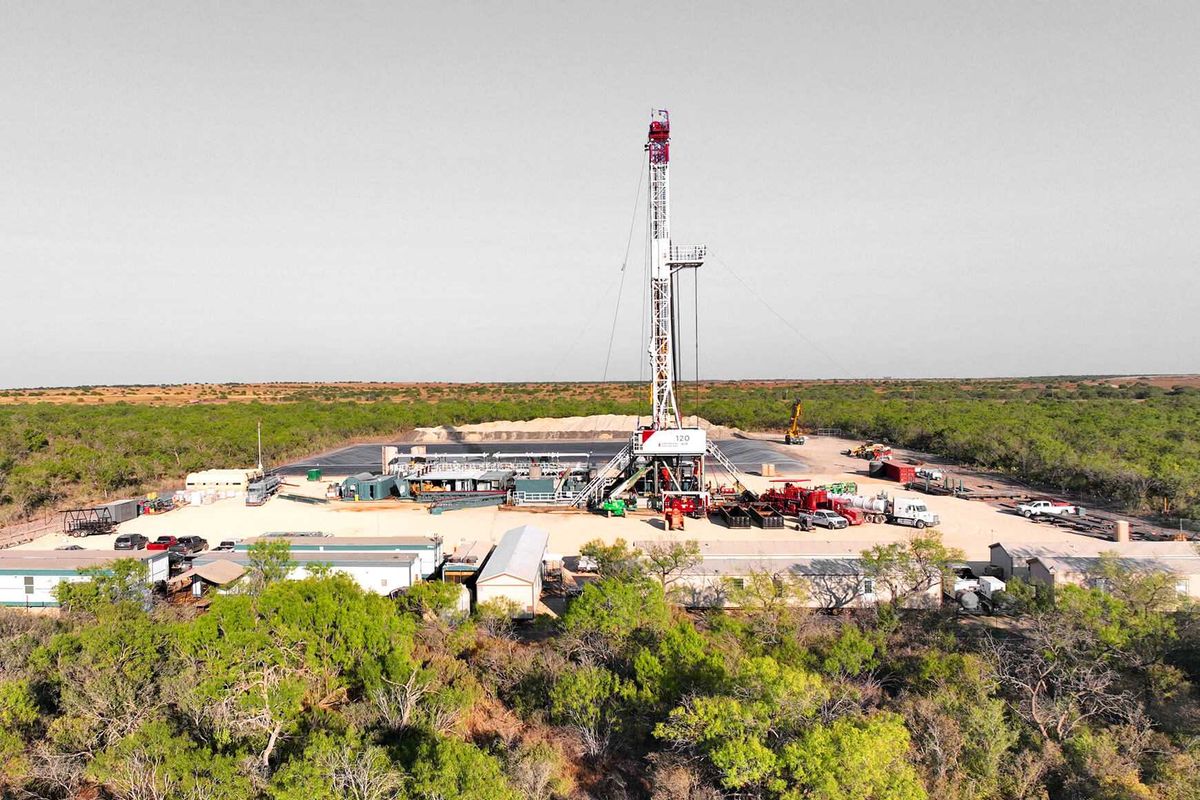
A forecast from Energy Innovation Policy & Technology shows that Texas is expected to see a decline in solar, wind and battery-powered storage by 2035 due to clean energy tax credit repeals in the 'One Big Beautiful Bill Act.' Photo via Getty Images.

Texas is expected to see a 77-gigawatt decrease in power generation capacity within the next 10 years under the federal "One Big Beautiful Bill Act," which President Trump recently signed into law, a new forecast shows.

Primarily due to the act’s repeal of some clean energy tax credits, a forecast, published by energy policy research organization Energy Innovation Policy & Technology, predicts that Texas is expected to experience a:

  • 54-gigawatt decline in capacity from solar power by 2035
  • 23-gigawatt decline in capacity from wind power by 2035
  • 3.1-gigawatt decline in capacity from battery-stored power by 2035
  • 2.5-gigawatt increase in capacity from natural gas by 2035

The legislation “will reduce additions of new, cost-effective electricity capacity in Texas, raising power prices for consumers and decreasing the state’s GDP and job growth in the coming years,” the forecast says.

The forecast also reports that the loss of sources of low-cost renewable energy and the resulting hike in natural gas prices could bump up electric bills in Texas. The forecast envisions a 23 percent to 54 percent hike in electric rates for residential, commercial and industrial customers in Texas.

Household energy bills are expected to increase by $220 per year by 2030 and by $480 per year by 2035, according to the forecast.

Energy Innovation Policy & Technology expects job growth and economic growth to also take a hit under the "Big Beautiful Bill."

The nonprofit organization foresees annual losses of $5.9 billion in Texas economic output (as measured by GDP) by 2030 and $10 billion by 2035. In tandem with the impact on GDP, Texas is projected to lose 42,000 jobs by 2030 and 94,000 jobs by 2035 due to the law’s provisions, according to the organization.

The White House believes the "Big Beautiful Bill" will promote, not harm, U.S. energy production. The law encourages the growth of traditional sources of power such as oil, natural gas, coal and hydropower.

“The One Big Beautiful Bill Act is a historic piece of legislation that will restore energy independence and make life more affordable for American families by reversing disastrous Biden-era policies that constricted domestic energy production,” Interior Secretary Doug Burgum said in a news release.

Promoters of renewable energy offer an opposing viewpoint.

“The bill makes steep cuts to solar energy and places new restrictions on energy tax credits that will slow the deployment of residential and utility-scale solar while undermining the growth of U.S. manufacturing,” says the Solar Energy Industries Association.

Jason Grumet, CEO of the American Clean Power Association, complained that the legislation limits energy production, boosts prices for U.S. businesses and families, and jeopardizes the reliability of the country’s power grid.

“Our economic and national security requires that we support all forms of American energy,” Grumet said in a statement. “It is time for the brawlers to get out of the way and let the builders get back to work.”

Ad Placement 300x100
Ad Placement 300x600

CultureMap Emails are Awesome

Italian clean energy co. selects The Woodlands for North American HQ

new HQ

An Italian renewable energy company has picked The Woodlands for its North American headquarters.

AB Energy USA will occupy about 11,000 square feet in The Woodlands Towers at The Waterway. The company expects to add about 45 jobs in The Woodlands this year. Beginning in 2027, AB Energy USA will add another 30 jobs over a five-year period.

The new headquarters will be the corporate and governance hub for all of AB Energy’s North American subsidiaries. AB Energy, an arm of Italy-based AB, supplies renewable natural gas systems for industrial, commercial and data center customers. AB has operated in the U.S. since 2014.

“Establishing our North American headquarters in the Energy Capital of the World is a strategic step in AB’s long-term commitment to the U.S. market,” Paolo Ruggeri, North American CEO for AB Energy USA, said in a news release. “Houston gives us access to world-class engineering and energy talent, and strengthens our ability to attract and grow a high-performing team.”

Jevon Gibb, CEO of The Woodlands Area Economic Development Partnership, said several markets competed for AB Energy’s North American headquarters.

“AB’s decision to establish its North American headquarters here demonstrates The Woodlands’ competitiveness for both international companies and energy sector leaders,” Gibb said.

40+ teams to pitch at annual CERAWeek clean energy competition

energy venture day

The Rice Alliance for Technology and Entrepreneurship, the Houston Energy Transition Initiative (HETI), the Texas Entrepreneurship Exchange for Energy (TEX-E) and the Ion have named the 30-plus energy ventures and teams that will pitch at the 2026 Energy Venture Day and Pitch Competition during CERAWeek this month.

The selected ventures are "driving efficiency and advancements toward the energy transition," according to the Rice Alliance. Each will each present a 3.5-minute pitch before a network of investors and industry partners during CERAWeek's Agora program on Wednesday, March 25, from noon-5:30 p.m.

The competition is divided up into the TEX-E university track, in which Texas student-led energy startups compete for $50,000 in cash prizes, and the industry ventures track.

Teams competing in the TEX-E Prize track include:

  • GOES
  • Quantum Power System
  • Quas
  • Resonant Thermal Systems
  • Srijan

The industry track is subdivided into three additional tracks, spanning materials to clean energy and will feature 37 companies. A group of expert judges will name the top three companies from each industry track. The winner of the CERAWeek competition will also have the chance to advance and compete for the $1 million investment prize at the Startup World Cup in November 2026.

Teams come from around the world, including several Houston-based ventures, such as Agellus Tank Robotics, Capwell Services and Corrolytics.

The full list of companies pitching at CERAWeek includes:

  • Agellus Tank Robotics
  • Airovation Technologies
  • Anax Power
  • Armeta
  • ATS Energy
  • Capwell Services
  • CarbonLume
  • Cogniprise
  • Corrolytics
  • Daphne Technology
  • Gemini Energy
  • Grid8
  • H Quest Vanguard
  • intcom
  • Ionada Canada
  • Junipix
  • Kunin Technologies
  • LAVA Power
  • Licube
  • LNK Energies
  • Maverick X
  • Membravo
  • Mirico
  • Mocean Energy
  • Monitorai
  • OCOchem
  • Oleo
  • Pix Force
  • PolyJoule
  • Power to Hydrogen
  • Sotaog
  • Spotlight
  • Tierra Climate
  • Verdagy
  • Via Separations
  • Vycarb
  • ZettaJoule

Those not attending CERAWeek can catch these companies and more than a dozen others at a pitch preview at the Ion. The free Pitch Preview will be held Tuesday, March 24, from 9 a.m.-2:30 p.m. Click here to register.

Additional companies pitching during the free preview include:

  • Ammobia
  • Arolytics
  • Ayrton Energy
  • ChainWeave
  • Cybereum
  • Energytech
  • ENP Technologies
  • KP Labs
  • Mcatalysis
  • Mitico
  • Mote
  • Nanos
  • New Horizon Oil and Gas
  • Predyct
  • Salem Robotics
  • Toluai

Two Rice University student teams took home top prizes during last year's TEX-E competition, while ventures from New Jersey, Wyoming and Virgina won in their respective industry tracks. See the full list of last year's winners here.

ExxonMobil to move legal home to Texas, citing business-friendliness

ExxonMobil is poised to move its legal headquarters from New Jersey to Texas in search of a more friendly business environment, the company announced March 10.

The board of directors for the largest U.S.-based oil producing company, which already runs its operations from the Houston suburb of Spring, unanimously recommended to its shareholders that they vote to redomicile the company in Texas.

Shareholders will vote on the change at the company’s annual meeting on May 27. If successful, it will move Exxon’s legal home for the first time since it registered in New Jersey in 1882 as Standard Oil Company — the company later changed its name to Exxon, then merged with Mobil Oil Corp.

“Over the past several years, Texas has made a noticeable effort to embrace the business community,” ExxonMobil Chair and CEO Darren Woods wrote in a statement Tuesday. “In doing so, it has created a policy and regulatory environment that can allow the company to maximize shareholder value. Aligning our legal home with our operating home, in a state that understands our business and has a stake in the company’s success, is important.”

The proposed move will not affect the company’s business operations or employee locations, the company said.

ExxonMobil has been headquartered in Texas since 1989, and about 30% of its employees currently work in the state.

The location of a company’s incorporation dictates the legal, tax and regulatory landscape for the business.

Exxon would join Tesla, Space X and Coinbase as major U.S. companies to redomicile in Texas in recent years as the state moves to become more business friendly.

In 2023, the Legislature passed and Gov. Greg Abbott signed a law that created the Texas Business Court and the 15th Court of Appeals, specialized legal venues designed to handle business and commercial disputes. Those courts began operating in 2024.

Last year, the Legislature also approved a law that made it more difficult to sue board members of companies incorporated in Texas.

“Freed from the stranglehold of over-regulation, Texas is where global brand leaders thrive and jobs for hardworking Texans grow,” Abbott wrote in a Tuesday statement. “I thank ExxonMobil for their decision to redomicile in Texas and for their long-standing partnership with our state. With this decision, Texas will further dominate the corporate landscape and ensure our economic growth reaches new heights.”

Exxon noted the creation of the business courts and other recent legal reforms made by Texas in its statement announcing the decision.

“In making its recommendation, the Board considered Texas’ legal and regulatory environment, including its modernized business statutes and the Texas Business Court, which is designed to resolve complex disputes efficiently,” the statement said.

Texas has benefited from growing frustration among company executives with traditional corporate havens of New Jersey and Delaware. New Jersey sued Exxon in 2022, alleging the company contributed to climate change, which forced the state to pay for cleanup after natural disasters. The lawsuit was dismissed last year.

Delaware remains the nation’s top state for U.S. companies’ legal home.

Coinbase’s CEO wrote last year that the company was reincorporating from Delaware to Texas because the Lone Star State’s legal framework is more predictable and efficient. Tesla reincorporated from Delaware to Texas after a 2024 court ruling ordered CEO Elon Musk to give up a compensation package, finding that the package’s shareholder approval process was “deeply flawed.”

___

This story was originally published by The Texas Tribune and distributed through a partnership with The Associated Press.