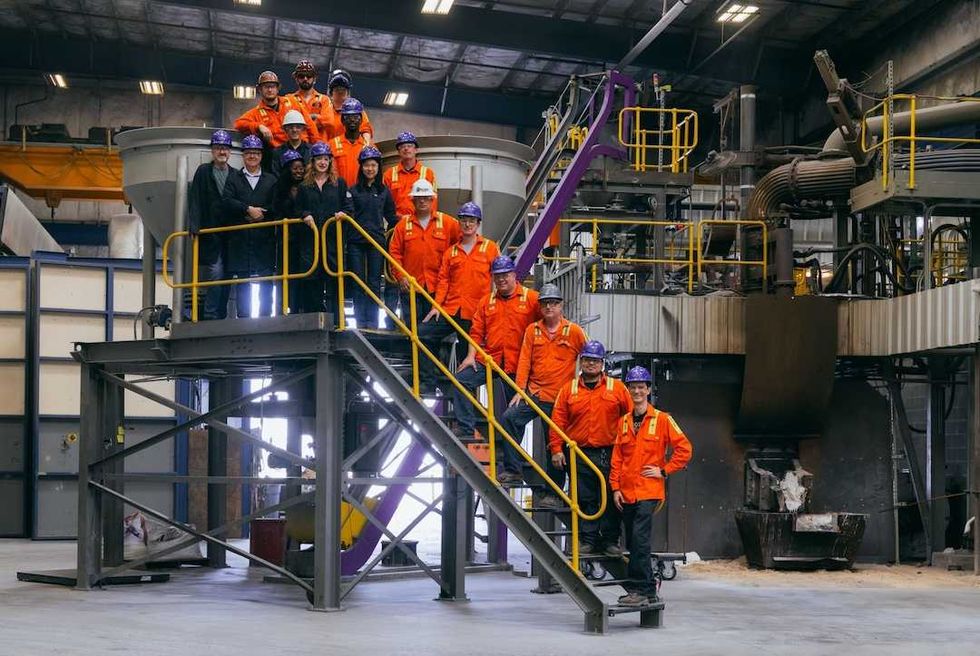
According to a new report, Houston is one of the top cities for funding for sustainability companies. Photo via Getty Images

From a financial standpoint, Houston appears to be a sustainable environment for sustainability-focused startups.

An analysis by PromoLeaf, a retailer of sustainable promotional products, that came out at the end of last year ranks Houston fourth among U.S. cities for the average funding raised by locally based startups in the sustainability sector, according to Crunchbase data.

Per the report, the Bayou City attracts $150.7 million in sustainability funding for startups. Ahead of Houston are Salt Lake City with $204.5 million; Santa Monica, California, with $154.3 million; and Fremont, California, with $153.4 million.

PromoLeaf’s analysis features cities where at least 20 companies are focused on sustainability.

The analysis indicates Houston has 20.6 sustainability startups per 100,000 residents. Ranking first in that regard is Boulder, Colorado (115 per 100,000 residents).

While Houston trails Boulder by a long distance, it fares well among the Texas cities in the analysis:

  1. Austin, 26.2 sustainability startups per 100,000 residents
  2. Houston, 20.6 sustainability startups per 100,000 residents
  3. Midland, 18.8 sustainability startups per 100,000 residents
  4. Plano, 11.9 sustainability startups per 100,000 residents
  5. Dallas, 11 sustainability startups per 100,000 residents
  6. Fort Worth, 5.3 sustainability startups per 100,000 residents
  7. San Antonio, 5.2 sustainability startups per 100,000 residents

PromoLeaf says more than 21,600 sustainability startups operate in the U.S. They’re in the renewable energy, recycling and pollution control, environmental engineering, green consumer goods, and environmental consulting industries.

The analysis shows Houston has:

  • 13.7 renewable energy startups per 100,000 residents
  • 5.8 recycling and pollution control startups per 100,000 residents
  • 3.5 environmental engineering startups per 100,000 residents
  • 2.9 environmental consulting startups per 100,000 residents
  • 0.70 green consumer goods startups per 100,000 residents

According to the Greater Houston Partnership, renewable energy startups leading Houston’s energy transformation include Energy Transition Ventures, Fysikes Biosolutions, Ionada, Katz Water Technologies, Pressure Corp., and Renewell Energy.

“A dynamic business climate combined with growth in venture capital funding in Houston has created fertile ground for companies of all stages aiming to power our world through the global energy transition,” the partnership says. “As the Energy Capital of the World, Houston has become a hub for startups and venture capital firms investing in the region’s energy future.”

Outside the energy sector, Houston startups like Trendy Seconds also are making their mark in sustainability. The company runs an online marketplace where women can find preowned clothing or shop for new clothing from sustainable brands.

“Our ultimate goal is to make responsible consumption super easy,” Maria Burgos, founder of Trendy Seconds, told InnovationMap last year.

------

This article originally ran on InnovationMap.
Ad Placement 300x100
Ad Placement 300x600

CultureMap Emails are Awesome

Houston clean energy startup acquired by battery storage company FlexGen

m&a activity

A North Carolina company has acquired Houston-based Clean Energy Services, a provider of services for battery energy storage systems and utility-scale solar, for an undisclosed amount.

The buyer is Durham, North Carolina-based FlexGen Power Systems, a provider of battery energy storage software and services.

Clean Energy Services (CES), whose offices are at the Ion, will operate as a subsidiary of FlexGen. Existing CES customers will continue to receive services from CES without disruption or change, FlexGen says.

“Demand for reliable, high-performance power is accelerating, and customers need partners who can deliver at scale,” Kelcy Pegler, CEO of FlexGen, said in a news release. “The addition of CES strengthens our service platform and reinforces our leadership in energy storage technology.”

Ahmad Atwan and Constantine Triantafyllides co-founded CES in 2022. As a startup, CES had raised $8 million in venture capital, according to PitchBook.

“CES has achieved a market leadership position in battery storage services by focusing on reliable speed of service delivery and optimizing asset performance,” Atwan, the company’s CEO, added the release. “FlexGen and CES have been strong partners for years, and this transaction enables us to deliver more robust solutions across a complementary set of customers and markets.”

CES will continue to operate its remote operations center in Houston for over 1 gigawatt of solar assets and 4.5 gigawatt-hours of battery assets, while FlexGen will maintain its remote operations center in Durham.

Halliburton Labs names 4 new clean energy startups to incubator

green team

Four new companies have joined Halliburton Labs, the incubator for early-stage energy and climate startups run by Houston energy giant Halliburton.

Halliburton Labs provides the emerging companies with mentorship, industry connections, laboratory access and other resources as they work toward commercialization, according to a news release.

The four new members include:

  • Nandina REM, a Singapore-based company that delivers carbon fiber thermoplastics. It turns end-of-life assets into new, reliable, high-performance materials for the aviation, aerospace and defense industries in a fraction of the time of standard supply chains.
  • Noon Energy, a California-based company that delivers clean, reliable electricity with ultra-long duration energy storage. Its system uses solid oxide electrochemical cells and stores energy as abundant, flexible industrial gases.
  • Proof Energy, a Silicon Valley-based company developed by the Lawrence Berkeley National Laboratory that is commercializing next-generation metallic solid oxide fuel cell (M-SOFC) technology. Its system uses widely available fuels such as ethanol, methanol, ammonia, and natural gas as hydrogen carriers to enable lower-cost, low-emission commercial transportation, and also offers a zero-emission heating solution to preserve battery range in electric vehicles.
  • Tidal Metals, a New Jersey-based company that has developed technology to economically make decarbonized magnesium metal from seawater and electricity.

"Halliburton Labs exemplifies our commitment to advance a secure and pragmatic energy future," Jeff Miller, chairman, president and CEO of Halliburton, said in the news release. "We welcome these companies into our ecosystem, where they will gain access to the tools, expertise, and connections needed to scale their technologies."

Auckland-based Aquafortus Technologies and California-based Sunchem joined Halliburton Labs in September. With the addition of the four new members, the incubator currently supports six early-stage companies.

Read more about the incubator's 2025 cohort here.

Houston-area company to develop next-gen batteries for electric helicopters

emissions-free flight

Webster-based KULR Technology Group has announced a strategic co-development collaboration with Robinson Helicopter Company (RHC) to develop a next-generation, high-performance battery system for the eR66 battery-electric helicopter demonstrator.

KULR, an electronics manufacturing company, will serve as the developer of the advanced battery system for the eR66 platform. KULR will design and integrate a high-performance battery structure that uses its proprietary battery safety technologies and thermal management solutions, previously developed for aerospace and spaceflight applications.

California-based Robinson Helicopter Company is the world's leading manufacturer of civil helicopters. Its eR66 is expected to deliver zero-emission, affordable and quiet performance for “high-demand applications.”

“Robinson Helicopter has built more civil helicopters than any manufacturer on Earth, and their commitment to reliability is exactly the standard KULR’s battery architecture is designed to meet,” Michael Mo, CEO of KULR, said in a news release. “KULR’s battery systems have been qualified for NASA spaceflight. They were designed from day one for dual use: a primary flight cycle and a certified second life. The eR66 is where that architecture proves itself in rotorcraft.”

David Smith, president and CEO of Robinson Helicopter Company, cited the partnership as a shift in service for commercial and civil operations and touted the potential environmental benefits.

“By integrating electric propulsion, we aren't just reducing our environmental impact; we are unlocking critical new capabilities for life-saving missions,” Smith added in the release. “For use cases like rapid organ and tissue transport, the reduced acoustic signature and zero-emission profile ensure that time-sensitive, low-emission deliveries are faster, quieter, and more sustainable than ever before."

The companies say, through the partnership, they aim to:

  • Advance eR66 performance
  • Enhance aviation safety
  • Increase cost efficiency
  • Uphold American aerospace leadership
  • Support decarbonization
  • Promote circular economy principles