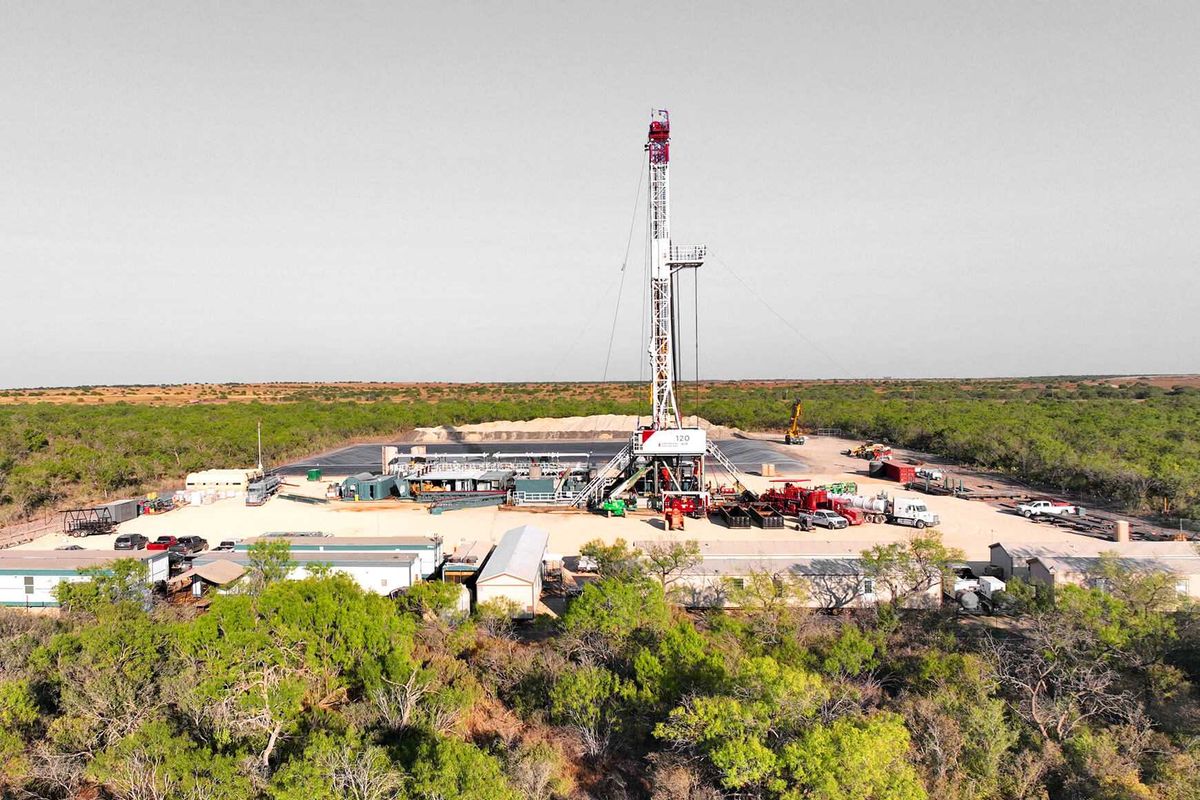
Solugen has named James Begeal, with more than 25 years of experience in the chemical industry, as its new president of energy and water. Photo courtesy Solugen.

Houston-based biochemical producer Solugen has hired chemical industry veteran James Begeal as its new president of energy and water.

In his new position, Begeal leads the commercial strategy for the energy and produced-water sectors, “bringing our innovative chemistry directly to leading oil and gas operators, accelerating revenue growth, and deepening our commercial pipeline,” Solugen said in a news release.

Begeal has more than 25 years of experience in the chemical industry, including roles at oilfield technology company Baker Hughes and chemical company Clariant. In 2016, he co-founded NexGen Chemical Technologies, a Cypress-based provider of alternative natural-gas sweeteners. Begeal served as chief operating officer and chief technology officer at NexGen, which was acquired by League City-based Foremark Performance Chemicals in 2023. He then joined Foremark, which was acquired by investment firm CC Industries in 2024.

Begeal is no stranger to Solugen, having previously served as a company advisor.

“James is a builder — he knows what it takes to launch, scale, and win in this space,” says Solugen CEO Gaurab Chakrabarti. “We’re excited to have him bring that same builder’s mindset to Solugen as we double down on delivering solutions that meet our customers’ toughest challenges.”

The company also recently named Carlos Diaz as its new VP of strategy and international business. Diaz worked for 18 years at Baker Hughes and will lead Solugen's commercial expansion efforts into Latin America and beyond, according to a company representative.

Solugen, founded in 2016, raised $357 million in a series C venture capital round. The 2021 round catapulted Solugen into the unicorn category, meaning the private company is valued at more than $1 billion.
Ad Placement 300x100
Ad Placement 300x600

CultureMap Emails are Awesome

Houston's KBR announces name for new ​government services company

Coming Soon

Houston-based KBR Inc.'s new Mission Technology Solutions unit officially has a name.

The previously announced government services spinoff, which until now has been nicknamed SpinCo, will be known as Trinzic. The company said that the name was inspired by the word intrinsic, "reflecting essential, built-in capabilities and deep expertise operating in some of the world’s most complex and mission-critical environments."

New York-based firm Siegel + Gale developed the company's new brand. In addition to the new name, the company shares that its new logo will feature a stylized letter N, with brand colors in orange and gray.

“Trinzic represents who KBR Mission Tech has always been at our core: an essential partner bringing innovation and trusted execution to the missions that matter most,” Stuart Bradie, KBR President and CEO, said in a release. “The new Trinzic brand represents both our strong heritage and the tremendous opportunity ahead. Our teams aim to deliver solutions that address some of the world’s most critical national priorities every day, and this new identity captures the purpose-driven culture and mission focus that we expect to continue to define the company moving forward.”

KBR expects the spin-off to be completed in January 2027. At that time, Trinzic will operate as an independent, publicly traded company that will focus on technology and engineering services for the space and national security sectors.

KBR will remain a separate publicly traded company that will focus solely on sustainability technology and services designed to reduce carbon emissions and support energy transition efforts.

Recently, KBR was picked as the technology provider for what’s expected to be Asia's first commercial-scale ethanol-to-jet sustainable aviation fuel (SAF) plant. The proposed plant on Jurong Island in Singapore is being developed by Keppel Ltd.’s Infrastructure Division and Aster Chemicals and Energy. KBR will provide technology licensing and Front-End Engineering Design (FEED) services based on its PureSAF technology.

KBR first announced the spinoff plans in October 2025. Last month, KBR announced two C-suite hires for Trinzic, or what was then known as SpinCo.

Michael LaRouche will serve as Trinzic's inaugural president and CEO. LaRouche is currently CEO of Serco North America, a Virginia-based government services contractor. Nicholas Veasey, current CFO of Virginia-based MAG Aerospace, was named Trinzic's CFO. Bradie will remain chairman, president and CEO of KBR.

---

This article originally appeared on CultureMap.com.

ExxonMobil expands Gulf Coast CCS business with Louisiana deal

carbon contract

Spring-based energy powerhouse ExxonMobil has picked up another project in the carbon capture and storage (CCS) market.

Natural gas pipeline operator Williams Cos. has tapped ExxonMobil to transport and store up to one metric ton per year of CO2 from Williams’ natural gas collection and processing plant in southwest Louisiana’s Haynesville Shale.

Williams will transport natural gas via its Louisiana Energy Gateway pipeline, then process the natural gas and deliver it to the Gulf Coast for export as liquefied natural gas (LNG). The LNG will be used in power generation, residential and commercial heating, and industrial processes.

Williams recently agreed to acquire Momentum Midstream for up to $5.5 billion to expand Williams’ LNG presence in the Haynesville Shale. Haynesville is the country’s third-largest producer of natural gas.

Once the deal closes, Williams will own a $1.5 billion project in southwest Louisiana that will expand capacity of the Transco natural gas distribution system. The system serves power and LNG-export customers. Williams will also gain over 4,000 miles of pipeline and more than one million acres.

While Williams is based in Tulsa, Oklahoma, it has a significant presence in Houston. Last month, Green Street’s Real Estate Alert reported Williams bought the 64-story, 1.4 million-square-foot Williams Tower south of The Galleria from Invesco Real Estate for more than $300 million. The company will occupy about 360,000 square feet in the skyscraper for its Houston hub.

Williams employs about 800 people in Bayou City, including roughly 700 who work at Williams Tower, and plans to hire another 100 by the end of this year.

The Williams deal is ExxonMobil’s seventh CCS contract. ExxonMobil’s CCS portfolio supports LNG, lower-carbon-intensity steel, ammonia, natural gas processing, industrial gases and methanol.

ExxonMobil has established a “carbon superhighway” along the Gulf Coast to fuel its CCS business. The company owns and operates a more than 1,300-mile CO2 pipeline system, the largest in the U.S.

“Carbon capture is becoming an increasingly important part of industrial operations, but capture alone doesn’t solve the problem of high emissions,” says ExxonMobil. “What matters next is how CO2 is transported, used, and stored.”

ExxonMobil’s CCS initiatives are aimed at capturing a chunk of the rapidly growing CCS market in the U.S. Straits Research forecasts the market will grow from $5.66 billion this year to $13.56 billion by 2034.

“It’s not every day you get to witness the birth of a new American industry, but that’s exactly what’s happening right now at the U.S. Gulf Coast,” Dominic Genetti, senior vice president of CCS at ExxonMobil, wrote in an article published last year on the company’s website.