







HIVE 3D is bringing science fiction to reality with this Texas project. Photo courtesy of HIVE 3D

A Houston company has teamed up with a Utah-based sustainable cement alternatives producer to construct eco-friendly homes made from 3D-printed pieces.

HIVE 3D was already revolutionizing the home-builder industry with its lightweight gantry system and mobile robotic arm system to 3D print its homes, but it took a giant leap further with its partnership with Eco Material Technologies.

Together, they are building the world’s first near-zero-carbon, 3D-printed homes. Using Eco Material’s cement mixture called PozzoCEM Vite, which has 92 percent lower emissions than traditional concrete that can set in just a few minutes, they are focusing on providing a sustainable, cost-efficient and affordable housing solution.

“We want our homes to last 1,000 years,” Timothy Lankau, CEO, Hive 3D CEO, tells InnovationMap. “We want archaeologists to dig them up and wonder what they were. I mean, you go to the Parthenon in Rome, and it looks similar today to how it did 2,000 years ago because the materials are so stable.

“Concrete's just a very stable material. It doesn't change over time, and that's also why building with stone and masonry is important for the future. We think it's more sustainable because it's ultimately going to be better in terms of longevity.”

Key collaboration

Eco Material Technologies and HIVE 3D’s collaborative mission began through a mutual desire to develop sustainable and eco-friendly solutions for the construction industry.

“Both companies recognized the pressing need to reduce the environmental impact of traditional construction materials and processes and the need for affordable, high-quality housing,” says Grant Quasha, CEO of Eco Material Technologies. “The partnership between the two companies began when Eco Material Technologies reached out to HIVE 3D to explore the potential of incorporating their eco-friendly materials into 3D printed construction.

“HIVE 3D recognized the opportunity to combine their expertise with sustainable material solutions. The finished product of this collaboration is an eco-friendly construction material that can be 3D printed into various structural elements like walls, floors and columns.”

Proof of concept
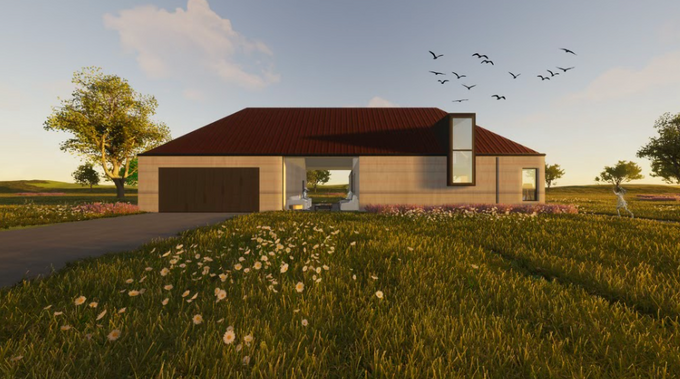
Photo courtesy of HIVE 3D

HIVE 3D’s first full project, a 3,150-square-foot home located in Burton, Texas, was printed with a rotating team of just four people using PozzoSlag, which replaces 50 percent of the portland cement in concrete and has been used in roads and bridges in Texas for over a decade.

The home used several innovations that hadn’t been used in a 3D printed house before, including parametric wall designs, foamcrete wall insulation, and pigmented concrete layers.

“Our product is more sustainable because it utilizes proprietary technology that allows for the use of alternative materials to replace the clinker and processes from traditional cement that contribute to its high emissions,” says Quasha. “It is estimated that the portland cement industry contributes to 8 percent of global emissions annually, but by utilizing Eco Material Technologies' cement replacement solutions ... builders can significantly decrease their carbon emissions without compromising on the product's setting time or long-term strength."

Each ton of portland cement replaced by a ton of Eco Material's products, PozzoSlag or Pozzocem, reduces emissions by close to one ton, Quasha explains.

The Calais project, located in Round Top, Texas, behind the Halles, an antique shopping and design destination, broke ground in March 2023 and will feature a collection of tiny homes known as casitas, including studio, single-bedroom and two-bedroom models, ranging from 400 to 900 square feet.

“These small homes will serve as a model for affordable and eco-friendly housing throughout the country,” says Lankau. “We plan to build them at a speed and cost point that is unprecedented in the affordable housing space.

“Ultimately, we want to build houses at a disruptive price point. We want to be vertically integrated and put our homes on the market at a significant discount to market wherever they are. And by significant, we're talking 20 or 30 percent. That's our goal.”

The right resources
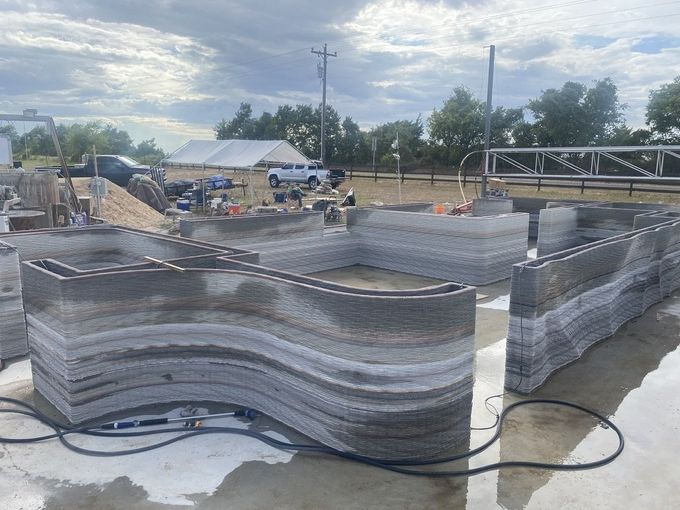
Photo courtesy of HIVE 3D

HIVE 3D worked with CyBe Construction to create a mobile construction 3D printer and mixing system that allows the printing mortar to be mixed onsite, which eliminates a significant amount of labor and time, which means those savings can be passed on to the consumer.

“We worked with a company called CyBe in the Netherlands to build a robotic arm, and that arm has about an 11-foot reach, and it can go all the way in a circle around itself,” says Lankau. “So, it drives around the foundation of the house, printing sections of the house at a time. So, it'll print a section, drive to the next section, and print the next section.

“So instead of having this many different materials and these many different traits, people that do all these different things, we have a machine that just uses one material and prints the wall.”

HIVE 3D has an internal engineer that works through all of the structural issues that may come up on projects and helps them build homes with monolithic, foot-thick concrete walls with rebar and steel supported in them.

According to Lankau, their 3D printed homes are tornado-proof, hurricane-proof, pest-proof, bullet-proof and can virtually withstand anything because of the sustainable materials used to build them.

“They're everything-proof,” says Lankau. “Just because of the natural strength of the concrete and the steel we use to create them, they can support millions of pounds. So, it's actually a stronger material than a typical house. By a factor of 100. Like I said, it's bulletproof and tornado-proof. You could drive a car into it, and it would total the car. I mean, it's a very, very sturdy structure.”

A bright future
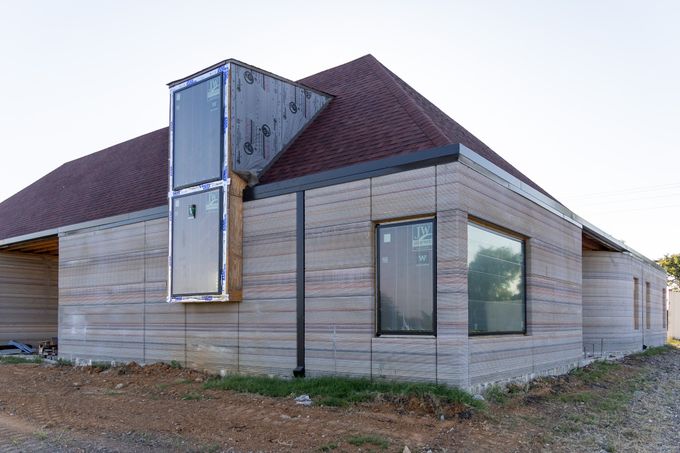
Photo courtesy of HIVE 3D

Moving forward, HIVE 3D would like to continue to innovate and advance its 3D printing technology by leaps and bounds.

“The science fiction goal here, which is maybe a five-year goal, is to be able to drive onto a site, press a button, and watch the robots work,” says Lankau. “We want to be a significant home builder. So, in five years, we want to be building a lot of houses quickly and affordably and we want to continue to automate more and more of the process.”

Right now, there is no formal process for commissioning a HIVE 3D printed home. Perspective customers are directed to the website, then put in a request to build a home, go through a screening process and if the project is a good fit, they'll put that project into their pipeline.

“We can build them quickly. It's just a matter of getting to them,” says Lankau. “We're also going to be doing some developments in Texas probably to start. We also have some international things that we'll be looking into next year. But right now, it's mostly in Texas. We'll be building some developments and putting those homes on the market. We hope to have some out this year and then a bigger chunk next year as we get more machines working. Those will be announced on our website.”

As HIVE 3D continues to find ways to scale its business model, there is a laser focus on the diminishing idea of the “American Dream,” where young families are able to purchase their first home. With the rising costs of supplies and labor, those families have been priced out of the market.

“That’s almost all we think about,” says Lankau. “Homeownership and that part of the American Dream is really struggling right now because the affordability gap between what the average person makes and what the average house on the market costs is just getting wider and wider.

According to Lankau, there are a lot of options to address the supply gap, but there aren’t an equal number of options to solve the affordability issue. Their goal is to find the best ways to deliver real cost savings over both traditional construction and other automated technologies.

“About three weeks ago, we kind of hit the inflection point in our current project where we printed a little house in three days. The cost of the house was what we wanted the cost to be, which is a disruptive amount less than what you could do traditionally or with any other construction technique. And we said, okay, now we're far enough along. We have this system. It's a scalable system. So, we're right now putting some capital together to go out and buy, build more of these machines and get out and start doing these truly affordable housing projects. Because that's where our heart is. Our heart's on the affordable side.”

HIVE 3D’s project in Burton, Texas isn’t available for sell yet, but it will be listed on Airbnb for interested customers to go and experience when it’s completed.

Additionally, the Casitas units in Round Top will be short-term rentals for festival patrons.

“We’ll go directly to market with our next projects,” says Lankau. “And then we'll sell that big house property in Burton at the end of this year.”

------

This article originally ran on InnovationMap.

Ad Placement 300x100
Ad Placement 300x600

CultureMap Emails are Awesome

CERAWeek crowns winners of 2026 clean tech pitch competition

top teams

Twelve teams from around the country, including several from Houston, took home top honors at this year's Energy Venture Day and Pitch Competition at CERAWeek.

The fast-paced event, held March 25, put on by Rice Alliance, Houston Energy Transition Initiative and TEX-E, invited 36 industry startups and five Texas-based student teams focused on driving efficiency and advancements in the energy transition to present 3.5-minute pitches before investors and industry partners during CERAWeek's Agora program.

The competition is a qualifying event for the Startup World Cup, where teams compete for a $1 million investment prize.

PolyJoule won in the Track C competition and was named the overall winner of the pitch event. The Boston-based company will go on to compete in the Startup World Cup held this fall in San Francisco.

PolyJoule was spun out of MIT and is developing conductive polymer battery technology for energy storage.

Rice University's Resonant Thermal Systems won the second-place prize and $15,000 in the student track, known as TEX-E. The team's STREED solution converts high-salinity water into fresh water while recovering valuable minerals.

Teams from the University of Texas won first and second place in the TEX-E competition, bringing home $25,000 and $10,000, respectively. The student winners were:

Companies that pitched in the three industry tracts competed for non-monetary awards. Here are the companies named "most-promising" by the judges:

Track A | Industrial Efficiency & Decarbonization

Track B | Advanced Manufacturing, Materials, & Other Advanced Technologies

  • First: Licube, based in Houston
  • Second: ZettaJoule, based in Houston and Maryland
  • Third: Oleo

Track C | Innovations for Traditional Energy, Electricity, & the Grid

The teams at this year's Energy Venture Day have collectively raised $707 million in funding, according to Rice. They represent six countries and 12 states. See the full list of companies and investor groups that participated here.

TotalEnergies $1B payout shows evolution in Trump's anti-wind strategy

Shift in the Winds

The Trump administration’s $1 billion payout to TotalEnergies to walk away from U.S. offshore wind development is a novel tactic against the industry that supporters see as creative — but opponents see as foolish and extreme.

The Interior Department announced March 23 that TotalEnergies agreed to what is essentially a refund of its leases for projects off the coasts of North Carolina and New York, and will invest the money in a liquefied natural gas export terminal in Texas and other fossil fuel projects instead. The department hailed it as an “innovative agreement” with the French energy giant so that the "American people will no longer pay for ideological subsidies that benefited only the unreliable and costly offshore wind industry.”

The tactical shift comes after federal courts have thwarted President Donald Trump's efforts to stop offshore wind through executive action.

U.S. Sen. Chuck Schumer, a New York Democrat, told The Associated Press that the payment “sets a dangerous precedent and is a shortsighted misuse of taxpayer dollars.”

Robin Shaffer, president of the anti-offshore wind group Protect Our Coast New Jersey, applauded what he called “out of the box” thinking. Shaffer said after losing in the courts, the administration needed a way to take back leases that never should have been issued because of the harm offshore wind development causes to the marine environment.

“The Trump administration has been relentlessly creative in its efforts to stop offshore wind development in the U.S.," he said.

While the Republican president has been particularly hostile to offshore wind, he has also blocked dozens of clean energy projects and canceled billions of dollars in grants to promote clean energy, which he derides as the “Green New Scam.” This comes at a time when the U.S. is trying to boost power supplies in an artificial intelligence race against China and keep electricity bills from rising even higher.

The Iran war has also dealt a massive energy shock to the global economy by choking off most exports of crude oil and liquefied natural gas through the Strait of Hormuz.

A vow to stop offshore wind

On the campaign trail, Trump vowed to end the offshore wind industry as soon as he returned to the White House. Trump said wind turbines are horrible and expensive and pose a threat to birds and other wildlife.

Connecticut is getting power from Revolution Wind, an offshore wind project, and estimates it will lower wholesale energy costs for the state. The National Audubon Society, which is dedicated to the conservation of birds, has said climate change is a greater threat to birds.

Trump has long opposed offshore wind energy. In 2015, he lost his yearslong battle to stop an offshore wind farm near Aberdeen in eastern Scotland when Britain’s Supreme Court unanimously ruled against him. Trump claimed the 11 turbines would spoil the view from his golf course.

He wants to boost production of oil, natural gas and coal, which cause climate change, because he argues that doing so would give the U.S. the lowest-cost energy and electricity of any nation in the world.

His first day back in office, he acted on his campaign promise, signing an executive order temporarily halting offshore wind lease sales in federal waters and pausing permitting for all wind projects.

The deal comes after the administration is thwarted by the courts

U.S. District Judge Patti Saris vacated Trump’s executive order blocking wind energy projects on Dec. 8, declaring it unlawful as she sided with state attorneys general from 17 states and Washington, D.C., who challenged the order. The administration is appealing.

Two weeks later, the administration ordered that construction stop on five major East Coast offshore wind projects, citing national security concerns. Developers and states sued, and federal judges allowed all five to resume construction, essentially concluding that the government didn't show that the national security risk was so imminent that construction must halt.

TotalEnergies wasn't one of those; it had already paused its two projects soon after Trump was elected. And the company has now pledged not to develop any new offshore wind projects in the United States. CEO Patrick Pouyanné said the refunded lease fees will finance the construction of a liquefied natural gas plant in Texas and the development of its oil and gas activities, calling it a “more efficient use of capital” in the U.S.

Kit Kennedy, who directs the power division at the Natural Resources Defense Council, said the proposed payment to TotalEnergies was a “boondoggle” that “transfers nearly $1 billion from American taxpayers to a foreign corporation and the oil and gas industry.”

Why is the U.S. using taxpayer dollars “to not develop power when we need energy?” she asked, calling the Trump administration deal a “scam” and harmful to the U.S. economy and environment.

Carl Tobias, a University of Richmond Law School professor who has been following the lawsuits, called it “unorthodox.”

Democrats criticize stopping offshore wind when energy prices are spiking

As crude oil and gasoline prices surge, Democrats in Virginia said the U.S. should be strengthening its energy independence and resilience. Virginia started receiving power on March 23 from an offshore wind project targeted by Trump.

“Giving an energy company $1 billion of taxpayer money to pack up its jobs and invest elsewhere — in the middle of an unpopular and unwise war that is spiking energy costs — is beyond idiotic,” U.S. Sen. Tim Kaine said in a statement to AP.

U.S. Rep. Chellie Pingree, a Maine Democrat, questioned whether the payout is legal under appropriations law and said she would question Interior Secretary Doug Burgum about it at the upcoming budget hearings.

Dozens of commercial leases issued by the Bureau of Ocean Energy Management remain active for wind energy development in the U.S.

Abigail Dillen, president of Earthjustice, said she wouldn't attempt to guess whether the Trump administration will pay to stop any others, but clearly it is willing to go to extreme measures.

“Will they do this again? Maybe,” she said.

Baker Hughes teams up with Google and XGS on energy tech

project partners

Houston-based energy technology company Baker Hughes recently forged two significant partnerships—one with tech titan Google and another with geothermal power startup XGS Energy.

Under the Google Cloud partnership, announced at CERAWeek 2026, Baker Hughes technology will be paired with Google Cloud AI and data analytics to improve the performance of AI data centers’ power systems and energy-transfer machinery. Furthermore, the two companies will explore opportunities for data centers to extract greater value from underused industrial and operational data.

“Infrastructure that powers the growing demand for AI and cloud computing is becoming one of the most critical drivers of global electricity needs,” Lorenzo Simonelli, chairman and CEO of Baker Hughes, said in the announcement.

“Through this partnership with Google Cloud, we are bringing together world-class power technologies and digital capabilities to help data center operators improve efficiency, enhance reliability, and accelerate progress toward lower-carbon operations,” he added.

Through the XGS partnership, Baker Hughes will provide engineering services for XGS’ 150-megawatt geothermal project in New Mexico. The project will supply energy to the Public Service Co. of New Mexico grid in support of New Mexico data centers operated by Meta Platforms, the parent company of Facebook and Instagram.

“With this single project for Meta in New Mexico, XGS will increase the state’s operating geothermal capacity by tenfold,” says Ghazal Izadi, chief operating officer at XGS.

“Geothermal energy plays a vital role in delivering reliable, cleaner power at scale,” added Maria Claudia Borras, chief growth and experience officer and interim executive vice president of industrial and energy technology at Baker Hughes. “By collaborating with XGS at this early stage, we are applying our ground‑to‑grid capabilities to reduce technical risk, accelerate reservoir validation, and engineer an integrated solution to deliver … power efficiently and reliably.”

California-headquartered XGS, which has a major presence in Houston, is known for its proprietary solid-state geothermal system that uses thermally conductive materials to deliver affordable energy wherever there is hot rock.