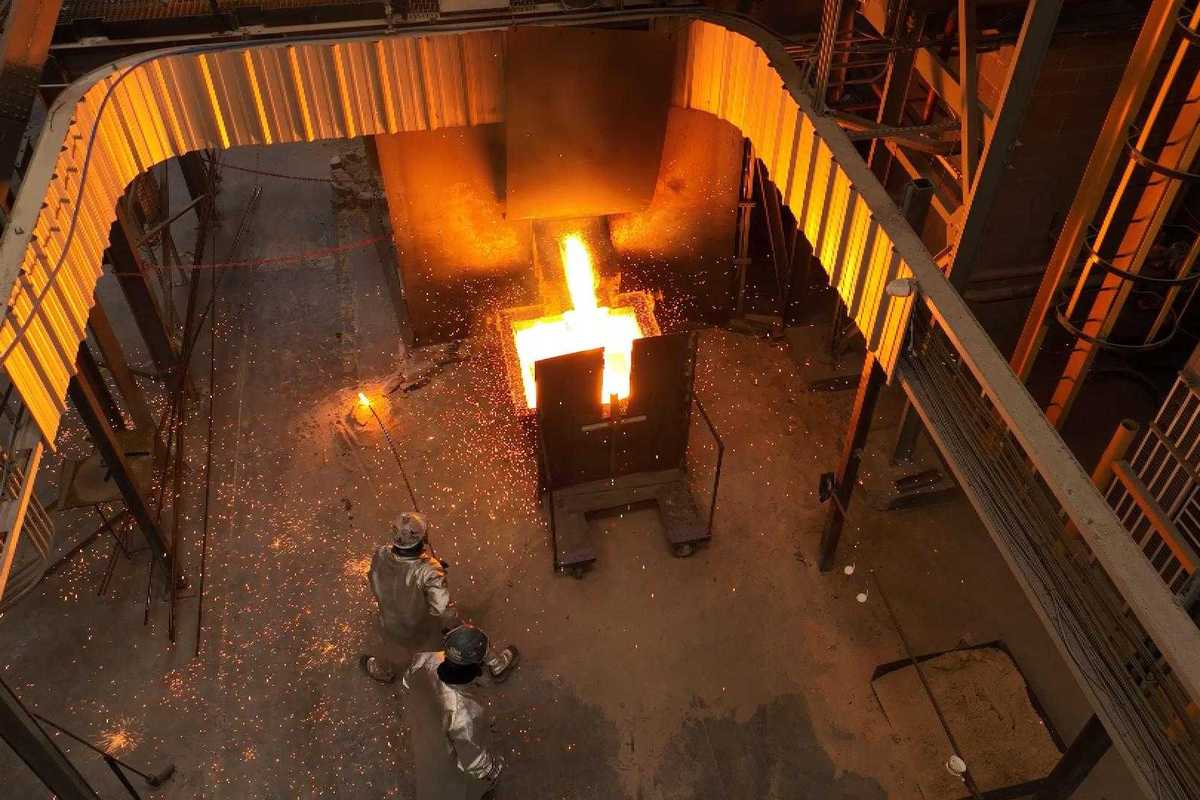
Texas fell four spots on WalletHub's annual Greenest States report. Photo via Pexels

Texas dropped in the rankings on WalletHub's Greenest States 2025 report.

The report, released last month, considered 28 relevant metrics—from air and water quality to the number of alternative fuel stations and green buildings per capita—to call out states doing the best (and worst) jobs of caring for the environment.

Texas came in at No. 42 out of 50, with a total score of 42.54 out of 100. Last year, the Lone Star State ranked No. 38 with a score of 50.40 based on 25 metrics.

Texas' poor ranking was driven by its last-placed ranking, coming in at No. 50, for overall environmental quality. It was tied for No. 45 for air quality and ranked No. 46 for water quality, which helped comprise the overall environmental quality score.

Other metrics fell closer toward the middle of the pack. The state ranked No. 32 for eco-friendly behaviors and No. 39 for climate-change contributions.

California also fell on the annual report. While the state claimed the top spot in 2024, it came in at No. 7 this year. Vermont, which came in second in 2024, was named the greenest state in 2025.

Hawaii, which didn't crack the top five last year, was ranked No. 2 on the 2025 report. New York, Maryland and Maine rounded out the top five this year.

West Virginia was the country's least green state again this year, followed by Louisiana, Kentucky, Alabama and Mississippi.

The report also showed that Democrat-led states ranked around No. 12 on average, whereas Republican states fell at around No. 33.

While the WalletHub report seems bleak for Texas, others have shown more positive signs for the state. Texas was ranked slightly above average in a recent ranking of the best states for sustainable development. A recently released U.S. Energy Storage Monitor shows that Texas led all states and surpassed California in the fourth quarter of 2024 by installing 1.2 gigawatts of utility-scale energy storage for solar and wind power.

Still, WalletHub also recently ranked Houston No. 98 out of 100 of the largest cities on its Greenest Cities in America report. Read more here.


Source: WalletHub
Ad Placement 300x100
Ad Placement 300x600

CultureMap Emails are Awesome

Rice, UH launch joint effort to accelerate plastics recycling solutions

plastics partnership

Institutes at two Houston universities are joining forces to help position the city as a global leader in plastics recycling innovation.

The Center for Energy Studies (CES) at Rice University’s Baker Institute for Public Policy and the University of Houston’s Energy Transition Institute (UH-ETI) have announced a strategic partnership that aims to develop real-world solutions for plastic recycling.

The universities will kick off the new initiative with the Annual Sustainability Summit: Innovations and Collaborations in Circularity & Supply Chain Resilience event April 22 at the Baker Institute.

“Houston sits at the center of the global plastics and petrochemical value chain, which makes it uniquely positioned to lead in circular solutions,” Rachel Meidl, deputy director of CES, said in a news release. “This partnership is about moving beyond theory and bringing together data, policy and industry insight to accelerate technologies and frameworks that can scale.”

The partnership—which was made official during CERAWeek—will integrate policy, economics, science and engineering. The universities will work to “share data, insights, networks and connections to advance global work in protecting the environment, economy and society,” according to a news release from Rice.

Initially, the universities will focus on evaluating scalable advanced recycling pathways, developing policy frameworks to improve plastics circularity, analyzing emerging technology and using industry stakeholders for deployment.

Plastics circularity aligns with Rice and UH’s energy transition efforts to advance a circular economy. UH's ETI recently published a white paper that analyzes how the U.S. currently handles plastics recycling and advocates for a new approach. Ramanan Krishnamoorti, author of the paper and vice president of energy and innovation at UH, said the partnership with Rice’s Baker Institute could help bring some of the ideas outlined in the paper to reality.

“Our research has shown that a uniform approach may be the best way for the U.S. to tackle plastic waste,” Krishnamoort said in a news release. “By partnering with Rice’s Baker Institute for Public Policy, we will be better positioned to deliver real-world solutions that advance a circular plastics economy.”

Fervo Energy adds former eBay CEO Meg Whitman, other leaders to board

power players

As it prepares for a highly anticipated IPO, Houston-based geothermal power provider Fervo Energy has added four heavyweights to its board of directors.

The most notable new board member is Meg Whitman, former CEO of eBay, Hewlett-Packard, and Spring-based HPE, and former U.S. ambassador to Kenya. She joined the Fervo board as lead independent director.

One of the other high-profile new board members at Fervo is Jessica Uhl. She was chief financial officer of Shell from 2017 to 2022 and spent a little over a year as president of GE Vernova, a GE energy spinoff. She is a former board member of GE, Goldman Sachs and Shell. Today, Uhl advises investment firms on energy matters.

Another energy industry veteran, Trey Lowe, also joined the Fervo board. Lowe is senior vice president and chief technology officer at oil and gas producer Devon Energy, a Fervo investor that’s moving its headquarters from Oklahoma City to Houston. Before Devon, Lowe worked in the U.S. and Norway for Houston-based energy technology company SLB.

The fourth new director at Fervo is Robert Keehan, who spent 37 years at professional services firm PwC. He most recently was PwC’s chief global auditor and earlier was a partner in the firm’s energy practice.

Keehan and Uhl will serve as independent directors, which are non-executive governance and oversight roles, while Lowe is a non-independent director, which is a more hands-on role.

With the four new directors, Fervo has seven board members.

The arrival of the four new board members comes at a monumental time for Fervo, a provider of utility-scale geothermal energy:

“Energy markets are demanding dependable, carbon-free power at an unprecedented scale, and Fervo is uniquely positioned to supply it,” Tim Latimer, co-founder and CEO of Fervo, said in December.