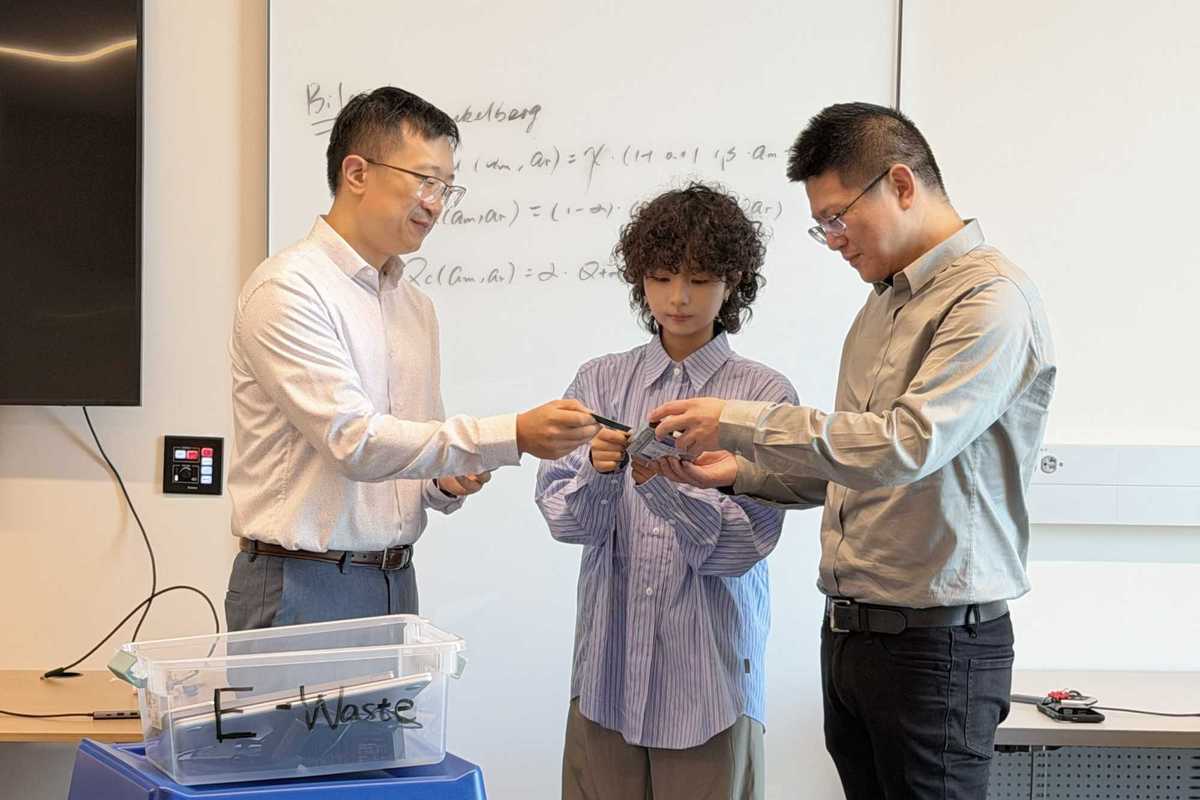
Jian Shi, Chuyue Wang and Kailai Wang have developed a model that aims to make recycling e-waste economically viable and help recover critical minerals needed for EVs. Photo courtesy UH.

Houston researchers propose model to scale e-waste recycling
critical research

The “missing link” in critical minerals may have been in our junk drawers all along, according to new research from the University of Houston.

Jian Shi, an associate professor in the UH Cullen College of Engineering, and his team have unveiled a new supply chain model that aims to make e-waste economically viable and could help make large-scale recycling possible.

Shi, along with professor Kailai Wang and graduate researcher Chuyue Wang, published the work in a recent issue of Nature. Their study outlines how gold, lithium and cobalt from discarded electronics can be kept circulating in the U.S. through the process of “urban mining.” It was supported by the U.S. Department of Energy’s Office of Energy Efficiency and Renewable Energy (EERE) through the Vehicle Technologies Office.

The team’s research found that e-waste is the fastest-growing solid waste stream in the world. When waste from smartphones or tablets is left unmanaged, the devices can leak hazardous waste and pose significant fire risks due to aging batteries. Additionally, when they are shipped off to foreign landfills, the U.S. loses the potential to recycle or reuse the critical minerals left inside.

“A lot of people have iPads or old iPhones sitting in their drawers right now, and that’s a waste of a critical resource,” Shi said in a news release. “Urban mining allows us to extract the same high-value materials found in traditional mines without the environmental destruction. More importantly, it helps secure our domestic supply chain for the technologies of tomorrow.”

According to UH, recycling e-waste has not succeeded in the U.S. due to a fragmented recycling system, in which manufacturers, collectors and recyclers operate separately, driving up costs.

The UH team's research looks to change that.

In the study, the researchers modeled streamlined recycling efforts by mapping the interactions between manufacturers and independent recycling markets. Their dual-channel closed-loop supply chain (CLSC) model identified how these players can transition from competitors to partners, which can distribute profits more equitably and make recycling efforts more financially attractive.

According to UH, the research has particular significance due to the growing demand for electronic vehicles and their batteries.

“We can improve the performance of the entire recycling ecosystem and make the profit distribution more balanced,” Wang said in the release. “This ensures that the materials we need for EVs and advanced electronics stay right here in the U.S.”

“By making recycling work at scale, we aren’t just cleaning up waste,” Shi added. “We’re building a foundation that benefits both our national security and our economy.”

Ad Placement 300x100
Ad Placement 300x600

CultureMap Emails are Awesome

8 Houston companies earn CleanTech Breakthrough Awards

winner, winners

Eight cleantech companies with Houston headquarters were recognized in this year’s CleanTech Breakthrough Awards program.

CleanTech Breakthrough, part of market intelligence platform Tech Breakthrough, honors innovative and influential energy, climate, and cleantech companies, products and services.

This year’s winners from Houston are:

  • CleanTech Analytics Company of the Year: Amperon, a provider of AI-powered energy forecasting software
  • Overall Hydrogen Solution of the Year: Eclipse Energy, which converts maxed-out oilfields into low-cost sources of hydrogen
  • Energy Production Company of the Year: Fervo Energy, a provider of geothermal power
  • Production Solution of the Year: Quaise Energy, a developer of a drilling system for converting traditional power stations into geothermal energy plants
  • Green Materials Solution of the Year: Solidec, which uses air, water, and electricity to produce chemicals
  • Hydrogen Production Solution of the Year: VEMA Hydrogen, a producer of renewable hydrogen
  • CleanTech Analytics Innovation Award: Finland-based Wärtsilä, a provider of advanced energy storage systems and services, which maintains its U.S. headquarters in Houston
  • Energy Production Platform of the Year: France-based energy giant TotalEnergies, which maintains its U.S. headquarters in Houston

Other Texas companies made the list, including Austin-headquartered Base Power, founded by Justin Lopas and Zach Dell. Zach Dell is the son of Austin billionaire and Houston native Michael Dell, chairman and CEO of Dell Technologies. The company recently started servicing Houston and established an office in Katy.

CleanTech Breakthrough says its annual awards program honors “the visionaries and leaders accelerating the transition to a cleaner, more sustainable future.”

“In a world increasingly focused on sustainability and environmental responsibility, innovation in clean technology has never been more critical,” said Bryan Vaughn, managing director of CleanTech Breakthrough. “This year’s winners represent the very best in ingenuity and execution, delivering solutions that not only reduce environmental impact but also drive efficiency, scalability and real-world results.”

See the full list of the 2026 winners here.

HETI's new executive director takes the helm

new leader

The Houston Energy Transition Initiative has a new executive director.

Sophia Cunningham assumed the position this month, succeeding the organization's founding executive director, Jane Stricker.

"Four years ago, I could never have imagined the opportunities, experiences and relationships this role has enabled," Strickler wrote in an address earlier this year. "I am truly grateful for the support and engagement of Houston’s business and community leaders, the visionary leadership of Bobby Tudor, Scott Nyquist, HETI Members, and the Greater Houston Partnership in creating this initiative at exactly the right moment in time. I am incredibly proud of the HETI and the Partnership team members who have delivered with purpose and passion, and I greatly appreciate Houston’s energy and climate leaders and champions who have supported my agenda, challenged my thinking, broadened my perspectives, and worked with HETI to demonstrate the power of partnership in developing, innovating and advancing the ideas and technologies needed to meet this challenge for our region and the world."

Stricker shared on LinkedIn that she has joined the advisory board of FluxPoint Energy, which launched last month during CERAWeek, in addition to her other roles at Greentown Labs, Prana Low Carbon Economy Investments and UNC Kenan-Flagler Energy Center.

Cunningham previously served as vice president at HETI, where she was responsible for efforts related to carbon capture, use and storage; methane management; community engagement and stakeholder activation. Before joining HETI, she was director of public policy at The Greater Houston Partnership.

She earned her master's in Energy Management and Systems Technology from Texas A&M University and holds a bachelor's degree from Davidson College.

“I’m honored to step into the role of Executive Director of the Houston Energy Transition Initiative at such a pivotal moment for our industry," Cunningham said over email. "Houston has the talent, infrastructure, and leadership to meet growing global energy demand while reducing emissions, and I’m excited to work alongside our members and partners to accelerate solutions that are reliable, affordable, and scalable.”

The Greater Houston Partnership launched HETI in June 2021 to "meet a Dual Challenge of producing more energy that the world needs with less emissions," according to its website.

Pattern Energy expands clean energy portfolio with acquisition of Canadian producer

acquisition closed

Clean energy and transmission infrastructure company Pattern Energy completed the acquisition of Canadian independent power producer Cordelio Power this month.

Pattern Energy, which is headquartered in San Francisco and has major operations in Houston, will now own one of the largest independent clean energy infrastructure platforms in North America, according to a release.

Pattern Energy will add approximately 1,550 megawatts of operating and in-construction assets, including 16 wind, solar and energy storage projects across the United States and Canada, as part of the deal. In addition, they have also acquired the majority of Cordelio’s development pipeline in key U.S. markets and members of Cordelio’s team.

“Closing this transaction marks a significant milestone for Pattern Energy as we continue to scale our platform to meet North America’s growing energy needs,” Hunter Armistead, CEO of Pattern Energy, said in the release. “Cordelio brings a highly complementary portfolio of quality assets and a talented team. Together, we are even better positioned to power the future.”

Currently, Pattern Energy’s portfolio includes wind, solar and energy storage projects in over 40 facilities in North America. Pattern Energy had 12,000 megawatts of operating and in-construction capacity before the deal.

The acquisition was first announced Jan. 6, 2025.

“Pattern and Cordelio share a commitment to responsible development and the communities in which we work,” Chris Hind, CEO of Cordelio Power, said in a news release. “We look forward to joining with Pattern Energy to deliver high-quality projects with expanded product offerings to support customers across more markets.”


Pattern Energy doubled down on its Houston commercial space in 2023, moving the company's development, meteorological, transmission and energy trading teams to a new office in the Montrose Collective. The company's Operations Control Center is also based in Houston.

Its Houston-based development team was assigned to work on Pattern's SunZia Transmission and Wind project in New Mexico and Arizona, expected to be one of the largest clean energy infrastructure projects in U.S. The project is targeting commercial operations this year, according to Pattern Energy's website.