







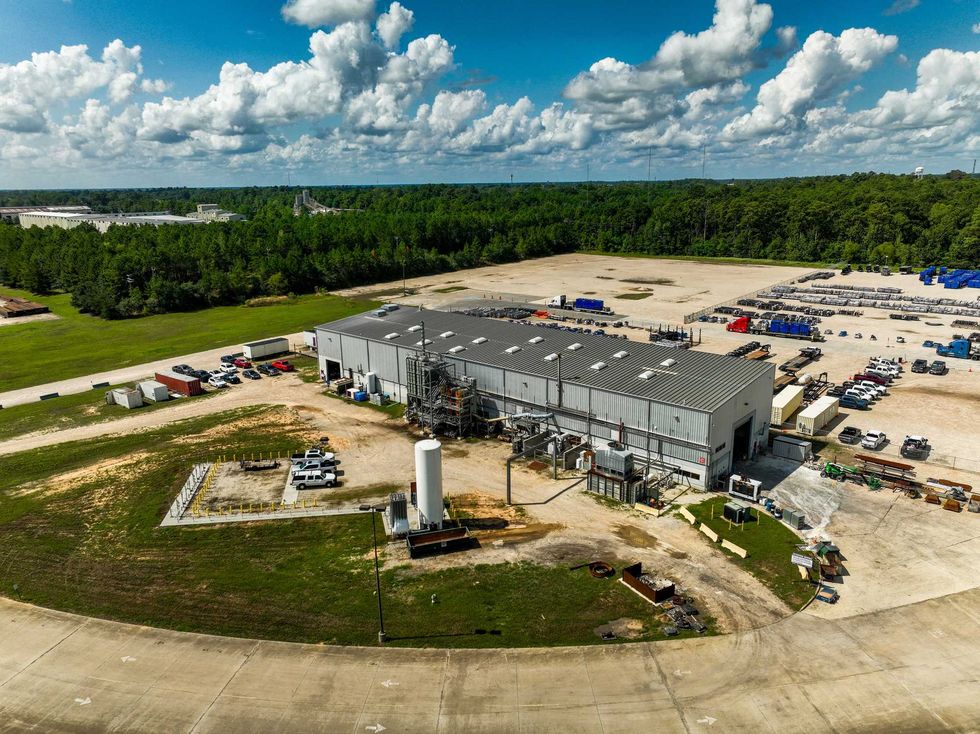
ExxonMobil Chairman and CEO Darren Woods said during the company’s recent second-quarter earnings call that the company is "concerned about the development of a broader market" for its low-carbon hydrogen plant in Baytown. Photo via exxonmobil.com

Spring-based ExxonMobil, the country’s largest oil and gas company, might delay or cancel what would be the world’s largest low-carbon hydrogen plant due to a significant change in federal law. The project carries a $7 billion price tag.

The Biden-era Inflation Reduction Act created a new 10-year incentive, the 45V tax credit, for production of clean hydrogen. But under President Trump’s "One Big Beautiful Bill Act," the window for starting construction of low-carbon hydrogen projects that qualify for the tax credit has narrowed. The Inflation Reduction Act mandated that construction start by 2033. But the Big Beautiful Bill switched the construction start time to early 2028.

“While our project can meet this timeline, we’re concerned about the development of a broader market, which is critical to transition from government incentives,” ExxonMobil Chairman and CEO Darren Woods said during the company’s recent second-quarter earnings call.

Woods said ExxonMobil is working to determine whether a combination of the 45Q tax credit for carbon capture projects and the revised 45V tax credit will help pave the way for a “broader” low-carbon hydrogen market.

“If we can’t see an eventual path to a market-driven business, we won’t move forward with the [Baytown] project,” Woods said.

“We knew that helping to establish a brand-new product and a brand-new market initially driven by government policy would not be easy or advance in a straight line,” he added.

Woods said ExxonMobil is trying to nail down sales contracts connected to the project, including exports of ammonia to Asia and Europe and sales of hydrogen in the U.S.

ExxonMobil announced in 2022 that it would build the low-carbon hydrogen plant at its refining and petrochemical complex in Baytown. The company has said the plant is slated to go online in 2027 and 2028.

As it stands now, ExxonMobil wants the Baytown plant to produce up to 1 billion cubic feet of hydrogen per day made from natural gas, and capture and store more than 98 percent of the associated carbon dioxide. The company has said the project could store as much as 10 million metric tons of CO2 per year.
Ad Placement 300x100
Ad Placement 300x600

CultureMap Emails are Awesome

Baker Hughes closes $13B acquisition of gas equipment maker Chart Industries

m&a activity

Houston-based energy technology company Baker Hughes has completed its $13.6 billion acquisition of Chart Industries, a provider of equipment and services for liquefying gases like LNG, hydrogen, nitrogen and oxygen.

Baker Hughes says the deal advances its “strategic vision” to be a leader in energy and industrial technology.

Jim Apostolides, who had previously served as chief infrastructure and performance officer at Baker Hughes, leads the Chart business in his new role as senior vice president. Chart President and CEO Jill Evanko left the company in January to become CEO of Duravant, which makes equipment for food processing, packaging and materials handling.

Publicly traded Chart reported $4.3 billion in revenue for fiscal year 2025. Its customers operate in sectors such as gas infrastructure, nuclear, data centers, carbon capture and storage, space, and geothermal energy.

“Chart’s thermal management solutions bring complementary capabilities and aftermarket service offerings that accelerate our portfolio strategy,” Lorenzo Simonelli, chairman and CEO of Baker Hughes, said in a news release. “Together, we will expand the solutions we deliver across a broader range of energy and industrial markets and create greater value for customers and shareholders.”

Chart will operate as a new financial reporting segment within Baker Hughes, reflecting what Baker Hughes says is the “scale and strategic importance of its differentiated capabilities in air and gas handling, thermal management, and lifecycle services.”

Baker Hughes announced the Chart deal last July.

“We know Chart well, having worked alongside them on many critical energy infrastructure projects,” Signorelli said last year. “Their products and services are highly complementary to our offerings and strongly aligned with our intent to deliver distinctive and efficient end-to-end lifecycle solutions for our customers across their most critical applications.”

Chart’s website lists offices in Houston, The Woodlands, and Austin, with corporate headquarters in Ball Ground, Georgia. It’s unclear what will happen to those offices.

KBR appoints C-suite duo to lead forthcoming spinoff

Making Moves

In advance of the spinoff of its Mission Technology Solutions unit, Houston-based KBR has made two C-suite hires for the new business.

Michael LaRouche is coming aboard as president and CEO of the spinoff, currently called SpinCo, on Sept. 26. Nicholas Veasey joined as executive vice president and chief financial officer earlier this month, on July 1.

“Michael and Nick bring a highly complementary combination of operational leadership, financial expertise, and mission-driven experience, and together they will accelerate our impact for stakeholders,” Stuart Bradie, chairman, president and CEO of publicly traded KBR, said in a news release.

LaRouche currently is CEO of Serco North America, a Herndon, Virginia-based government services contractor. Veasey most recently was CFO of MAG Aerospace, a Fairfax, Virginia-based defense contractor.

SpinCo, a government services contractor, will launch with more than $5.3 billion in annual revenue and 20,000 employees. KBR’s total headcount is around 36,000. Branding for SpinCo, including a formal name, will be revealed in July.

“SpinCo is positioned as a top-tier provider of differentiated technology solutions, anchored by deep mission expertise, global scale, and a relentless commitment to delivering for our customers,” LaRouche says.

After the spinoff, the slimmed-down KBR will focus on its Sustainable Technology Solutions business, a provider of energy and industrial technology that generated $2.5 billion in revenue in 2025 and is designed to reduce carbon emissions and support energy transition efforts. Bradie will remain chairman, president and CEO of the business.

Both SpinCo and the new KBR will be public companies. The spinoff is scheduled to be completed in January 2027.

---

This article first appeared on InnovationMap.com.

Houston PE firm makes latest nuclear industry acquisition

nuclear deal

Houston-based private equity firm Pelican Energy Partners has acquired California-based Veridiam for an undisclosed amount in an effort to further increase the firm’s focus on the nuclear energy sector.

Veridiam is a strategic manufacturer that specializes in the precision fabrication of components and assemblies made from exotic metals or advanced alloys for the nuclear, aerospace, defense, space and medical fields.

Following the acquisition, Veridiam will continue to operate under its existing name and will led by its current management team, including CEO Brian Joyal.

“Joining the Pelican platform accelerates our strategic trajectory," Joyal said in a news release. "With Pelican's support, we will accelerate the modernization and expansion of our manufacturing capabilities to meet unprecedented demand across the nuclear, aerospace, defense, and medical sectors. This partnership also enables us to expand our portfolio of mission-critical products and engineered solutions while maintaining the uncompromising quality, precision, and reliability standards that have defined Veridiam for more than 60 years."

Since 2011, Pelican has raised over $1 billion in committed capital and has realized over 15 investments. Currently, Pelican is investing from its fourth fund, which aims to support and advance companies that provide critical services and products to the nuclear power industry.

In 2024, Pelican raised a $450 million fund to invest in nuclear energy services and equipment companies.

The Veridiam deal comes after Pelican has completed several nuclear acquisitions. The PE firm acquired New Hampshire-based Environmental Alternatives Inc., which provides nuclear decontamination services, in April; it acquired Georgia-based WSI Welding Solution in December, which services the nuclear sector.

"Veridiam sits at the center of our investment thesis and reflects the kind of deal Pelican does best," Mike Scott, managing partner and founder of Pelican Energy Partners, added in the news release. "With the right capital and operating support, we see a clear opportunity to strengthen the business, invest in its capabilities, and create long-term value for customers and shareholders."