




Houston energy leader Katie Mehnert shared her key takeaways from Houston Energy and Climate Week 2026 with Energy Capital. Photo courtesy

While hundreds of thousands descend on New York for Climate Week, Houston offered a different proposition: come where the work is being built. And last week Houston proved that it’s solving for more energy and fewer emissions; reliability and affordability; speed and durability. We are solving for the “&.”

That equation sharpened last week. On Sept. 14, the Environmental Protection Agency announced it had repealed most 2024 federal carbon-pollution standards for power plants and proposed rescinding remaining greenhouse-gas requirements. Policy matters, but it can pivot. The need to build does not.

HECW is a proving ground, not another conference stop. As I wrote in the Houston Chronicle, Mayor Sylvester Turner planted the seed by insisting we bring people together across the city and industry to drive Houston’s energy future. He knew false choices have no place here: oil and gas and clean technology; prosperity and stewardship; industry and lower emissions.

ECW joined the Climate Week Network this year, connecting Houston to a growing community of more than 500,000 people across 22-plus cities. We now have a seat at the global table—and a responsibility to use it well, building with other cities and the wider clean-energy-solutions world rather than merely talking at them.

The capital is already moving. Since 2017, Houston Energy Transition Initiative member companies have invested more than $95 billion in low-carbon infrastructure, technologies, and research and development. This is where the transition is financed, engineered, tested and operated. But the work requires more than capital. It requires capital allocators who understand the difference between a promising idea and a project that can scale, hire and endure.

Last week was Houston’s show and tell. At ARTECHOUSE, The &Bassador Reception & Awards brought art, technology, culture, philanthropy and energy together. Then the week went beyond downtown.

Sugar Land Town Square became the launchpad for the Metro Innovation Tour & Market: a place for an ecosystem conversation about smart cities, clean energy, equitable access and next-generation mobility before participants boarded three tour routes across greater Houston. It was also the starting point for the Bay City South Innovation Tour to Erthos Project Bravo in Matagorda County, where small groups saw Earth Mount solar modules being installed in real time. The conversation did not end at a panel. It went to the project site.
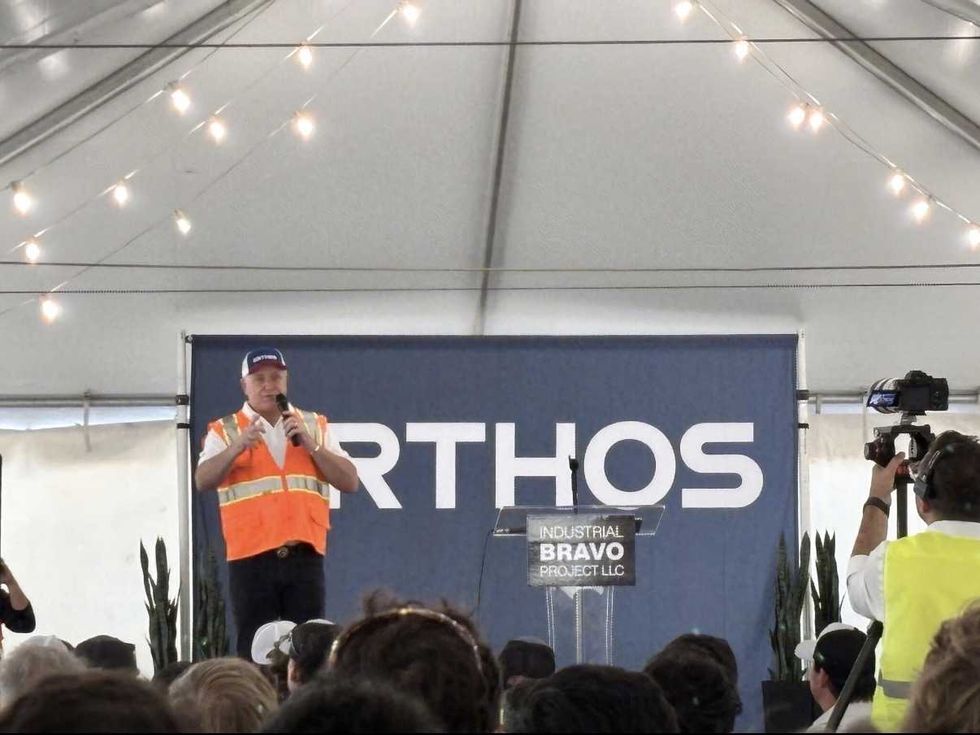
The HTX Tech Tours included a visit to the Erthos Project Bravo in Matagorda County. Photo courtesy

Approximately 100 startups from around the world pitched at Rice Alliance, Greentown Labs and Halliburton Labs events. At Astros Night at Daikin Park, builders, backers, and believers traded conference rooms for the diamond, creating an experience, not just another event. That is how this work becomes civic fabric.

Activation also means making the energy story felt, not merely explained. AY Young brought the Battery Tour for live performances. It was a reminder that the “Power of &” is not confined to a boardroom or a laboratory. Art and technology, culture and commerce, a new generation and established industry can share the same stage—and help more people see themselves in the work ahead.

Perhaps no activation made the “Power of &” more immediate and real than the Houston, We Have Solutions open mic night. At Creatopia’s Innovation Studio, people took the mic—or simply listened—to share what they were building, the problem they could not stop thinking about, and the connection they hoped to make. It put founders, artists, community builders, researchers and future-makers in one room. That is collaboration in real time: different kinds of expertise meeting before anyone knows exactly what the solution will be.

FOX26 helped carry that story beyond the rooms we convened, hosting Erthos COO Jessica Knight, Mars Materials co-founder Aaron Fitzgerald, and investors Taylor Chapman and Juliana Garaizar to discuss building and backing the future in Houston. Our region should be proud—not as self-congratulation, but because the world is beginning to experience energy and climate solutions firsthand.

This was also a week to give back. Allies in Energy awarded $27,500 to nine organizations advancing energy and climate literacy, civil dialogue, workforce pathways and community action. NRG Energy’s Brighter Communities provided a founding gift to expand the week and fund local grants. It took partners, hosts, sponsors, volunteers, funders and community organizations. That is the “Power of &”: collaboration that leaves a stronger community behind.

The “Power of &” cannot stop at Houston’s city limits. Louisiana’s participation—through its support of the Digital Delta Symposium & Expo—made clear that Houston’s builder ecosystem is regional by necessity. Gulf Coast infrastructure, supply chains, talent, and industrial decisions do not recognize state lines. Neither should our collaboration. If we are serious about building more energy with fewer emissions, we must align capital, resources and opportunity across the entire Gulf Coast.

That same commitment to practical collaboration means listening, learning and adjusting. A builder’s mindset does not protect a plan simply because it came first; it improves the conditions for the work to succeed. That is why Houston Energy and Climate Week will move to April 4–10, 2027—better weather, more time and space for connection, and a stronger city-wide experience for the people building what comes next.

But the real test begins now. Can we keep widening the circle? Can we continue to turn research into projects, pilots into infrastructure, capital into good jobs and climate ambition into results that families and communities can see? Can we make every new solution stronger by bringing in the people who must finance it, build it, operate it, live beside it and benefit from it?

That is the work ahead. Turner understood that Houston does not move forward by asking who wins the argument. It moves forward by asking who is ready to solve the problem. His legacy—and the promise of the “&”—is an invitation to choose collaboration over division, action over performance and possibility over false choices.

The future does not need another city to talk about it. It needs Houston to keep building it. And it will only be built if we keep choosing the "&."

---

Katie Mehnert is the CEO of The Bee Suite, and a recent partner to The Builder’s Movement.

Ad Placement 300x100
Ad Placement 300x600

CultureMap Emails are Awesome

Fervo Energy scores third consecutive nod on MIT climatech list

top honor

Houston-based geothermal power company Fervo Energy has notched a three-peat on MIT Technology Review’s annual 10 Climate Tech Companies to Watch List.

“The newly public company is betting that Al’s power boom will help turn enhanced geothermal energy into a scalable reality,” MIT Technology Review says of the three-time honoree.

Fervo went public in May through a $2.2 billion IPO.

Other Fervo recent milestones include:

“We are in the midst of a once-in-a-generation surge in power demand that is likely to dictate the outcome of the American success story in both artificial intelligence and industrial growth, but also the extent to which people have access to affordable, reliable power,” Tim Latimer, co-founder, chairman, president and CEO, said during Fervo’s second-quarter earnings call.

“The stakes have never been higher,” he added, “and I’ve never been more convinced that Fervo is uniquely positioned to meet this moment.”

Also making MIT Technology Review’s fourth annual list were:

  • Greentown Houston alum Energy Dome, based in Milan, Italy. “Energy Dome is using the gas to deliver cheap long-duration energy storage for the grid,” MIT Technology Review says.
  • Greentown Houston alum Moment Energy, based in Vancouver, Canada. “The startup is betting that repurposing — rather than recycling — used EV batteries will help buoy much-needed U.S. supply,” MIT Technology Review says.
  • Greentown Boston member Form Energy, based in Somersville, Massachusetts. It’s a three-time honoree. “Form’s 100-hour batteries could make clean energy more weather-resilient and help power data centers,” MIT Technology Review says.

Greentown Labs is an incubator for climatech and energy startups that's co-located in Houston and Boston. Fervo is also an alum of Greentown Houston.

“Whether early-stage startup or multinational corporation, the businesses we’ve chosen are working on technologies to help us address climate change or adapt to our warming world,” MIT Technology Review says. “There’s an urgent need for these innovators: We must begin to drastically reduce emissions to avoid the deadliest impacts of climate change, while also contending with its harmful effects.”

ExxonMobil and Chevron top Q3 estimates on higher prices and strong output

Q3 Report

ExxonMobil and Chevron both reported better than expected quarterly results Friday as the oil majors benefited from higher prices and record production.

Besides the disruption caused by the wars in Iran and Ukraine that have driven up the cost of fuel, Exxon is also seeing strong production in its fields in Guyana and the Permian Basin in the Southwest. Chevron said its results include one month of production in Venezuela where it’s making a big investment.

Utilization at Exxon's U.S. Gulf Coast refineries was at 100%, and U.S. Gulf Coast diesel production was at the second-highest on record.

The price of diesel, currently about $6.32 per gallon, is up 71% since last year, according to AAA. Diesel surpassed $6 last month — a record. Regular gasoline is up about 38% in the past year as well. To that end, some state officials have been offering gas tax holidays and other measures to ease costs.

Pain at the pump

The cost of crude oil — the main ingredient in gasoline as well as diesel — has been volatile amid ongoing uncertainty about the war's future. The conflict with Iran has impeded most shipping through the Strait of Hormuz, a narrow waterway that previously served as a delivery route for a fifth of the world’s oil and natural gas.

Both Brent crude and benchmark U.S. crude were at over $100 a barrel on Friday. Brent is still near the high end of its range since the war with Iran began. The highest price for the most actively traded contract in the market for Brent crude since then is nearly $120, reached in March.

At the beginning of the month, the Group of Seven wealthy democracies announced that they planned to release 100 million barrels of oil and fuel products in the coming weeks, starting with “substantial” amounts of diesel.

The release follows on from a March announcement that International Energy Agency member countries would release 426 million barrels of oil and products to stabilize the oil market. European Union countries committed about 92 million barrels, a promise weighted toward refined products made from crude such as diesel.

President Donald Trump has been trying to tamp down soaring energy costs ahead of the U.S. midterm elections. As part of those efforts, he announced earlier this month that the U.S. struck a deal to obtain diesel from Russia. Congress has criticized the deal as fueling Russia’s war against Ukraine, violating existing U.S. laws and drawing the U.S. closer to Russia. Even as Congress has tried to push back, the first tanker carrying Russian diesel to the United States set sail a week ago.

Results beat Wall Street expectations

Darren Woods, ExxonMobil chairman and CEO, noted that investments such as the expansion of its Beaumont refinery in Texas have contributed to an increase in its distillate production by approximately 40% since 2019.

For the third quarter, net income more than doubled to $3.72 per share. On an adjusted basis, profit totaled $4.23 per share, easily topping the average analyst estimate of $4.12 per share.

Revenue during the three months ended in September rose 33% to $113.16 billion, also beating estimates.

The Spring, Texas-based company also raised its quarterly dividend to $1.07 and set a $20 billion stock buyback plan.

Houston-based Chevron said it earned $9.9 billion, or $5.06 per share, during the third quarter, as revenue surged 36% to $67.8 billion. Its results handily topped estimates.

Crude utilization at Chevron's U.S. refineries totaled 98%. Those refineries processed more than 1 million barrels of crude oil per day. The company said it set production records at its Eastern Mediterranean and Australian assets.

Chevron, the second-largest U.S. oil company, has had a presence in Venezuela since 1923. Last month it announced it will invest $7 billion over the next five years in Venezuela. It said Friday that following an accounting-related change during the quarter, it’s now including those results.

Overall capital expenditures during the quarter were lower compared with a year ago because it spent less in the Permian Basin.

Mike Wirth, Chevron’s chairman and CEO, said that the company signed agreements to reduce Bakken midstream costs by about 50%, strengthening the asset’s competitiveness. Chevron increased its holdings in the Bakken fields in North Dakota and Montana following its $53 billion acquisition of Hess Corp. last year.

Shares of Exxon rose 1.3% in morning trading. The stock is up 64% in the past 12 months. Chevron's stock climbed 1.8%.

Houston clean energy leader to receive posthumous Trailblazer Legacy Award

lasting legacy

Every year, the Houston Innovation Awards, presented by EnergyCapital's sister site InnovationMap, honor one Houstonian with the Trailblazer Award, whose impact is felt throughout the city's innovation and business ecosystem.

This year, the Trailblazer Legacy Award will be given posthumously to Don Kendall Jr., who died in September while on a trip to the Republic of the Congo with the Jane Goodall Institute, one of the many organizations he was deeply involved with.

Kendall's obituary puts it simply: "Don’s truest passions were conservation and his family." Many saw those passions play out in his career, particularly in the role he played in shaping Houston's clean energy sector.

Kendall served as general partner of New Climate Ventures, a Houston-based early-stage venture capital firm that invests in next-gen energy, materials and fuel technologies and startups. The firm's portfolio includes Houston-based clean energy companies like Solidec, Syzygy Plasmonics and Rheom Materials.

Kendall was also founding managing director and CEO of Kenmont Capital LP. He ran a $500 million distressed debt and credit-based hedge fund focused on the energy, power and transportation sectors and one of the top-performing private equity funds under the Kenmont umbrella.

He served on the board of Talos Energy, American Midstream Partners, Syzygy Plasmonics, Tangent Energy, Stream Energy and others. Notably, he served as Chair of the Special Committee of the SolarCity board during its acquisition by Tesla in 2016. According to his obituary, Kendall negotiated with "Elon Musk in the middle of the night on a rickety pier in Indonesia after eluding a poisonous snake."

Outside of the clean energy space, Kendall also served on the boards of the Jane Goodall Institute, Earthwatch International and Ecological Defense Group. He also served as vice chair of the Houston Zoo Inc. and chair of its Conservation Committee.

Kendall was selected by our esteemed panel of judges to receive the 2026 Trailblazer Legacy Award. The panel includes carbon removal entrepreneur and CEO of Houston-based Mars Materials Aaron Fitzgerald.

Fitzgerald shares the profound impact Kendall had on his career and those of many others.

"Honoring Don with the Trailblazer Legacy Award is a fitting tribute to a leader whose impact spanned civic work with the Houston Zoo, wildlife conservation, and the growth of our startup ecosystem," Fitzgerald says. "He paired a keen eye for potential with the relentless drive to unlock it. For Mars Materials, his early backing carried us through a critical valley when we needed belief the most, and his presence as a personal mentor is profoundly missed."

Don was an avid traveler, cyclist and collector. He is survived by his wife of 50 years, Diane S. Kendall. A celebration of life will be held early in 2027.

---

This article originally appeared on our sister site, InnovationMap.