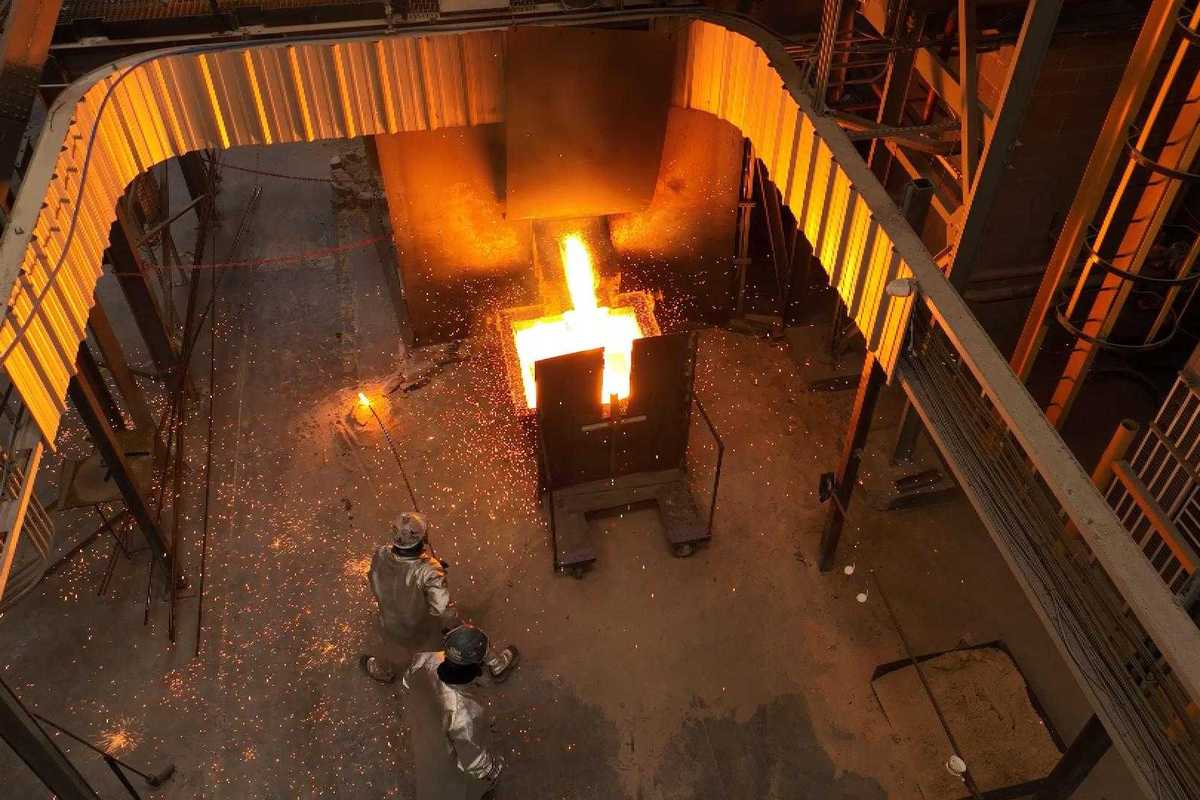
Square Robot has landed funding and a new partnership with Marathon Petroleum. Photo courtesy of Square Robot

Houston- and Boston-based Square Robot Inc. has announced a partnership with downstream and midstream energy giant Marathon Petroleum Corp. (NYSE: MPC).

The partnership comes with an undisclosed amount of funding from Marathon, which Square Robot says will help "shape the design and development" of its submersible robotics platform and scale its fleet for nationwide tank inspections.

“Marathon’s partnership marks a major milestone in our mission to transform industrial tank inspection,” David Lamont, CEO of Square Robot, said in a news release. “They recognize the proven value of our robotic inspections—eliminating confined space entry, reducing the environmental impact, and delivering major cost efficiencies all while keeping tanks on-line and working. We’re excited to work together with such a great company to expand inspection capabilities and accelerate innovation across the industry.”

The company closed a $13 million series B last year. At the time of closing, Square Robot said it would put the funding toward international expansion in Europe and the Middle East.

Square Robot develops autonomous, submersible robots that are used for storage tank inspections and eliminate the need for humans to enter dangerous and toxic environments. Its newest tank inspection robot, known as the SR-3HT, became commercially available and certified to operate at a broader temperature range than previous models in the company's portfolio this fall.

The company was first founded in the Boston area in 2016 and launched its Houston office in 2019.
Square Robot's newest robot is certified to operate in hazardous locations and at extreme temps. Photo courtesy of Square Robot

Houston robotics company unveils extreme-temperature tank robot

hot new robot

Houston- and Boston-based Square Robot Inc.'s newest tank inspection robot is commercially available and certified to operate at extreme temperatures.

The new robot, known as the SR-3HT, can operate from 14°F to 131°F, representing a broader temperature range than previous models in the company's portfolio. According to the company, its previous temperature range reached 32°F to 104°F.

The new robot has received the NEC/CEC Class I Division 2 (C1D2) certification from FM Approvals, allowing it to operate safely in hazardous locations and to perform on-stream inspections of aboveground storage tanks containing products stored at elevated temperatures.

“Our engineering team developed the SR-3HT in response to significant client demand in both the U.S. and international markets. We frequently encounter higher temperatures due to both elevated process temperatures and high ambient temperatures, especially in the hotter regions of the world, such as the Middle East," David Lamont, CEO of Square Robot, said in a news release. "The SR-3HT employs both active and passive cooling technology, greatly expanding our operating envelope. A great job done (again) by our engineers delivering world-leading technology in record time.”

The company's SR-3 submersible robot and Side Launcher received certifications earlier this year. They became commercially available in 2023, after completing initial milestone testing in partnership with ExxonMobil, according to Square Robot.

The company closed a $13 million series B round in December, which it said it would put toward international expansion in Europe and the Middle East.

Square Robot launched its Houston office in 2019. Its autonomous, submersible robots are used for storage tank inspections and eliminate the need for humans to enter dangerous and toxic environments.
Ad Placement 300x100
Ad Placement 300x600

CultureMap Emails are Awesome

Texas' oil and gas foundation could boost its geothermal future, UH says

future of geothermal

Equipped with the proper policies and investments, Texas could capitalize on its oil and gas infrastructure and expertise to lead the U.S. in development of advanced geothermal power, a new University of Houston white paper says.

Drilling, reservoir development and subsurface engineering are among the Texas oil and gas industry’s capabilities that could translate to geothermal energy, according to a news release. Furthermore, oil and gas skills, data, technology and supply chains could help make geothermal power more cost-effective.

Up to 80 percent of the investment required for a geothermal project involves capacity and skills that are common in the oil and gas industry, the white paper points out.

Building on its existing oil-and-gas foundation, Texas could help accelerate production of geothermal energy, lower geothermal energy costs and create more jobs in the energy workforce, according to the news release.

The paper also highlights geothermal progress made by Houston-based companies Fervo Energy, Quaise Energy and Sage Geosystems, as well as Canada-based Eavor Technologies Inc.

UH’s Division of Energy published the white paper, Advanced Geothermal: Opportunities and Challenges, in partnership with the C.T. Bauer College of Business’ Gutierrez Energy Management Institute.

“Energy demand, especially electricity demand, is continuing to grow, and we need to develop new low-carbon energy sources to meet those needs,” Greg Bean, executive director of the institute and author of the white paper, said of geothermal’s potential.

HETI leader reflects on four years focused on the energy transition

The View From HETI

It’s hard to believe only four years have passed since I joined the Greater Houston Partnership to lead the Houston Energy Transition Initiative. We talk about COVID years feeling simultaneously like just yesterday and a lifetime ago, and my time at HETI feels quite similar. The energy and climate landscape has evolved dramatically over the last few years, but one constant has endured…Houston remains at the heart of the energy industry.

When I joined HETI at the start of 2022, I could not have imagined the impact we would have over the next four years. Our vision, laid out in 2020 by then Partnership Chair Bobby Tudor, was bold – leverage Houston’s energy leadership to accelerate global solutions for an energy abundant, low-carbon future. Our mission was clear – ensure the long-term economic competitiveness of the Houston region in a changing energy landscape. Our strategy, developed with strong support from McKinsey, was sound – build a coalition of industry, academic and community partners to position Houston as a leading hub for energy and climate innovation, commercialization and economic growth.

And Houston’s energy leaders, across business, academia and community, came together to deliver that strategy. Bobby Tudor’s timely vision created an anchor for Houston’s energy community that allowed us to broaden the energy and climate discussion to one focused on meeting growing energy demand and reducing emissions. That vision was a catalyst for changing the perception of Houston from oil & gas capital to an “all of the above” energy capital with a thriving energy and climate tech innovation ecosystem. Houston is where you can work collaboratively to build new energy value chains and ensure an affordable, secure, and lower emissions energy mix for our region, our country, and the world.

In this fast-moving energy environment, it can be easy to focus on what to do next without taking time to reflect on the work and celebrate the wins. We took the opportunity at the end of 2025 to reflect on five years of impact. As we developed that report, I thought about how fortunate I have been to lead this work for the last four years. HETI’s impact has been incredibly meaningful for our region, our members, and the new companies and founders building the next generation of energy technology and talent. As my time as executive director comes to an end, HETI’s work continues. The need remains clear: more energy, less emissions, and continued collaboration that brings together innovation and infrastructure, policies and markets, and hard tech together with human ingenuity.

As I prepare to hand the reigns to HETI’s new SVP and executive cirector, Sophia Cunningham, at the end of March, I have been reflecting on the impact this role has had on me. Four years ago, I could never have imagined the opportunities, experiences and relationships this role has enabled. I am truly grateful for the support and engagement of Houston’s business and community leaders, the visionary leadership of Bobby Tudor, Scott Nyquist, HETI Members, and the Greater Houston Partnership in creating this initiative at exactly the right moment in time. I am incredibly proud of the HETI and partnership team members who have delivered with purpose and passion, and I greatly appreciate Houston’s energy and climate leaders and champions who have supported my agenda, challenged my thinking, broadened my perspectives, and worked with HETI to demonstrate the power of partnership in developing, innovating and advancing the ideas and technologies needed to meet this challenge for our region and the world.

As excited as I am to see where this next chapter takes me, I am even more excited to see where the work of HETI goes from here. I am still optimistic that the challenge of providing the world with affordable, reliable, and resilient energy while simultaneously reducing emissions is one Houston is uniquely positioned to meet.

———

This article originally appeared on the Greater Houston Partnership's Houston Energy Transition Initiative blog. HETI exists to support Houston's future as an energy leader. For more information about the Houston Energy Transition Initiative, EnergyCapitalHTX's presenting sponsor, visit htxenergytransition.org.

Texas could topple Virginia as biggest data-center market by 2030, JLL report says

data analysis

Everything’s bigger in Texas, they say—and that phrase now applies to the state’s growing data-center presence.

A new report from commercial real estate services provider JLL says Texas could overtake Northern Virginia as the world’s largest data-center market by 2030. Northern Virginia is a longtime holder of that title.

What’s driving Texas’ increasingly larger role in the data-center market? The key factor is artificial intelligence.

Companies like Google and Microsoft need more energy-hungry data centers to power AI innovations. In a 2023 article, Forbes explained that AI models consume a lot of energy because of the massive amount of data used to train them, as well as the complexity of those models and the rising volume of tasks assigned to AI.

“The data-center sector has officially entered hyperdrive,” Andy Cvengros, executive managing director at JLL and co-leader of its U.S. data-center business, said in the report. “Record-low vacancy sustained over two consecutive years provides compelling evidence against bubble concerns, especially when nearly all our massive construction pipeline is already pre-committed by investment-grade tenants.”

Dallas-Fort Worth has long dominated the Texas data-center market. But in recent years, West Texas has emerged as a popular territory for building data-center campuses, thanks in large part to an abundance of land and energy. Nearly two-thirds of data-center construction underway now is happening in “frontier markets” like West Texas, Ohio, Tennessee and Wisconsin, the JLL report says.

Northern Virginia, the current data-center champ in the U.S., boasted a data-center market with 6,315 megawatts of capacity at the end of 2025, the report says. That compares with 2,423 megawatts in Dallas-Fort Worth, 1,700 megawatts in the Austin-San Antonio corridor, 200 megawatts in West Texas, and 164 megawatts in Houston.