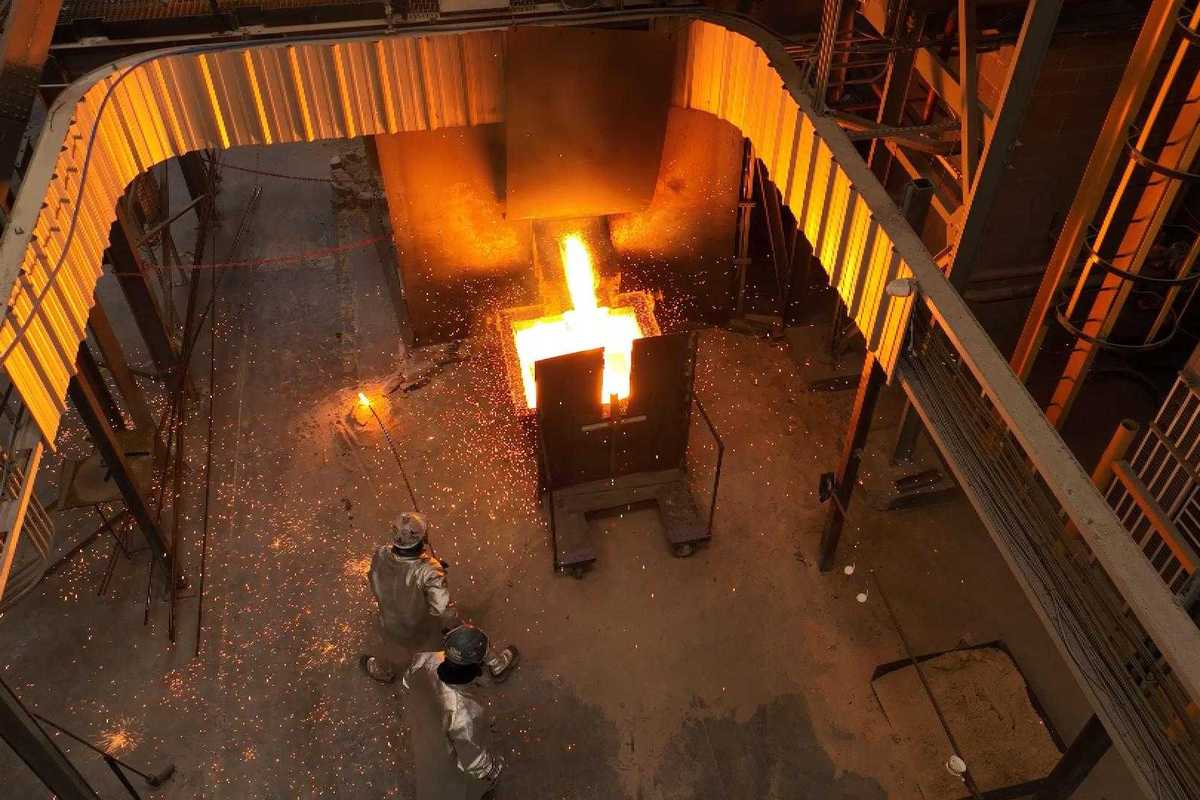
What lies ahead over the next year? Photo via Getty Images

Oil prices are once again riding the waves of geopolitics. Uncertainty remains a key factor shaping global energy trends.

As of June 25, 2025, U.S. gas prices were averaging around $3.22 per gallon, well below last summer’s levels and certainly not near any recent high. Meanwhile, Brent crude is trading near $68 per barrel, though analysts warn that renewed escalation especially involving Iran and the Strait of Hormuz could push prices above $90 or even $100. Trump’s recent comments that China may continue purchasing Iranian oil add yet another layer of geopolitical complexity.

So how should we think about the state of the oil market and what lies ahead over the next year?

That question was explored on the latest episode of The Energy Forum with experts Skip York and Abhi Rajendran, who both bring deep experience in analyzing global oil dynamics.

“About 20% of the world’s oil and LNG flows through the Strait of Hormuz,” said Skip. “When conflict looms, even the perception of disruption can move the market $5 a barrel or more.”

This is exactly what we saw recently: a market reacting not just to actual supply and demand, but to perceived risk. And that risk is compounding existing challenges, where global demand remains steady, but supply has been slow to respond.

Abhi noted that U.S. shale production has been flat so far this year, and that given the market’s volatility, it’s becoming harder to stay short on oil. In his view, a higher price floor may be taking hold, with longer-lasting upward pressure likely if current dynamics continue.

Meanwhile, OPEC+ is signaling supply increases, but actual delivery has underwhelmed. Add in record-breaking summer heat in the Middle East, pulling up seasonal demand, and it’s easy to see why both experts foresee a return to the $70–$80 range, even without a major shock.

Longer-term, structural changes in China’s energy mix are starting to reshape demand patterns globally. Diesel and gasoline may have peaked, while petrochemical feedstock growth continues.

Skip noted that China has chosen to expand mobility through “electrons, not molecules,” a reference to electric vehicles over conventional fuels. He pointed out that EVs now account for over 50% of monthly vehicle sales, a signal of a longer-term shift in China’s energy demand.

But geopolitical context matters as much as market math. In his recent policy brief, Jim Krane points out that Trump’s potential return to a “maximum pressure” campaign on Iran is no longer guaranteed strong support from Gulf allies.

Jim points out that Saudi and Emirati leaders are taking a more cautious approach this time, worried that another clash with Iran could deter investors and disrupt progress on Vision 2030. Past attacks and regional instability continue to shape their more restrained approach.

And Iran, for its part, has evolved. The “dark fleet” of sanctions-evasion tankers has expanded, and exports are booming up to 2 million barrels per day, mostly to China. Disruption won’t be as simple as targeting a single export terminal anymore, with infrastructure like the Jask terminal outside the Strait of Hormuz.

Where do we go from here?

Skip suggests we may see prices drift upward through 2026 as OPEC+ runs out of spare capacity and U.S. shale declines. Abhi is even more bullish, seeing potential for a quicker climb if demand strengthens and supply falters.

We’re entering a phase where geopolitical missteps, whether in Tehran, Beijing, or Washington, can have outsized impacts. Market fundamentals matter, but political risk is the wildcard that could rewrite the price deck overnight.

As these dynamics continue to evolve, one thing is clear: energy policy, diplomacy, and investment strategy must be strategically coordinated to manage risk and maintain market stability. The stakes for global markets are simply too high for misalignment.

------------

Scott Nyquist is a senior advisor at McKinsey & Company and vice chairman, Houston Energy Transition Initiative of the Greater Houston Partnership. The views expressed herein are Nyquist's own and not those of McKinsey & Company or of the Greater Houston Partnership. This article originally appeared on LinkedIn.

Ad Placement 300x100
Ad Placement 300x600

CultureMap Emails are Awesome

$21.5 billion merger to create Houston-based energy powerhouse

Major Merger

Oklahoma City, Oklahoma-based Devon Energy has agreed to buy Houston-based Coterra Energy in a $21.5 billion all-stock deal, forming an energy powerhouse that will be headquartered in Houston. The combined company, boasting an enterprise value of $58 billion, will adopt the Devon brand name.

Revenue for the two publicly traded companies totaled nearly $18.8 billion in the first nine months of 2025. Devon is a Fortune 500 company, but Coterra doesn’t appear in the most recent ranking.

The deal, already approved by the boards of both companies, is expected to close in the second quarter of 2026. Once the transaction is completed, Devon shareholders will own about 54 percent of the combined company and Coterra shareholders will own 46 percent.

“This transformative merger combines two companies with proud histories and cultures of operational excellence, creating a premier shale operator,” says Clay Gaspar, Devon’s president and CEO.

The combined company will be one of the world’s largest shale producers, with third-quarter 2025 production exceeding 550 thousand barrels of oil per day and 4.3 billion cubic feet of gas per day. A significant presence in the Delaware Basin, encompassing hundreds of thousands of acres, will anchor the company’s operations. The 10,000-square-mile Delaware Basin is in West Texas and southeastern New Mexico.

The new Devon also will operate in the Permian Basin, located in West Texas and New Mexico; Marcellus Shale, located in five states in the East; and Anadarko Basin, located in the Texas Panhandle, Colorado, Kansas, and Oklahoma.

Gaspar will be president and CEO of the combined company, and Tom Jorden, chairman, president, and CEO of Coterra, will be non-executive chairman.

Houston climatech startup closes $5M seed round to scale copper alternative

seeing green

Houston-based material science and climatech startup DexMat has closed a $5 million seed round.

The round was led by non sibi ventures, with participation from Governance Partners, Tailwind Futures, BetterWay, Capital Factory and other investors. The company additionally announced that it has secured $3 million of non-dilutive funding.

DexMat plans to use the recent round to commercially scale Galvorn, its carbon-based conductive fiber. The high-performance copper alternative, originally developed at Rice University, is made from carbon nanotube (CNT) fibers, which are less energy- and CO2-intensive to produce.

The company says it will grow its technical and commercial teams and advance pilot-scale production to meet demand from new and existing customers in aerospace, defense and manufacturing industries.

"We’re seeing clear customer pull, particularly in wire and cable applications, as manufacturers look for conductive materials that are less dense, more durable, and resilient at scale,” Bryan Guido Hassin, CEO of DexMat, said in a news release. “This funding allows us to meet near-term demand and expand production capabilities in response to evolving supply-chain constraints."

The recent funding comes after a year of impressive growth. According to the news release, DexMat more than doubled its production and sales of Galvorn in 2025 compared to the previous year.

“We consistently hear the same message from customers: the material performs really well, and they need more of it at a lower cost,” Dmitri Tsentalovich, co-founder and CTO of DexMat, added in the release. “This round supports the production scale-up and cost reductions required to move Galvorn into broader commercial use.”

DexMat raised $3 million in funding in a round led by Shell Ventures in 2023. The company reports a 20-fold increase in capacity since its pre-seed round, along with a 96 percent reduction in production costs.

DexMat's technology was originally developed in the Rice University lab of co-founder Matteo Pasquali, who also serves as director of Rice’s Carbon Hub. According to previous reports, the company was built on over $20 million in non-dilutive funding—including grants from the Air Force Research Laboratory, Air Force Office of Scientific Research, U.S. Department of Energy, NASA, Advanced Functional Fabrics of America and the National Science Foundation—with Rice University included in the list of original investors.

Here are 5 must-attend Houston energy events for February 2026

Mark Your Calendar

Editor's note: The second half of February is buzzing with must-attend events for those in the Houston energy sector. We've rounded up a host of events to put on your calendar for the month, with topics ranging from AI in energy to emissions management for a sustainable future. Get the details below, and register now.

Feb. 18-20 — NAPE Summit Week 2026

NAPE is the energy industry’s marketplace for the buying, selling, and trading of prospects and producing properties. NAPE brings together all industry disciplines and companies of all sizes, and in 2026 it will introduce three new hubs — offshore, data centers, and critical minerals — for more insights, access, and networking opportunities. The event includes a summit, exhibition, and more.

This event begins Feb. 18 at George R. Brown Convention Center. Register here.

Feb. 23-25 — AI in Energy Summit

The third annual AI in Energy Summit will bring together 200 senior leaders from the utilities, oil and gas, power generation, and renewables sectors for three days of conversation in Houston, the heart of energy innovation. Attendees will hear directly from operators who’ve taken AI projects from proof of concept to full deployment; learn how make data AI-ready and align AI with business goals; and discover what’s working in GenAI, ML Ops, Agentic AI, and more.

This event begins Feb. 23 at Norris Conference Center. Register here.

Feb. 24-26 — 2026 Energy HPC & AI Conference

The 2026 Energy HPC & AI Conference marks the 19th year for the Ken Kennedy Institute to convene experts from the energy industry, academia, and national labs to share breakthroughs for HPC and AI technologies. The conference returns to Houston with engaging speaker sessions, a technical talk program, networking receptions, add-on workshops, and more.

This event begins Feb. 24 at Rice University's BRC. Register here.

Feb. 25-26 — Energy Emissions Management Conference

The fifth annual Energy Emissions Management Conference is the premier gathering for energy leaders who are committed to staying ahead of the rapidly evolving emissions landscape. The conference aims to foster collaboration, drive technological innovation, and strengthen transparency, supporting organizations in meeting their regulatory obligations and sustainability goals.

This event begins Feb. 25 at Hilton Houston Westchase. Register here.

Feb. 26 — February Transition on Tap

Mix and mingle at Greentown Labs' first Transition on Tap event of the year. Meet the accelerator's newest startup members, who are working on innovations ranging from methane capture to emissions-free manufacturing processes to carbon management.

This event begins at 5:30 pm on Feb. 26 at Greentown Labs Houston. Register here.