Students from the University of Houston are celebrating a win at a national competition focused on carbon innovation. Photo via UH.edu

A team of students from the University of Houston have placed in the top three teams for a national competition for the Department of Energy.

The inaugural American-Made Carbon Management Collegiate Competition, hosted by the U.S. Department of Energy's Office of Fossil Energy and Carbon Management, or FECM, tasked the student teams with "proposing regional carbon networks capable of transporting at least one million metric tons of carbon dioxide per year from industrial sources," according to a news release from DOE.

“With this competition, DOE hopes to inspire the next generation of carbon management professionals to develop carbon dioxide transport infrastructure that will help drive technological innovation and emissions reductions, new regional economic development, and high-wage employment for communities across the United States,” Brad Crabtree, assistant secretary of fossil energy and carbon management at DOE, says in the release.

GreenHouston, the University of Houston team mentored by Assistant Professor Jian Shi from the UH Cullen College of Engineering, took third place in the competition, securing a $5,000 cash prize. Sequestration Squad of University of Michigan secured first place and $12,000 and Biggest Little Lithium of the University of Nevada won second and a $8,000 prize.

The UH team's proposal was for an optimized carbon dioxide transportation pipeline for the Houston area. The presentation included cost analysis, revenue potential, safety considerations, weather hazards, and social impact on neighboring communities, according to a release from UH.

“We chose the greater Houston metropolitan area as our target transition area because it is a global hub of the hydrocarbon energy industry,” says Fatemeh Kalantari, team leader, in the release.

“Our team was committed to delivering an optimized and cost-effective carbon dioxide transfer plan in the Houston area, with a focus on safety, environmental justice, and social engagement,” she continues. “Our goal is to ensure the health and safety of the diverse population residing in Houston by mitigating the harmful effects of carbon dioxide emissions from refineries and industries in the area, thus avoiding environmental toxicity.”

With the third place win, GreenHouston will get to present their proposal at DOE’s annual Carbon Management Research Project Review Meeting slated for August.

"We are thrilled to see the exceptional work and dedication displayed by the GreenHouston team in this competition," said Ramanan Krishnamoorti, vice president of energy and innovation at UH. "The team’s innovative proposal exemplifies UH’s commitment to addressing the pressing global issue of carbon management and advancing sustainable practices. We wish the students continued success."

The team included four Cullen College of Engineering doctoral students from the Department of Electrical and Computer Engineering – Kalantari, Massiagbe Diabate, Steven Chen, and Simon Peter Nsah Abongmbo – and one student, Bethel O. Mbakaogu, pursuing his master’s degree in supply chain and logistics technology.

The prize money will go toward funding additional research, refining existing technologies, addressing remaining challenges and raising awareness of CCUS and its project, according to the release, as the team feels a responsibility to continue to work on the GreenHouston project.

“The energy landscape by 2050 will be characterized by reduced greenhouse gas emissions, cleaner air quality, and a more sustainable environment,” Kalantari says. “The transition to green energy will not only mitigate the harmful effects of carbon dioxide on climate change but also create new jobs, promote economic growth, and enhance energy security. This is important, and we want to be part of it.”
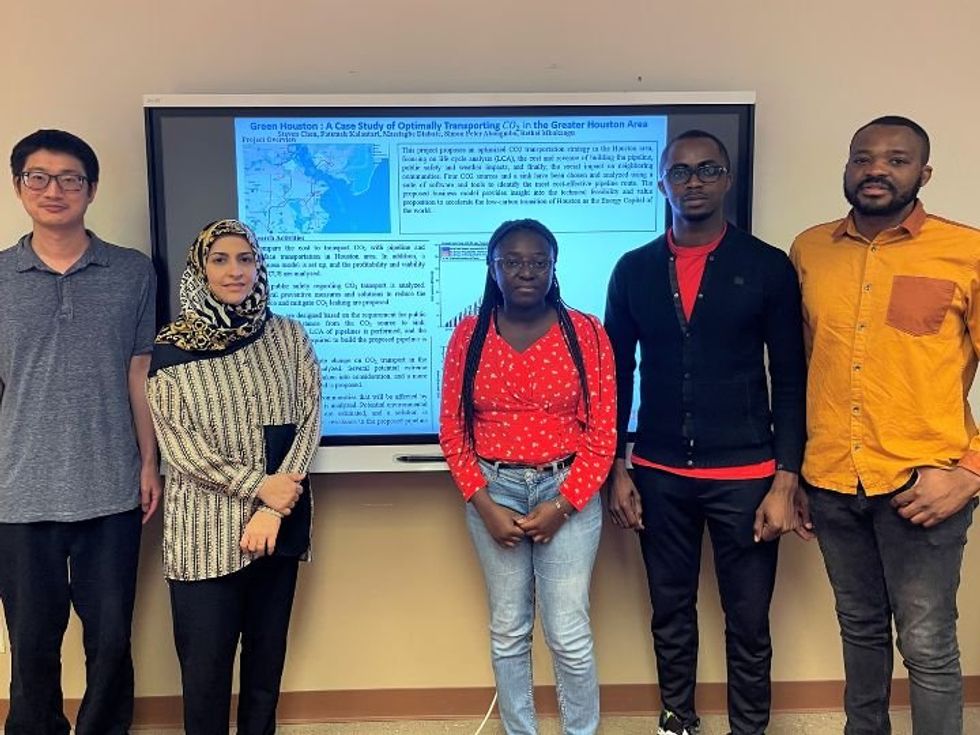
The team of students plans to continue to work on the GreenHouston project. Photo courtesy

------

This article originally ran on InnovationMap.
Ad Placement 300x100
Ad Placement 300x600

CultureMap Emails are Awesome

Report shows geoscientists earn largest salary premium in Texas

Career Day

A move to Texas bolsters earnings for some, and a new SmartAsset study has revealed the top professions where the median annual earnings in the Lone Star State exceed the national median.

The report, "When it Pays to Work in Texas — and When It Doesn’t," published in April, analyzed over 700 occupations to determine which have the biggest "Texas premium" — meaning jobs where the price-adjusted median annual pay in Texas most exceeds the national median for the same occupation — and which jobs have the biggest “Texas penalty,” where the statewide median annual pay falls furthest below the national median. Salaries were sourced from the U.S. Bureau of Labor Statistics (BLS) and adjusted for regional price parity.

According to the report's findings, geoscientists have the biggest "Texas premium" and make a $159,903 median annual salary. Texas' salary for geoscientists is 61 percent higher than the national median for the same position (after adjusting for regional price parity).

"Texas’s large petroleum industry helps explain why employers in the state retain so many geoscientists," the report's author wrote. "In fact, the Lone Star State is home to more geoscientists than any other state except California."

There are more than 3,600 geoscientists working in Texas, SmartAsset said.

These are the remaining top 10 occupations with the biggest "Texas premiums" (salaries are price-adjusted):

  • No. 2 – Commercial pilots: $167,727 median Texas earnings; 37 percent higher than the national median
  • No. 3 – Sailors: $67,614 median Texas earnings; 36 percent higher than the national median
  • No. 4 – Aircraft structure assemblers: $83,519 median Texas earnings; 35 percent higher than the national median
  • No. 5 – Ship captains: $108,905 median Texas earnings; 27 percent higher than the national median
  • No. 6 – Nursing instructors (postsecondary): $100,484 median Texas earnings; 26 percent higher than the national median
  • No. 7 – Tax preparers: $63,321 median Texas earnings; 25 percent higher than the national median
  • No. 8 – Chemists: $104,241 median Texas earnings; 24 percent higher than the national median
  • No. 9 – Health instructors (postsecondary): $128,680 median Texas earnings; 22 percent higher than the national median
  • No. 10 – Engineering instructors (postsecondary): $129,030 median Texas earnings; 22 percent higher than the national median
---

This article originally appeared on CultureMap.com.

Solar manufacturer expands Houston footprint with new 4-gigawatt factory

coming soon

Houston-based SEG Solar plans to open a new 4-gigawatt solar module manufacturing facility in Cypress.

The facility represents more than a $200 million investment and will raise SEG's total annual U.S. module production capacity to approximately 6 gigawatts, according to a new release. The expansion is part of SEG’s long-term goal of becoming one of the largest 100 percent U.S.-owned module manufacturers.

The new 500,000-square-foot facility will be located on Telge Road and is expected to create 800 new jobs, according to reports.

“This new facility marks an important milestone for SEG,” Timothy Johnson, VP of operations, said in the release. “It will further strengthen our U.S. manufacturing capabilities while supporting ongoing technology innovation. The plant is designed with the flexibility to integrate next-generation technologies, including (heterojunction solar technology) as the industry evolves.”

Commercial operations at the new facility are expected to commence in Q3 2026.

SEG is also developing a 5-gigawatt ingot and wafer manufacturing facility in Indonesia. Construction on the facility is expected to begin in Q2 2026.

In 2024, SEG Solar opened a new $60 million, 250,000-square-foot facility in Houston to house its production workshops, raw material warehouses, administrative offices, finished goods warehouses and supporting infrastructure. Read more here.

Fervo Energy bumps up IPO target to $1.82B

IPO update

Houston-based geothermal power company Fervo Energy is now eyeing an IPO that would raise $1.75 billion to $1.82 billion, up from the previous target of $1.33 billion.

In paperwork filed Monday, May 11 with the U.S. Securities and Exchange Commission, Fervo says it plans to sell 70 million shares of Class A common stock at $25 to $26 per share.

In addition, Fervo expects to grant underwriters 30-day options to buy up to 8.33 million additional shares of Class A common stock. This could raise nearly $200 million.

When it announced the IPO on May 4, Fervo aimed to sell 55.56 million shares at $21 to $24 per share, which would have raised $1.17 billion to $1.33 billion. The initial valuation target was $6.5 billion.

A date for the IPO hasn’t been scheduled. Fervo’s stock will be listed on Nasdaq under the ticker symbol FRVO.

Fervo, founded in 2017, has attracted about $1.5 billion in funding from investors such as Bill Gates-founded Breakthrough Energy Ventures, Google, Mitsubishi Heavy Industries, Devon Energy (which is moving its headquarters to Houston), Tesla co-founder JB Straubel, CalSTRS, Liberty Mutual Investments, AllianceBernstein, JPMorgan, Bank of America and Sumitomo Mitsui Trust Bank.

Fervo’s marquee project is Cape Station in Beaver County, Utah, the world’s largest EGS (enhanced geothermal system) project. The first phase will deliver 100 megawatts of baseload clean power, with the second phase adding another 400 megawatts. The site can accommodate 2 gigawatts of geothermal energy. Fervo holds more than 595,000 leased acres for potential expansion.

Cape Station has secured power purchase agreements for the entire 500-megawatt capacity. Customers include Houston-based Shell Energy North America and Southern California Edison.